WEEK 1
1. Cells in may act as a reservoir in which HIV can be relatively protected from antiviral drugs.
- The central nervous system
2. Which statement is true about fungal infections?
- They are controlled by phago
...
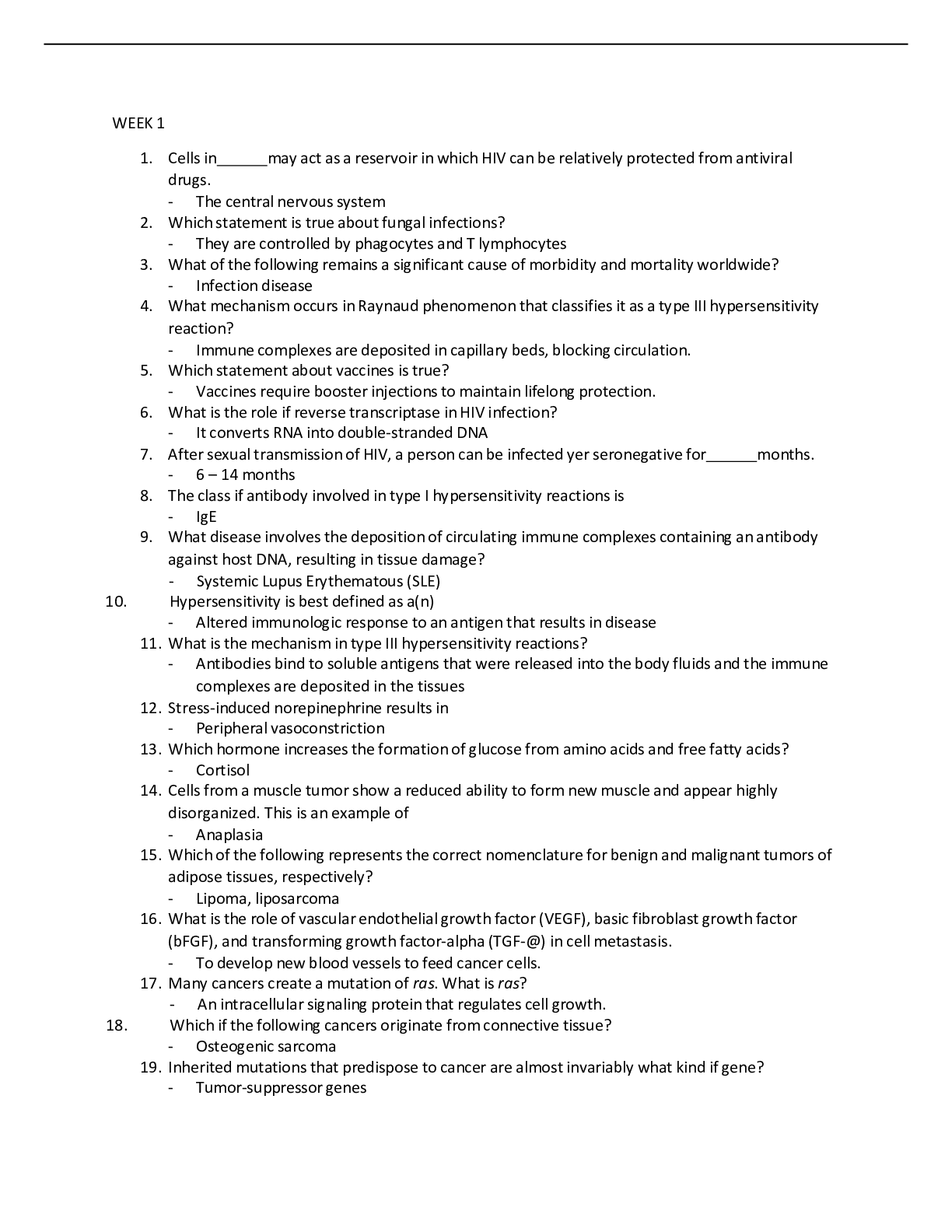
WEEK 1
1. Cells in may act as a reservoir in which HIV can be relatively protected from antiviral drugs.
- The central nervous system
2. Which statement is true about fungal infections?
- They are controlled by phagocytes and T lymphocytes
3. What of the following remains a significant cause of morbidity and mortality worldwide?
- Infection disease
4. What mechanism occurs in Raynaud phenomenon that classifies it as a type III hypersensitivity reaction?
- Immune complexes are deposited in capillary beds, blocking circulation.
5. Which statement about vaccines is true?
- Vaccines require booster injections to maintain lifelong protection.
6. What is the role if reverse transcriptase in HIV infection?
- It converts RNA into double-stranded DNA
7. After sexual transmission of HIV, a person can be infected yer seronegative for months.
- 6 – 14 months
8. The class if antibody involved in type I hypersensitivity reactions is
- IgE
9. What disease involves the deposition of circulating immune complexes containing an antibody against host DNA, resulting in tissue damage?
- Systemic Lupus Erythematous (SLE)
10. Hypersensitivity is best defined as a(n)
- Altered immunologic response to an antigen that results in disease
11. What is the mechanism in type III hypersensitivity reactions?
- Antibodies bind to soluble antigens that were released into the body fluids and the immune complexes are deposited in the tissues
12. Stress-induced norepinephrine results in
- Peripheral vasoconstriction
13. Which hormone increases the formation of glucose from amino acids and free fatty acids?
- Cortisol
14. Cells from a muscle tumor show a reduced ability to form new muscle and appear highly disorganized. This is an example of
- Anaplasia
15. Which of the following represents the correct nomenclature for benign and malignant tumors of adipose tissues, respectively?
- Lipoma, liposarcoma
16. What is the role of vascular endothelial growth factor (VEGF), basic fibroblast growth factor (bFGF), and transforming growth factor-alpha (TGF-@) in cell metastasis.
- To develop new blood vessels to feed cancer cells.
17. Many cancers create a mutation of ras. What is ras?
- An intracellular signaling protein that regulates cell growth.
18. Which if the following cancers originate from connective tissue?
- Osteogenic sarcoma
19. Inherited mutations that predispose to cancer are almost invariably what kind if gene?
- Tumor-suppressor genes
20. Which characteristic among women correlates with a high morbidity of cancer of the colon, , uterus, liver, gallbladder, pancreas, breast, uterus, and kidney?
- Women who had a high body mass index.
21. What congenital malformation is commonly linked to acute leukemia in children?
- Down Syndrome
WEEK 2
1. At the arterial end of capillaries, fluid moves from the intravascular space into the interstitial space because the
- Capillary hydrostatic pressure is higher than the capillary oncotic pressure
2. Which enzyme is secreted by the juxtaglomerular cells of the kidney when circulating blood is reduced?
- Renin
3. Water movement between the intravascular fluid compartment and the extracellular compartment is primarily a function of
- Osmotic forces
4. Physiologic ph is maintained around 7.4 because bicarbonate (HCO3) and carbonic acid (H2CO3) exist in a ratio of
- 20:1
5. Which are indications of dehydration?
- Tachycardia and weight loss
6. In hyperkalemia, cardiac rhythm changes are a direct result of
- Cardiac cell hypopolarization.
7. What is a major determinant of the resting membrane potential necessary for transmission of nerve impulses?
- The ration between intracellular K+ and extracellular K+
8. Which inflammatory mediators are produced in asthma?
- Histamine prostaglandins, and leukotrienes
9. is a fulminant form of respiratory failure characterized by acute lung inflammation and diffuse alveolocapillary injury.
- Acute respiratory distress syndrome.
10. Dyspnea is not a result of
- Decrease blood flow to the medulla oblongata
11. Which of the following is a true statement?
- Hyperventilation results in an increase PaCO2.
12. Clinical manifestations that include unexplained weight loss, dyspnea on exertion, use of accessory muscles, and tachypnea with prolonged expiration are indicative of
- Emphysema
13. The most successful treatment of chronic asthma begins with
- Elimination of the causative agent
14. Clinical manifestations of pulmonary hypertension include
- Peripheral edema and jugular venous distention.
15. Pulmonary edema usually begins at a pulmonary capillary wedge pressure or left atrial pressure of mmHg.
- 20
16. In tuberculosis, the body walls off the bacilli in a tubercle by stimulating
- Apoptotic infected macrophages that activate cytotoxic T
[Show More]