1) A patient’s nutritional intake and lab work reflect hypoalbuminemia. This is critical to
prescribing because: Distribution of drugs to target tissue may be affected.
2) Drugs that have a significant first-pass effec
...
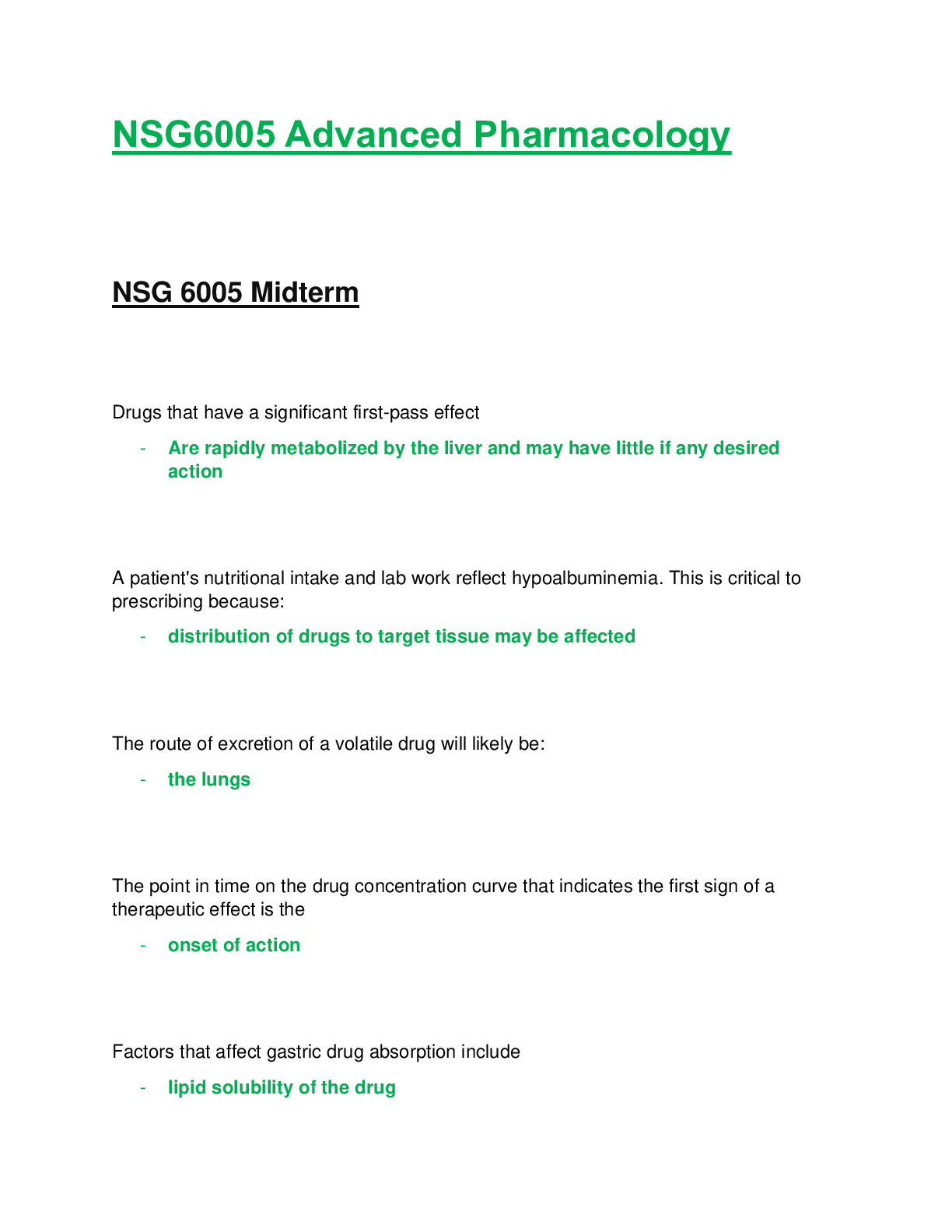
1) A patient’s nutritional intake and lab work reflect hypoalbuminemia. This is critical to
prescribing because: Distribution of drugs to target tissue may be affected.
2) Drugs that have a significant first-pass effect: Are rapidly metabolized by the liver and
may have little if any desired action.
3) The route of excretion of a volatile drug will likely be: The lungs
4) The point in time on the drug concentration curve that indicates the first sign of a
therapeutic effect is the: Onset of action
5) Factors that affect gastric drug absorption include: Lipid solubility of the drug
6) Which one of the following statements about bioavailability is true? Bioavailability
issues are especially important for drugs with narrow therapeutic ranges or sustained
release mechanisms.
7) Steady state is: When the amount of drug in the body remains constant.
8) The time required for the amount of drug in the body to decrease by 50% is called: Halflife
9) An advantage of prescribing a sublingual medication is that the medication is: Absorbed
rapidly
10) Drugs that use CYP3A4 isoenzymes for metabolism may: Both A and B(Induce the
metabolism of another drug; inhibit the metabolism of another drug)
11) A nurse practitioner would prescribe the liquid form of ibuprofen for a six-year-old
because: A six-year-old may have problems swallowing a pill
12) The first step in the prescribing process according to the World Health Organization is:
Diagnosing the patient’s problem
13) Patient education regarding prescribed medication includes: Discussion of expected
ADRs
14) Pharmacokinetic factors that affect prescribing include: Bioavailability
15) Infants and young children are at higher risk of ADRs due to: Lack of safety and efficacy
studies in the pediatric population.
16) Infants and young children are at higher risk of ADRs due to: Lack of safety and efficacy
studies in the pediatric population.
17) The elderly are at high risk of ADRs due to: Age-related decrease in renal-function
18) The type of ADR that is the result of an unwanted but otherwise normal pharmacological
action of a drug given in the usual therapeutic doses is: Type A
19) A patient may develop neutropenia from using topical Silvadene for burns. Neutropenia
is: A cytoxic hypersensitivity reaction
20) The angiotensin converting enzyme (ACE) inhibitor Lisinopril is a known teratogen.
Teratogens cause Type __ ADR. D
21) A twenty-four-year-old male received multiple fractures in a motor vehicle accident that
required significant amounts of opioid medication to treat his pain. He is at risk for Type
__ ADR when he no longer requires the opioids. E
22) Which of the following factors may adversely affect a patient’s adherence to a therapeutic
drug regimen? Both A and B
23) Nonadherence is especially common in drugs that treat asymptomatic conditions, such as
hypertension. One way to reduce the likelihood of nonadherence to these drugs is to
prescribe a drug that: Has a tolerability profile with less of the adverse effects that are
considered “irritating,” such as nausea and dizziness
This study source was downloaded by 100000831988016 from CourseHero.com on 03-16-2022 15:30:21 GMT -05:00
https://www.coursehero.com/file/28726324/Midtermdocx/
24) Patients with psychiatric illnesses have adherence rates to their drug regimen between
35% and 60%. To improve adherence in this population, prescribe drugs: With a longer
half-life so that missed doses produce a longer taper on the drug curve
25) Genetic polymorphisms account for differences in metabolism, including: All of the
above (Poor metabolizers (PMs) that lack a working enzyme; Intermediate metabolizers
(IMs) that have on working, wild-type allele and one mutant allele; Extensive
metabolizers (EMs), with two normally functioning alleles)
[Show More]