ASM 275: Forensic Anthropology Exam 4 Study Guide
What are positive identification and individuation?
• Final phase of forensic analysis
• GOAL: Identify with high prob the exact identity of ind.
• Begin w/ info on s
...
ASM 275: Forensic Anthropology Exam 4 Study Guide
What are positive identification and individuation?
• Final phase of forensic analysis
• GOAL: Identify with high prob the exact identity of ind.
• Begin w/ info on sex, age, stature, ancestry
• Add other info gleaned from skeleton
Paleopathology: The study of ancient disease in skeletal remains
Also focuses on mummified remains
Pathology: Know the three ways pathology affects bone and the terms lytic, osteoclastic, and
osteoblastic
Pathology affects bone in 3 ways:
1. Excess osteoclastic activity produces lytic lesions
Osteoclasts: Bone cells responsible for removal of bone from body
2. Excess osteoblastic activity produces proliferate lesions
Osteoblasts: create new bone
3. Abnormalities of shape produces by both lytic and proliferative processes
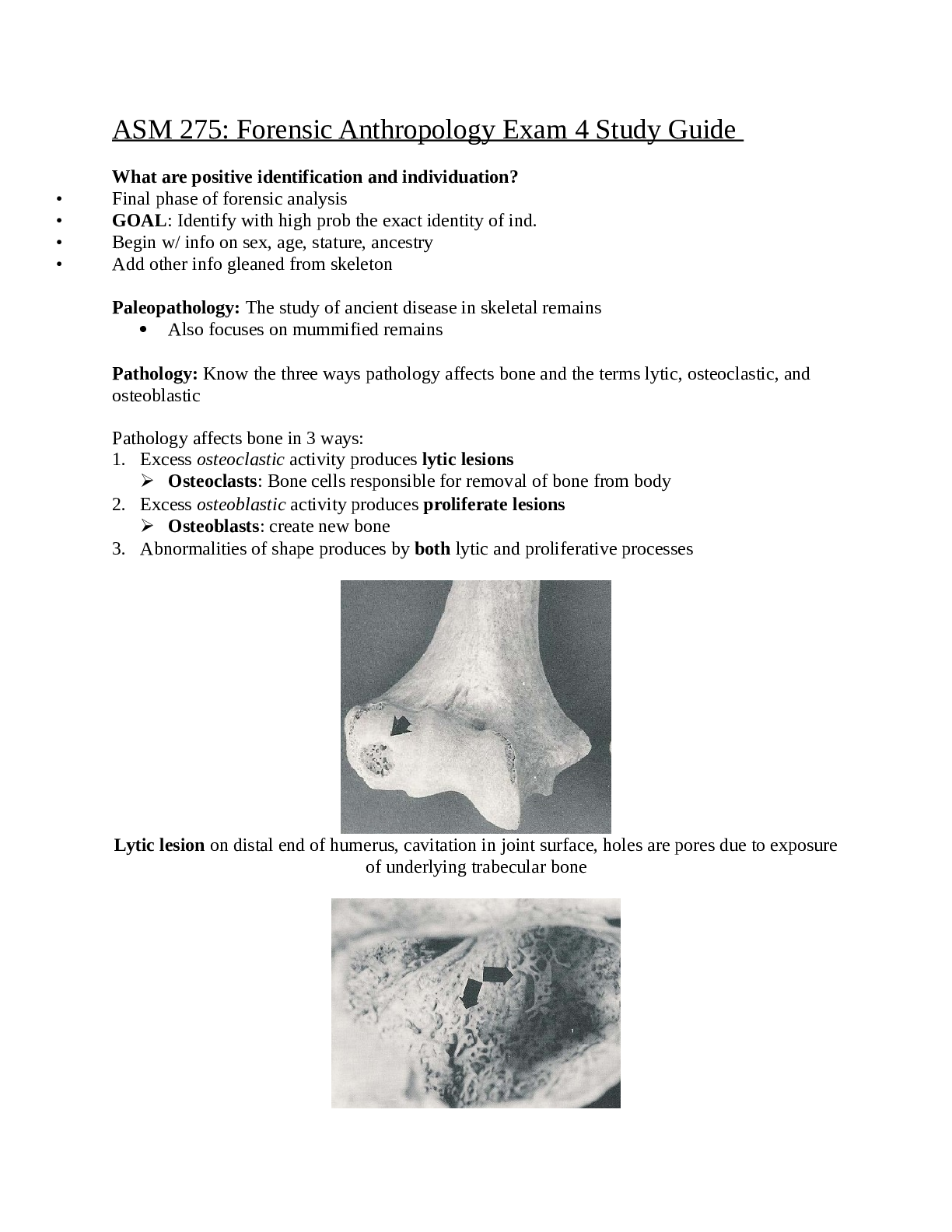
Lytic lesion on distal end of humerus, cavitation in joint surface, holes are pores due to exposure
of underlying trabecular bone
Proliferative legions (Maxillary sinusitis): little additions of bones that look like spider
webs; body responded to disease by activating osteoblasts and creating new bone
Left: Woven bone to some sort of systemic infection
Right: Excess piece of bone, may be traumatic in origin
What is it? How is it useful to forensic anthropologists?
1. Can be confused with perimortem trauma (fusion defects-bones don’t fuse correctly in
adulthood)
2. Can be confused with postmortem taphonomic alterations
3. Can provide information on life course experience of individual- healthy of unhealthy life?
4. Can provide info on socio-economic status (poor health) based on patterning of disease
5. Therefore, #3 & #4 (disease pathology) can lead to positive identification
Pathological conditions disease processes that affect bone (MOST DO NOT!)
Past patterns of trauma = occupations, social economic status, work-related injuries
Diet and health conditions- generalized stress level that could be related to socio
economic status
Congenital disease malformations- born with them, should be medically documented, ID
and individuation
Infectious diseases (communicably diseases that you catch from contact with others)-
health, medical history
Rare bone diseases- geographic origin
What can past patterns of trauma tell us about the individual?
• Shows occupational, social economic status, work related injuries
Osteoarthritis: degenerative joint disease
Results from break down of joint capsule do to overuse, can be linked to certain types of
activities
3 Skeletal Manifestations:
1. lipping of joint surface (osteophytes)
2. porosity of joint surface (little holes seen on surface of joint)
3. eburnation, polishing of joint surface: results from bone on bone contact
[Show More]