*NURSING  >  TEST BANKS  >  Maternal-Child-Nursing-5th-Edition-by-McKinney. (All)

Maternal-Child-Nursing-5th-Edition-by-McKinney.

Document Content and Description Below

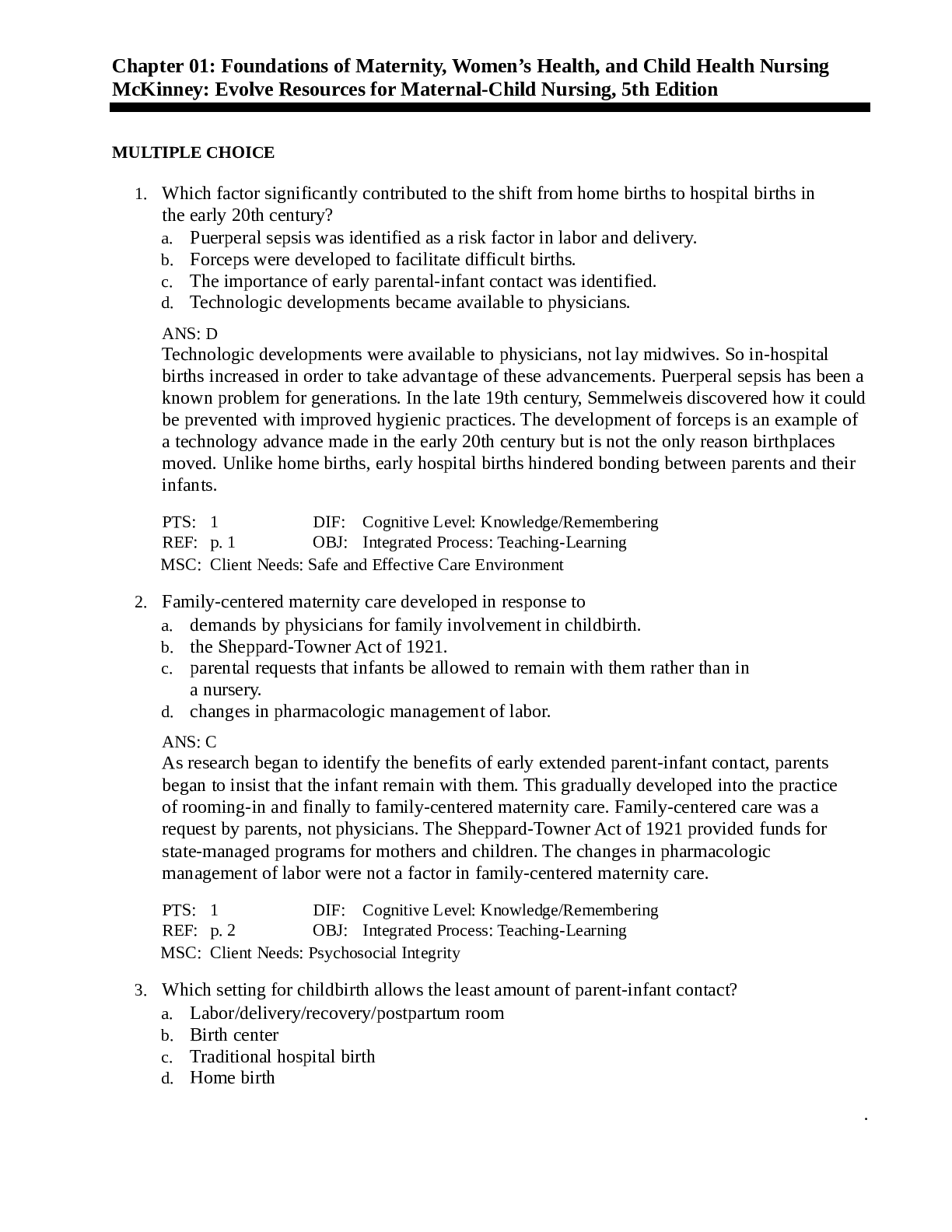
ULTIPLE CHOICE 1. Which factor significantly contributed to the shift from home births to hospital births in the early 20th century? a. Puerperal sepsis was identified as a risk factor in labor an ... d delivery. b. Forceps were developed to facilitate difficult births. c. The importance of early parental-infant contact was identified. d. Technologic developments became available to physicians. ANS: D Technologic developments were available to physicians, not lay midwives. So in-hospital births increased in order to take advantage of these advancements. Puerperal sepsis has been a known problem for generations. In the late 19th century, Semmelweis discovered how it could be prevented with improved hygienic practices. The development of forceps is an example of a technology advance made in the early 20th century but is not the only reason birthplaces moved. Unlike home births, early hospital births hindered bonding between parents and their infants. PTS: 1 DIF: Cognitive Level: Knowledge/Remembering REF: p. 1 OBJ: Integrated Process: Teaching-Learning MSC: Client Needs: Safe and Effective Care Environment 2. Family-centered maternity care developed in response to a. demands by physicians for family involvement in childbirth. b. the Sheppard-Towner Act of 1921. c. parental requests that infants be allowed to remain with them rather than in a nursery. d. changes in pharmacologic management of labor. ANS: C As research began to identify the benefits of early extended parent-infant contact, parents began to insist that the infant remain with them. This gradually developed into the practice of rooming-in and finally to family-centered maternity care. Family-centered care was a request by parents, not physicians. The Sheppard-Towner Act of 1921 provided funds for state-managed programs for mothers and children. The changes in pharmacologic management of labor were not a factor in family-centered maternity care. PTS: 1 DIF: Cognitive Level: Knowledge/Remembering REF: p. 2 OBJ: Integrated Process: Teaching-Learning MSC: Client Needs: Psychosocial Integrity 3. Which setting for childbirth allows the least amount of parent-infant contact? a. Labor/delivery/recovery/postpartum room b. Birth center c. Traditional hospital birth [Show More]

Last updated: 2 years ago

Preview 1 out of 609 pages

Buy Now

Instant download

We Accept:

Payment methods accepted on Scholarfriends (We Accept)
Preview image of Maternal-Child-Nursing-5th-Edition-by-McKinney. document

Buy this document to get the full access instantly

Instant Download Access after purchase

Buy Now

Instant download

We Accept:

Payment methods accepted on Scholarfriends (We Accept)

Reviews( 0 )

$20.00

Buy Now

We Accept:

Payment methods accepted on Scholarfriends (We Accept)

Instant download

Can't find what you want? Try our AI powered Search

96
0

Document information


Connected school, study & course


About the document


Uploaded On

Oct 02, 2021

Number of pages

609

Written in

All

Seller


Profile illustration for Quiz analyst
Quiz analyst

Member since 4 years

2 Documents Sold

Additional information

This document has been written for:

Uploaded

Oct 02, 2021

Downloads

 0

Views

 96

Document Keyword Tags

Recommended For You

Get more on TEST BANKS »

$20.00
What is Scholarfriends

Scholarfriends.com Online Platform by Browsegrades Inc. 651N South Broad St, Middletown DE. United States.

We are here to help

We're available through e-mail, Twitter, Facebook, and live chat.
 FAQ
 Questions? Leave a message!

Follow us on
 Twitter

Copyright © Scholarfriends · High quality services·