Chemistry  >  GIZMOS  >  GIZMOS Student Exploration: Nuclear Reactions (All)

GIZMOS Student Exploration: Nuclear Reactions

Document Content and Description Below

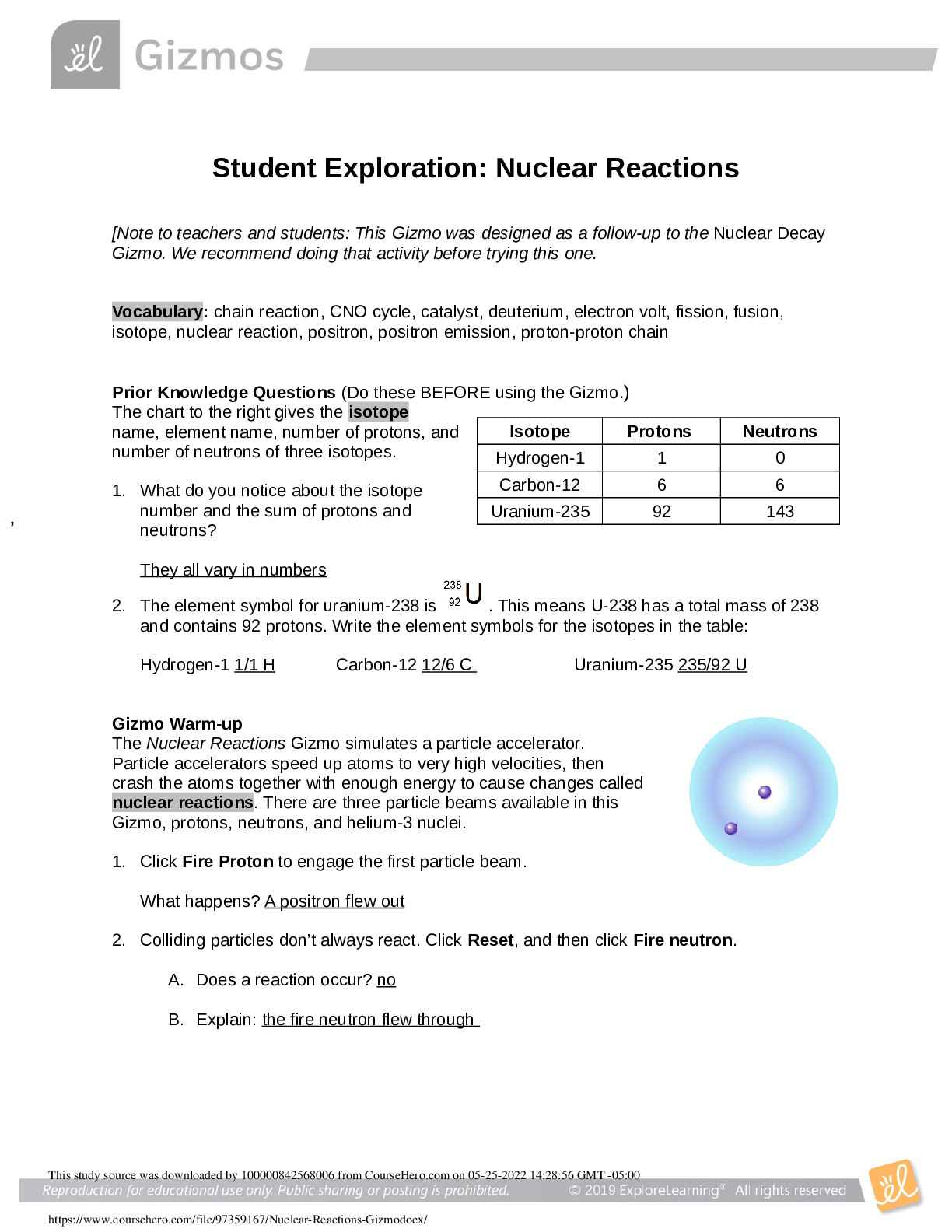
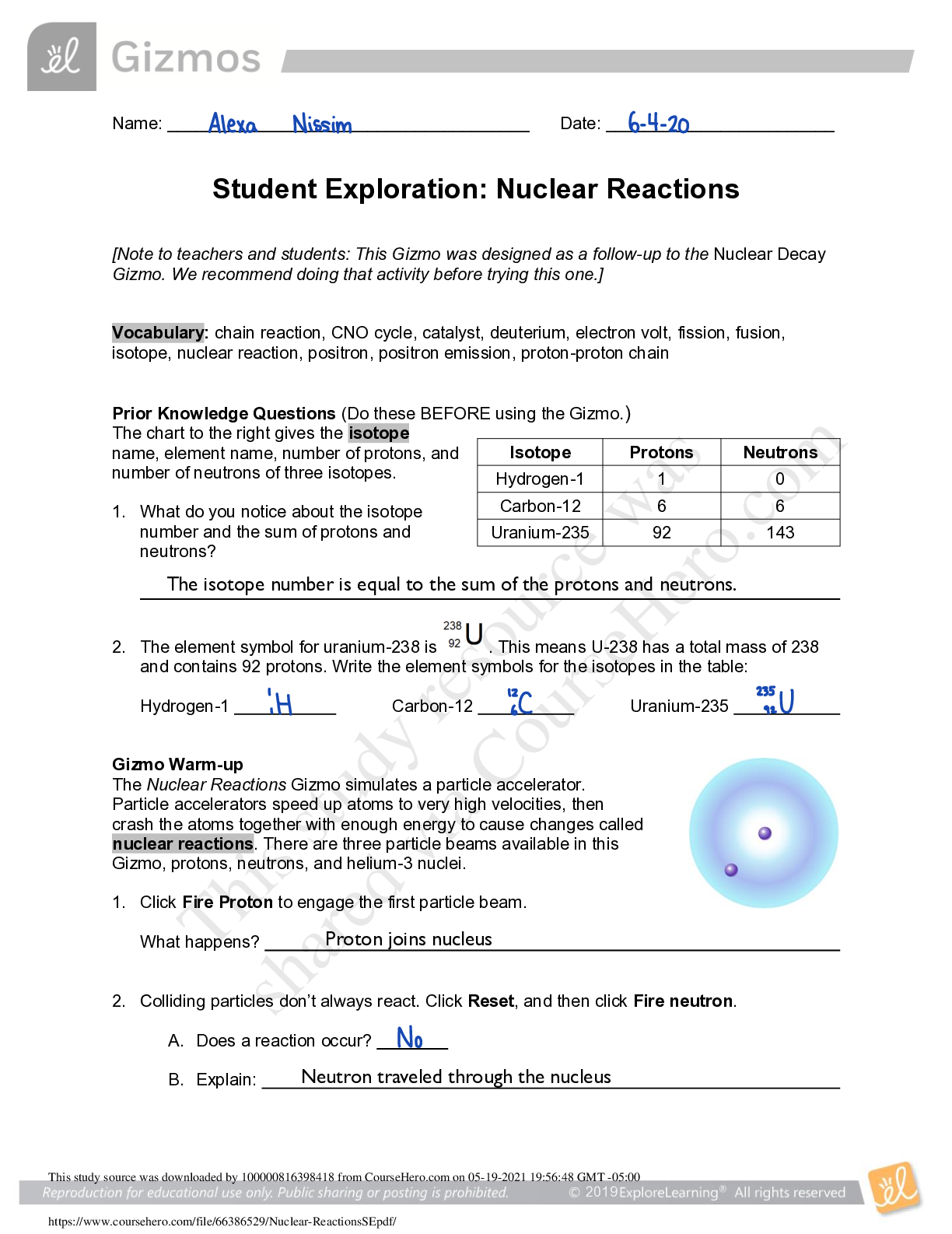
Student Exploration: Nuclear Reactions [Note to teachers and students: This GizmoTM was designed as a follow-up to the Nuclear Decay Gizmo. We recommend doing that activity before trying this one. ... ] Vocabulary: chain reaction, CNO cycle, catalyst, deuterium, electron volt, fission, fusion, isotope, nuclear reaction, positron, positron emission, proton-proton chain Prior Knowledge Questions (Do these BEFORE using the Gizmo.) The chart to the right gives the isotope name, element name, number of protons, and number of neutrons of three isotopes. 1. What do you notice about the isotope number and the sum of protons and neutrons? 2. The element symbol for uranium-238 is . This means U-238 has a total mass of 238 and contains 92 protons. Write the element symbols for the isotopes in the table: Hydrogen-1 Carbon-12 Uranium-235 Gizmo Warm-up The Nuclear Reactions Gizmo simulates a particle accelerator. Particle accelerators speed up atoms to very high velocities, then crash the atoms together with enough energy to cause changes called nuclear reactions. There are three particle beams available in this Gizmo, protons, neutrons, and helium-3 nuclei. 1. Click Fire Proton to engage the first particle beam. What happens? 2. Colliding particles don’t always react. Click Reset, and then click Fire neutron. A. Does a reaction occur? Isotope Protons Neutrons Hydrogen-1 1 0 Carbon-12 6 6 Uranium-235 92 143 B. Explain: Activity A: Proton-proton chain Get the Gizmo ready:  Click Reset.  Be sure Proton-proton is selected in the Reaction menu. Introduction: All stars turn hydrogen into helium in a process called nuclear fusion. Stars perform this process in different ways. In stars like our sun, the proton-proton chain is used. This reaction requires temperatures greater than 4,000,000 K to occur. Question: How does the process of fusion turn hydrogen into helium in stars? 1. Observe: Click Fire proton and observe. What happens after the proton merges into the nucleus? This is a form of nuclear decay called positron emission. During positron emission, a proton decays into a neutron. In this process, it emits a positron, which is a nearly massless antimatter particle with a positive charge. [Show More]

Last updated: 3 years ago

Preview 1 out of 13 pages

Buy Now

Instant download

We Accept:

Payment methods accepted on Scholarfriends (We Accept)
Preview image of GIZMOS Student Exploration: Nuclear Reactions document

Buy this document to get the full access instantly

Instant Download Access after purchase

Buy Now

Instant download

We Accept:

Payment methods accepted on Scholarfriends (We Accept)

Reviews( 0 )

$8.00

Buy Now

We Accept:

Payment methods accepted on Scholarfriends (We Accept)

Instant download

Can't find what you want? Try our AI powered Search

403
0

Document information


Connected school, study & course


About the document


Uploaded On

Oct 06, 2021

Number of pages

13

Written in

All

Seller


Profile illustration for Professor Lynne
Professor Lynne

Member since 4 years

372 Documents Sold

Reviews Received
34
13
4
0
4
Additional information

This document has been written for:

Uploaded

Oct 06, 2021

Downloads

 0

Views

 403

Document Keyword Tags

More From Professor Lynne

View all Professor Lynne's documents »

Recommended For You

Get more on GIZMOS »
$8.00
What is Scholarfriends

Scholarfriends.com Online Platform by Browsegrades Inc. 651N South Broad St, Middletown DE. United States.

We are here to help

We're available through e-mail, Twitter, and live chat.
 FAQ
 Questions? Leave a message!


Copyright © Scholarfriends · High quality services·