BIOS242, Week 2, Lab 2
Name:
Lab 4: Simple Staining
Learning Objectives:
To learn about principle of staining
To learn the process of simple stain
To prepare wet mount slides
In light microscopy, colored dye
...
BIOS242, Week 2, Lab 2
Name:
Lab 4: Simple Staining
Learning Objectives:
To learn about principle of staining
To learn the process of simple stain
To prepare wet mount slides
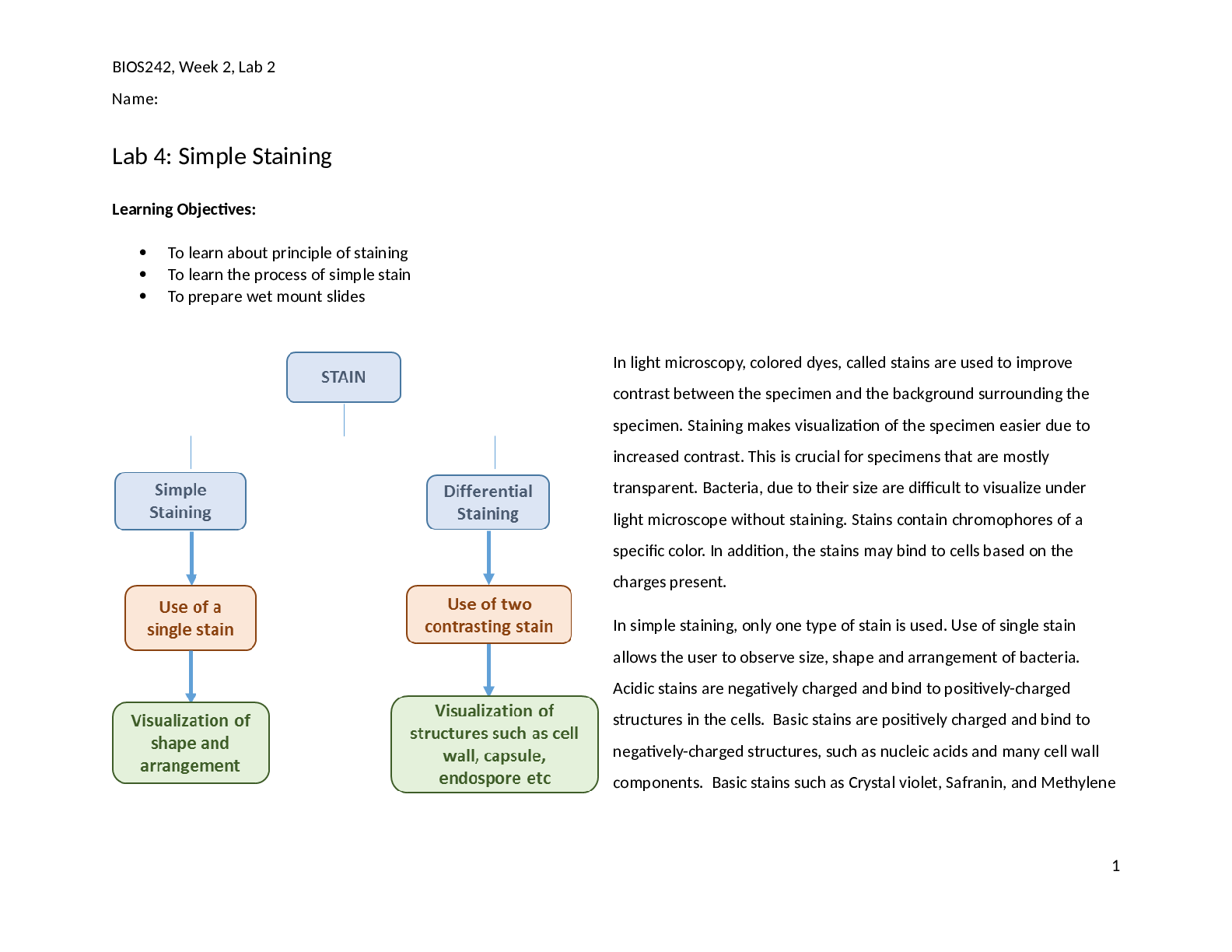
In light microscopy, colored dyes, called stains are used to improve
contrast between the specimen and the background surrounding the
specimen. Staining makes visualization of the specimen easier due to
increased contrast. This is crucial for specimens that are mostly
transparent. Bacteria, due to their size are difficult to visualize under
light microscope without staining. Stains contain chromophores of a
specific color. In addition, the stains may bind to cells based on the
charges present.
In simple staining, only one type of stain is used. Use of single stain
allows the user to observe size, shape and arrangement of bacteria.
Acidic stains are negatively charged and bind to positively-charged
structures in the cells. Basic stains are positively charged and bind to
negatively-charged structures, such as nucleic acids and many cell wall
components. Basic stains such as Crystal violet, Safranin, and Methylene
1
BIOS242, Week 2, Lab 2
Name:
blue are some of the common stains used in a Microbiology laboratory. Differential staining uses two or more similar stains in a way that it
allows observation of specific features of bacteria which often becomes basis of identification of the bacteria.
In this lab, we will carry out simple staining and subsequent observation of size, shape and arrangement on bacteria and yeast. We will also make
wet-mount slides of yeast and cheek cells.
Exercise 1: Simple Stain
Materials:
Overnight cultures of S. epidermidis, B. subtilis, S. cerevisiae (yeast) , inoculating loop, glass slides, incinerators, crystal violet or any other stain
chosen by instructor; tongs, staining racks/trays, immersion oil, lens paper, bibulous paper, microscope
Note to students: Wear gloves and use PPE before starting the lab work. Use aseptic technique to prevent contamination. Use only 1-2 drops of
stain per slide. Avoid using excess.
Method:
1. Obtain a clean glass slide, loop and overnight cultures. Hold the glass slides from the edges to avoid transferring grease or oil from fingers
to the slide.
2. Using aseptic technique, transfer a loop full of S. epidermidis culture at the middle of the glass slide. Spread it in a thin layer.
a. It is important to make a thin smear. A thick smear prevents light to pass through it, may have cells too close to each other or as
clumps which results in poor observation. A thin smear allows better observation of cells by allowing the light to pass through it.
3. Allow the smear to air dry completely. Once the smear is completely dry, hold the glass slide using tongs and quickly pass the slide 1-2
times through flame of Bunsen burner to heat fix the bacteria.
a. Completely air drying the specimen on the slide is crucial. Complete air drying of the specimen allows the cells to attach to the
glass slide without boiling of the wet smear. Boiling will cause fragmentation/shrinkage of bacteria resulting in poor specimen
quality and observation.
2
BIOS242, Week 2, Lab 2
Name:
b. Once heat fixed, cells become attached to surface of the glass slide and will not get washed off during the staining process.
4. Once bacteria is heat fixed, allow the glass slide to cool to room temperature.
5. Add 1-2 drops of diluted stain and wait for 1 minute.
6. Remove the stain and gently wash it off using minimal amount of DI water.
7. Blot dry the slide and observe using 10X and then 40X lens of a compound microscope.
8. Record your observations at 40X lens in Lab report.
a. Process to use Microscope is described in appendix A.
b. Check with your instructor if 100X lens is needed. If 100X lens is used, don’t forget to use oil.
c. Record results in the lab report.
9. Repeat the method using cultures of B. subtilis and S. cerevisiae. Record observations in Lab report and answer questions.
[Show More]