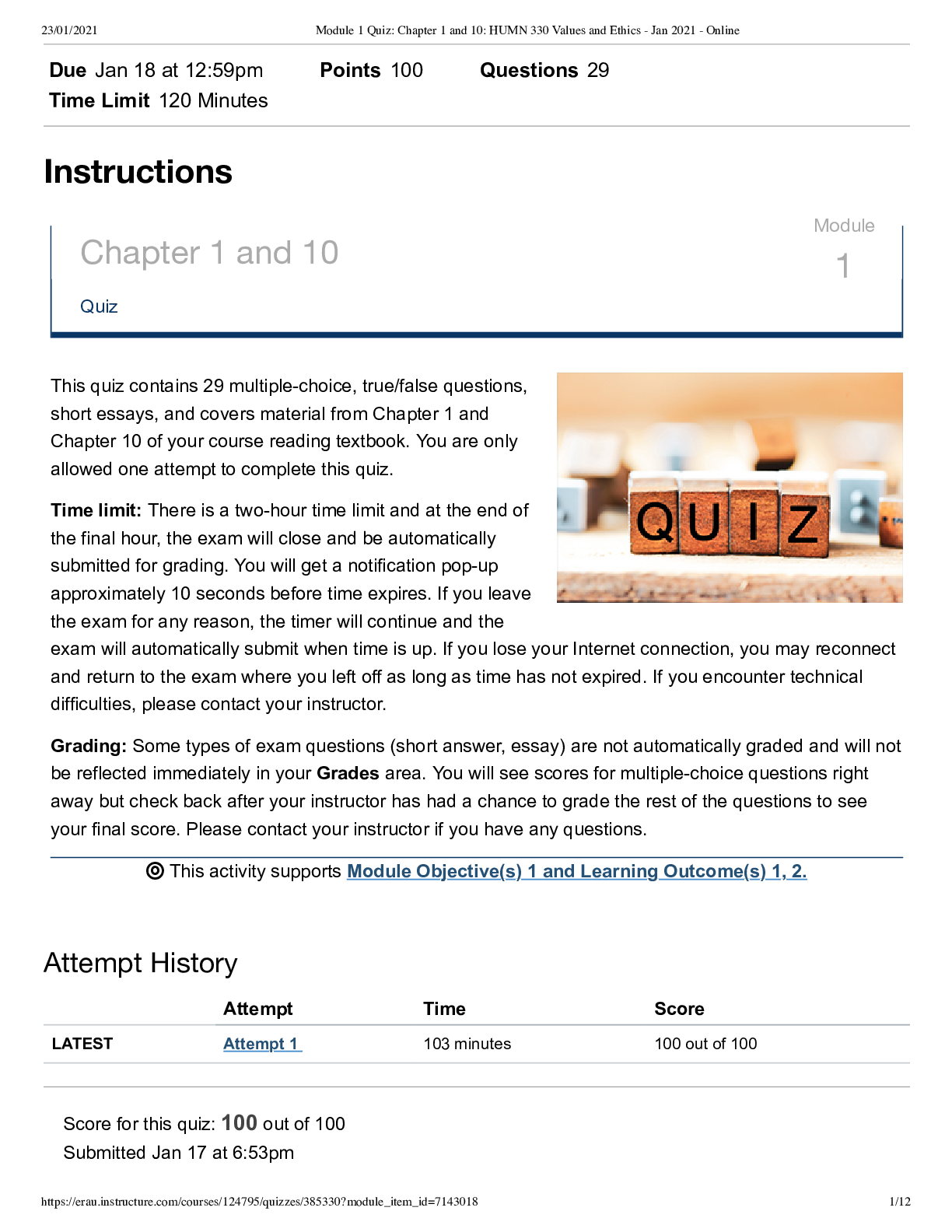
Module 1 Quiz: Chapter 1 and 10: HUMN 330 Values and Ethics - Jan 2021 - Online
Score for this quiz: 100 out of 100
Question 1 2.8 / 2.8 pts
Removing a person from a respirator after he has been declared dead accordin
...
Module 1 Quiz: Chapter 1 and 10: HUMN 330 Values and Ethics - Jan 2021 - Online
Score for this quiz: 100 out of 100
Question 1 2.8 / 2.8 pts
Removing a person from a respirator after he has been declared dead according to whole
brain death criteria is a case of passive euthanasia.
True
False
Question 2 2.8 / 2.8 pts
According to Rachels, if the motive is morally appropriate,
passive euthanasia is not morally worse than active euthanasia.
active euthanasia is not morally worse than passive euthanasia.
the action itself is inconsequential.
physician-assisted suicide is ethical.
Question 3 2.8 / 2.8 pts
Another name for a good argument is
A correct argument.
A sound argument.23/01/2021 Module 1 Quiz: Chapter 1 and 10: HUMN 330 Values and Ethics - Jan 2021 - Online
https://erau.instructure.com/courses/124795/quizzes/385330?module_item_id=7143018 3/12
A winning argument.
A fair argument.
Question 4 2.8 / 2.8 pts
If a person asks to be disconnected from certain life support equipment, and this is done,
this would be a case of voluntary active euthanasia.
True
False
Question 5 2.8 / 2.8 pts
Metaethics is largely about studying
The meanings of ethical language.
Those things which are beyond normal ethics.
Historical literature about ethics.
Ethical decisions sanctioned by religious beliefs.
Question 6 2.8 / 2.8 pts
According to the text, one reason why we study ethics is to see whether we can justify the
beliefs we already hold.23/01/2021 Module 1 Quiz: Chapter 1 and 10: HUMN 330 Values and Ethics - Jan 2021 - Online
https://erau.instructure.com/courses/124795/quizzes/385330?module_item_id=7143018 4/12
True
False
Question 7 2.8 / 2.8 pts
The following is an example of normative ethics: "Capital punishment is wrong because it
is wrong to directly take a human life."
True
False
Question 8 2.8 / 2.8 pts
Relatively common or standard measures of life support are always to be considered
ordinary means of life support.
True
False
Question 9 2.8 / 2.8 pts
What is the condition the American Medical Association has defined as dead?
The spirit leaves the body.23/01/2021 Module 1 Quiz: Chapter 1 and 10: HUMN 330 Values and Ethics - Jan 2021 - Online
https://erau.instructure.com/courses/124795/quizzes/385330?module_item_id=7143018 5/12
Heart has stopped beating.
Whole brain death has occurred.
Person has lost all mental function.
Question 10 2.8 / 2.8 pts
Which of the following claims that our ideas about ethics rest upon some sort of intuitive
knowledge of ethical truths.
Intuitionism
Emotivism
Objectivism
Subjectivism
Question 11 2.8 / 2.8 pts
To give pain medication in order to relieve pain, knowing that there is also a chance that
the patient might be so weakened as to die from the medication, is generally considered a
case of active euthanasia.
True
False
Question 12 2.8 / 2.8 pts23/01/2021 Module 1 Quiz: Chapter 1 and 10: HUMN 330 Values and Ethics - Jan 2021 - Online
https://erau.instructure.com/courses/124795/quizzes/385330?module_item_id=7143018 6/12
Which of the following terms refers to the administering of medication with good intended
effect but bad foreseen effect?
Active euthanasia
Double effect
Overdose
Physician error
Question 13 2.8 / 2.8 pts
The reasons supporting a conclusion in an argument are called
Ethical principles.
Ad hominems.
Valid forms.
Premises.
Question 14 2.8 / 2.8 pts
Ethics requires skillful reasoning. Which of the following is not important to making a
good argument?
The structure of the argument.
The conclusion follows from the premises.23/01/2021 Module 1 Quiz: Chapter 1 and 10: HUMN 330 Values and Ethics - Jan 2021 - Online
https://erau.instructure.com/courses/124795/quizzes/385330?module_item_id=7143018 7/12
The argument leads to the right conclusion.
The argument has internal logic.
Question 15 2.8 / 2.8 pts
Administering a lethal dose to a person who requests it is termed voluntary
active euthanasia.
True
False
Question 16 2.8 / 2.8 pts
Ethics is exclusively a descriptive discipline.
True
False
Question 17 2.8 / 2.8 pts
Some laws in the United States allow for nonvoluntary passive euthanasia.
True
False23/01/2021 Module 1 Quiz: Chapter 1 and 10: HUMN 330 Values and Ethics - Jan 2021 - Online
https://erau.instructure.com/courses/124795/quizzes/385330?module_item_id=7143018 8/12
Question 18 2.8 / 2.8 pts
All the following are recognized as legal grounds for withdrawing life support except
Living will.
Verbal request by adult patient.
Request of responsible family member.
Written request by minor patient.
Question 19 2.8 / 2.8 pts
Nonvoluntary euthanasia means causing death in violation of the patient's consent.
True
False
Question 20 2.8 / 2.8 pts
Physician-assisted suicide is suicide that results from a physician’s prescription of lethal
medication.
True
False23/01/2021 Module 1 Quiz: Chapter 1 and 10: HUMN 330 Values and Ethics - Jan 2021 - Online
https://erau.instructure.com/courses/124795/quizzes/385330?module_item_id=7143018 9/12
Question 21 2.8 / 2.8 pts
Which of the following is considered by many to be a problem for naturalistic
explanations of ethics?
Naturalistic fallacy
Natural law theory
Subjectivism
Emotivism
Question 22 2.8 / 2.8 pts
Terri Schiavo's medical condition in 2005 can best be described as
Brain dead.
Unconscious.
Permanent vegetative state.
Coma.
Question 23 2.8 / 2.8 pts
The naturalistic fallacy says that you cannot derive a descriptive claim from a normative
claim.23/01/2021 Module 1 Quiz: Chapter 1 and 10: HUMN 330 Values and Ethics - Jan 2021 - Online
https://erau.instructure.com/courses/124795/quizzes/385330?module_item_id=7143018 10/12
True
False
Question 24 2.8 / 2.8 pts
Which of the following in not a reason given for developing our natural moral reasoning
skills?
We should be able to critically evaluate our own beliefs.
As we develop our skills we will be able to win more ethical arguments.
People of all perspectives should be able to hold meaningful dialogue with each
other.
Diverse communities necessitate that values be built of reason.
Question 25 2.8 / 2.8 pts
The difference between teleological and deontological is that
Teleological is moral and deontological is immoral.
Teleological is focused on intention and deontological is focused on motive.
Deontological is focused on intention and teleological is focused on
consequence.
Deontological is moral and teleological is immoral.23/01/2021 Module 1 Quiz: Chapter 1 and 10: HUMN 330 Values and Ethics - Jan 2021 - Online
https://erau.instructure.com/courses/124795/quizzes/385330?module_item_id=7143018 11/12
Question 26 7.5 / 7.5 pts
Your Answer:
Discuss the differences between the ideas that ethics is subjective vs that it
is objective.
People view ethics differently. defining what is good and evil, right and
wrong, is a rather subjective matter. For example, stealing is wrong.
However, when you are unemployed, and your family is starving, such
actions might not be slightly more justified. However, there are certain
actions that are just unacceptable regardless of the context. For example,
you do not have the rights to take away another person’s life.
Question 27 7.5 / 7.5 pts
Your Answer:
Do you think that an action ought to be judged morally in terms of its
motive, its consequences, something about the nature of the action, or
some combination of these? Explain.
A combination of all these. A person’s motive, consequences, and the
nature of one’s actions or behavior are all personal issues. We on the
outside may not be able to grasp what he or she is going through. Hence,
we have to fully understand their situation, put ourselves into their shoes
before judging them in contrast to the general human morality, in order to
conclude if their actions were justified.
Question 28 7.5 / 7.5 pts
What is the difference between active and passive euthanasia? Is
physician-assisted suicide more like active or passive euthanasia? Explain23/01/2021 Module 1 Quiz: Chapter 1 and 10: HUMN 330 Values and Ethics - Jan 2021 - Online
https://erau.instructure.com/courses/124795/quizzes/385330?module_item_id=7143018 12/12
Your Answer:
your reasoning.
Active euthanasia is giving patients a lethal dose of drugs to end their lives
in a painless death while passive euthanasia is stopping a current
treatment or withdrawing of life support to patients who are in a vegetative
state.
Physical-assisted suicide is more like active euthanasia because the
physician prescribes the drug, intentionally helping a person commit
suicide, allowing them to kill themselves. Therefore, this is more like an
active rather than passive because the physician prescribes them the drug
rather than stopping the patient's treatment
Question 29 7.5 / 7.5 pts
Your Answer:
Do you think that voluntariness is morally important in euthanasia
decisions? How important do you think it is? For example, do you think that
it is so important that whatever a person requests ought to be done?
Explain. Does your conclusion only regard the morality or also the legality
of euthanasia?
Yes, I do think voluntariness is morally important in euthanasia decisions. It
is extremely important, doctors or those executing this procedure should
seek the patient’s opinion early and when they have a clear head. My
conclusion regards both the morality and legality of euthanasia. I believe it
is morally wrong as legalizing euthanasia will only encourage suicide
because it is a painless way to die. Regardless of what suffering the person
is facing, they should not end their life just to ease their suffering and
misery.
Quiz Score: 100 out of 100
[Show More]



.png)




 Summer 2022.png)


