Always do manual stabilization of the cervical spine
ABCS
1.) Airways
2.) Breathing
3.) circulation
Head-chin, jaw lif
1.) For whom is the Jaw thrust maneuver for?
For suspected spinal injury patients
2.) F
...
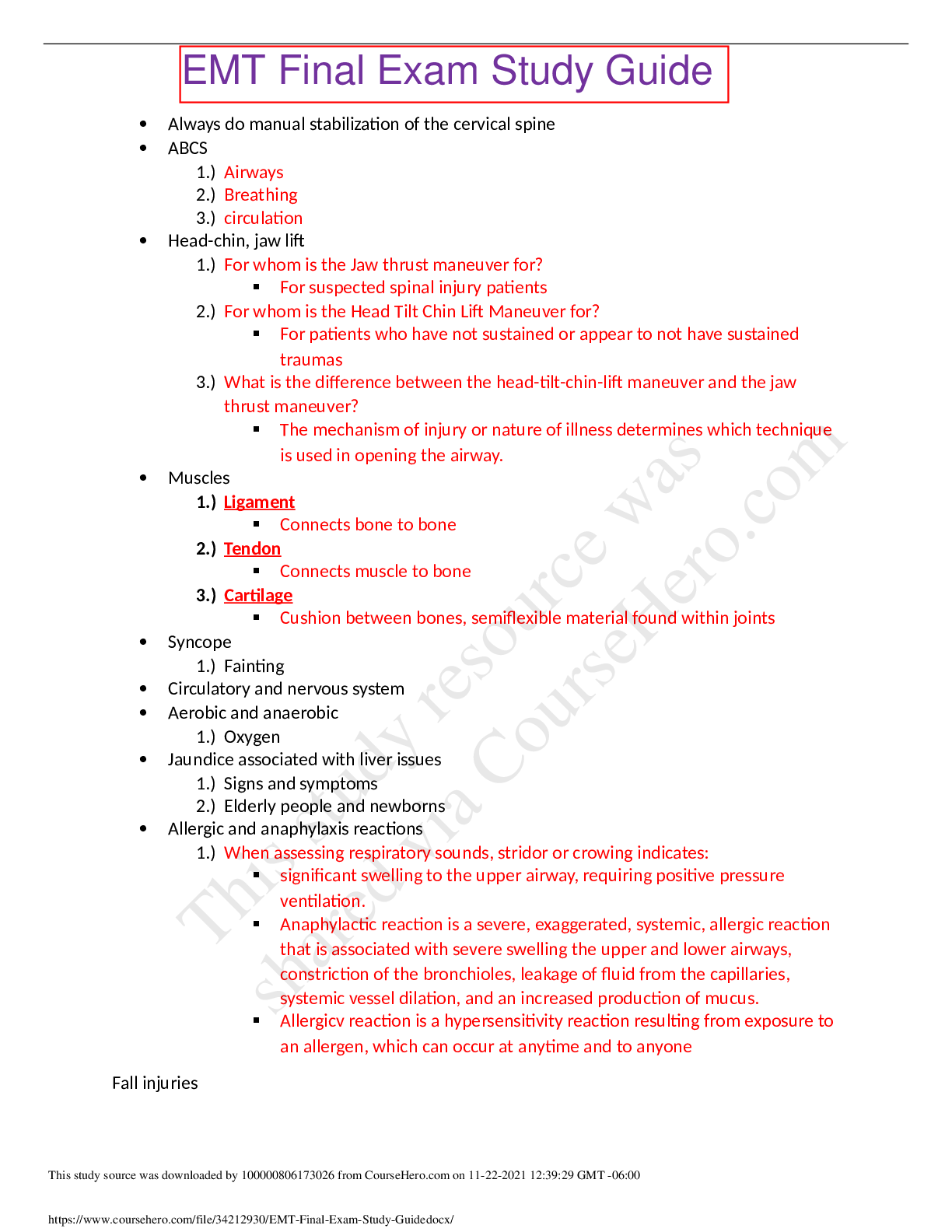
Always do manual stabilization of the cervical spine
ABCS
1.) Airways
2.) Breathing
3.) circulation
Head-chin, jaw lif
1.) For whom is the Jaw thrust maneuver for?
For suspected spinal injury patients
2.) For whom is the Head Tilt Chin Lif Maneuver for?
For patients who have not sustained or appear to not have sustained
traumas
3.) What is the difference between the head-tilt-chin-lif maneuver and the jaw
thrust maneuver?
The mechanism of injury or nature of illness determines which technique
is used in opening the airway.
Muscles
1.) Ligament
Connects bone to bone
2.) Tendon
Connects muscle to bone
3.) Cartilage
Cushion between bones, semiflexible material found within joints
Syncope
1.) Fainting
Circulatory and nervous system
Aerobic and anaerobic
1.) Oxygen
Jaundice associated with liver issues
1.) Signs and symptoms
2.) Elderly people and newborns
Allergic and anaphylaxis reactions
1.) When assessing respiratory sounds, stridor or crowing indicates:
significant swelling to the upper airway, requiring positive pressure
ventilation.
Anaphylactic reaction is a severe, exaggerated, systemic, allergic reaction
that is associated with severe swelling the upper and lower airways,
constriction of the bronchioles, leakage of fluid from the capillaries,
systemic vessel dilation, and an increased production of mucus.
Allergicv reaction is a hypersensitivity reaction resulting from exposure to
an allergen, which can occur at anytime and to anyone
Fall injuries
This study source was downloaded by 100000806173026 from CourseHero.com on 11-22-2021 12:39:29 GMT -06:00
https://www.coursehero.com/file/34212930/EMT-Final-Exam-Study-Guidedocx/
This study resource was
shared via CourseHero.com2.) Different types
1.) Compression:
a. When the weight of the body is driven against the head.
b. Common in falls, when the accident involves the person impacts an object head
first
2.) Flexion:
a. When there is a severe forward movement of the head in which the chin meets
the chest, or when the torso is excessively curled forward
3.) Extension:
a. When there is a severe backward movement of the head in which the neck is
stretched, or when the torso is severely arched backwards
4.) Rotation:
a. When there is lateral movement of the head or spine beyond its normal rotation
5.) Lateral bending:
a. When the body or neck is bent severely from the side
6.) Distraction:
a. When the vertebrae and spinal cord are stretched and pulled apart (Hangings)
7.) Penetrations:
a. When there is injury from gunshots, stabbings, or other types of penetrating
trauma that involves the cranium or spinal column
Stroke and spinal injury differentiation
-Neurological Deficit: defined as any deficiency in the functioning of the brain or nervous
system. EX: Altered mental status, slurred or absent speech, paralysis, weakness, and numbness
are all signs and symptoms of neurologic deficit
1.) Strokes:
a. Ischemic strokes are strokes caused by a blockage of blood flow to the brain
i. Thrombotic stroke: the process of clot formation
ii. A clot or other matter that has traveled from another area of the
brain is called an embolus
b. Hemorrhagic stroke: strokes caused by bleeding or rupture
2.) Spinal injury:
a. Loss of motor and sensory function below the level of injury
b. Inability to move or feel sensations of pain, light touch, and crude pressure
below the level of injury
3.) Spinal Shock:
a. Temporary concussion insult to the spinal cord that causes effects below the
level of the injury.
b. Below the level of injury, there is loss of muscle tones, anesthetic effect, and
muscle paralysis
c. Male patients might experience priapism.
Different type of burns
[Show More]






.png)