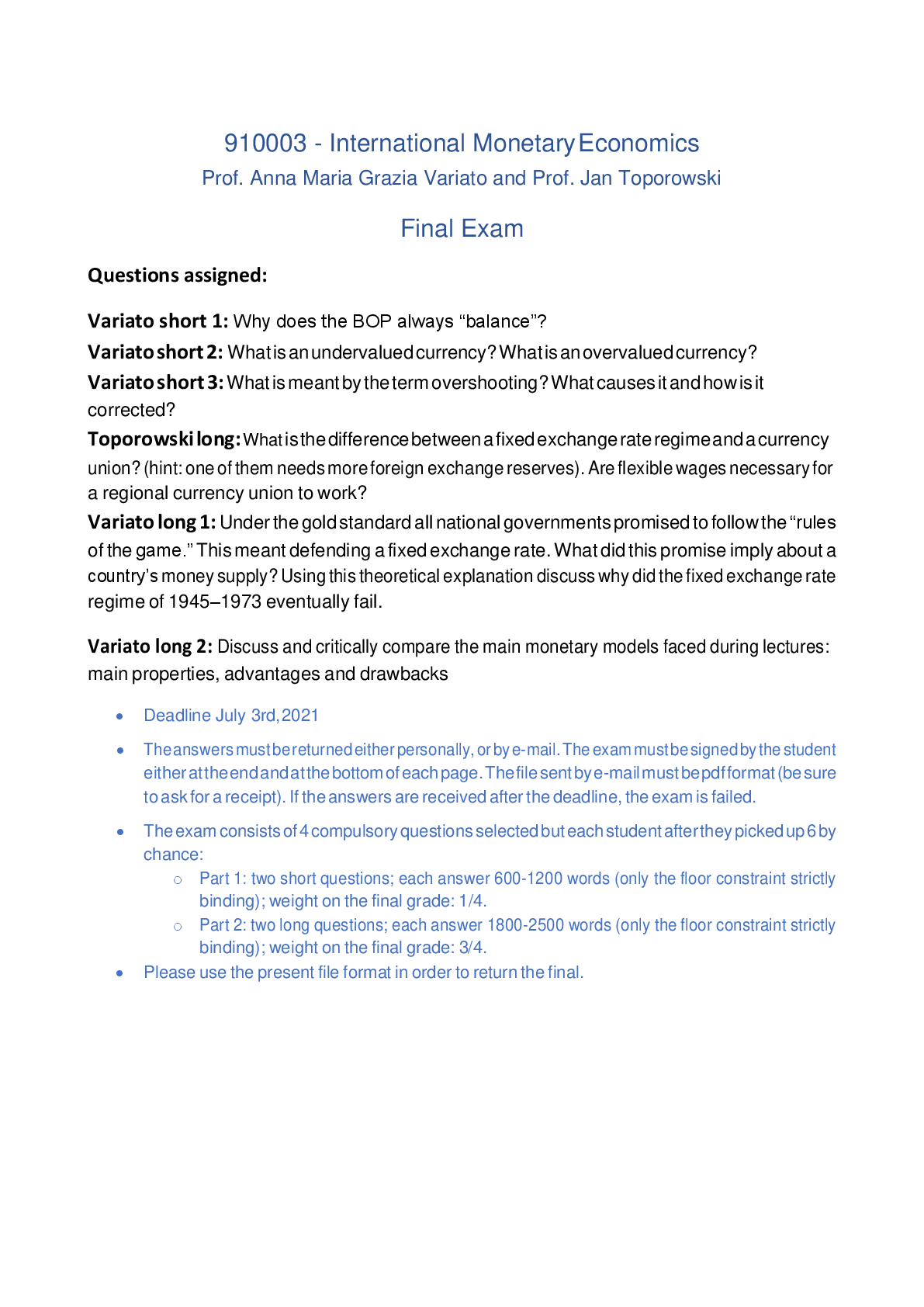
Points Awarded 100.00
Points Missed 0.00
Percentage 100%
1.
Explain, in five sentences or less, exactly why the trade deficit in the US increased from 1995 to 2000. There
are two specific reasons. Make sure you expl
...
Points Awarded 100.00
Points Missed 0.00
Percentage 100%
1.
Explain, in five sentences or less, exactly why the trade deficit in the US increased from 1995 to 2000. There
are two specific reasons. Make sure you explain clearly (the intuition) why each reason would add to our trade
deficit.
Feedback: TWO REASONS: 1) Very strong growth in the US economy relative to the rest of the world,
increasing our appetite for foreign goods resulting in a trade deficit (recall the marginal propensity to import!). 2)
Various financial crises (E. Asia, Russian) that resulted in the $ US appreciating (safe haven argument). The
stronger dollar made imports cheaper (we buy more) and exports more expensive resulting in a larger trade
deficit.
Table for Individual Question Feedback
Points
Earned:
20.0/20.0
Correct
Answer(s):
TWO REASONS: 1) Very strong growth in the US economy relative to
the rest of the world, increasing our appetite for foreign goods resulting
in a trade deficit (recall the marginal propensity to import!). 2) Various
financial crises (E. Asia, Russian) that resulted in the $ US appreciating
(safe haven argument). The stronger dollar made imports cheaper (we
buy more) and exports more expensive resulting in a larger trade deficit.
2.
Suppose that you received your college degree from Penn State and nailed a great job over in Europe in the
summer of 2001. Given that your family remains in the US, you make sure that you visit the family every
November by traveling from Europe to the US. We are going to compare the cost of this vacation, in terms of
euros, during two different periods: November 2002 and November 2012. We assume that the cost of the trip,
in terms of $ US, remains the same at $1,000 in both periods. Using the data below, we will compare the euro
cost of the trip in November 2002 vs. the euro cost of the trip in November 2012.
Data:
11/1/2002 the $ per euro exchange rate is $1.00 per euro
11/1/2012 the $ per euro exchange rate was $1.28 per euro
What was the cost of the trip in 2002 measured in euros?
A) 1 euro
B) 1,000 euros
C) 780 euros
D) 1.28 euros
Feedback: November 2002 - $1 = 1 euro so euro price of trip = 1,000 euros
Table for Individual Question Feedback
Points Earned: 5.0/5.0
Correct Answer(s): B
3.
What was the cost of the trip in 2012 measured in euros? Round to the nearest whole number.
A) 1 euro
B) 1,000 euros
C) 781 euros
D) 1.28 euros
Feedback: November 2012 - $ 1.28 = 1 euro or 1/1.28 = .78125 euro per $ - trip cost, 781.25 euros.
Table for Individual Question Feedback
Points Earned: 5.0/5.0
Correct Answer(s): C
4.
Using the data below, we are now going to use our supply/demand framework for US $ to model the movement
in the euro per $ exchange rate between December 2007 (the very beginning of the Great Recession) and
November 2008 (pretty much the height of the global financial crisis). Note that the data is given in $ per euro
and then converted into euro per dollar. For example, $ 1.2 per euro is converted by 1/1.2 = .833 meaning
that $1 = .83 euro (this is the vertical axis on your graph, i.e., euro per $).
Draw a supply and demand diagram like we did numerous times in the lectures labeling the vertical axis as
euro per $, the horizontal axis with Quantity of dollars, the initial supply and demand curves labeled with 12/07,
Label this initial intersection point as point A. Now explain what happened to each curve and WHY between
12/07 and 11/08. Label as point B with your supply and demand curves labeled accordingly (Hint: the two
obvious facts during this period is that the 1) US was in a deep recession and 2) we were at the height
of the (global) financial crisis (in 11/08). Assume all else is constant.
Data:
12/1/2007 the dollar per euro exchange rate is $1.45, so the euro per dollar exchange rate is 1/1.45 = .69
euros per dollar.
11/1/2008 the dollar per euro exchange rate is $1.27, so the euro per dollar exchange rate is 1/1.27=.79
euros per dollar.
Feedback:
Table for Individual Question Feedback
Points Earned: 15.0/15.0
Correct Answer(s):
5.
Upload your graph here, using the Upload File button
homework 7 graph.pdf
Table for Individual Question Feedback
Points Earned: 0.0/0.0
[Show More]
.png)




.png)

.png)
.png)