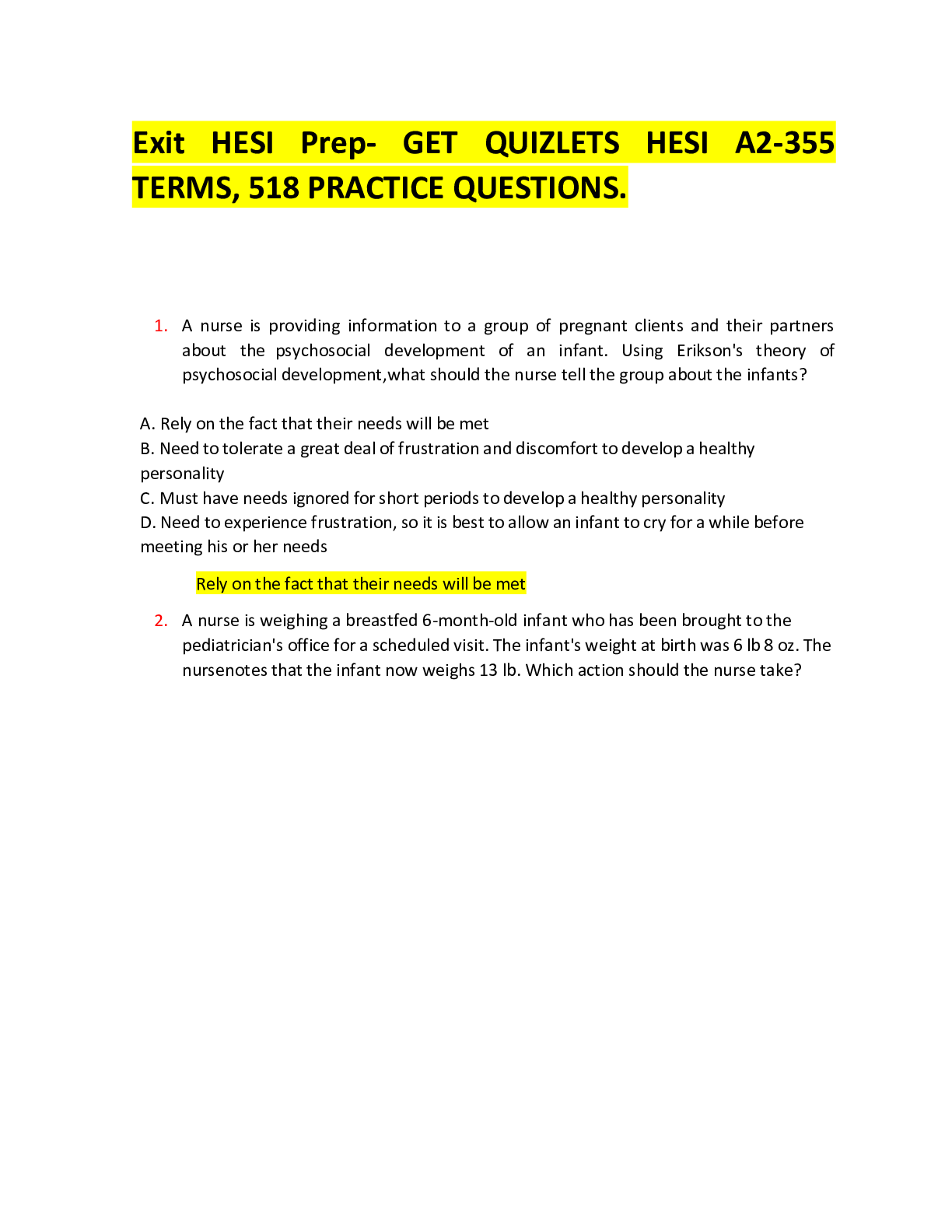
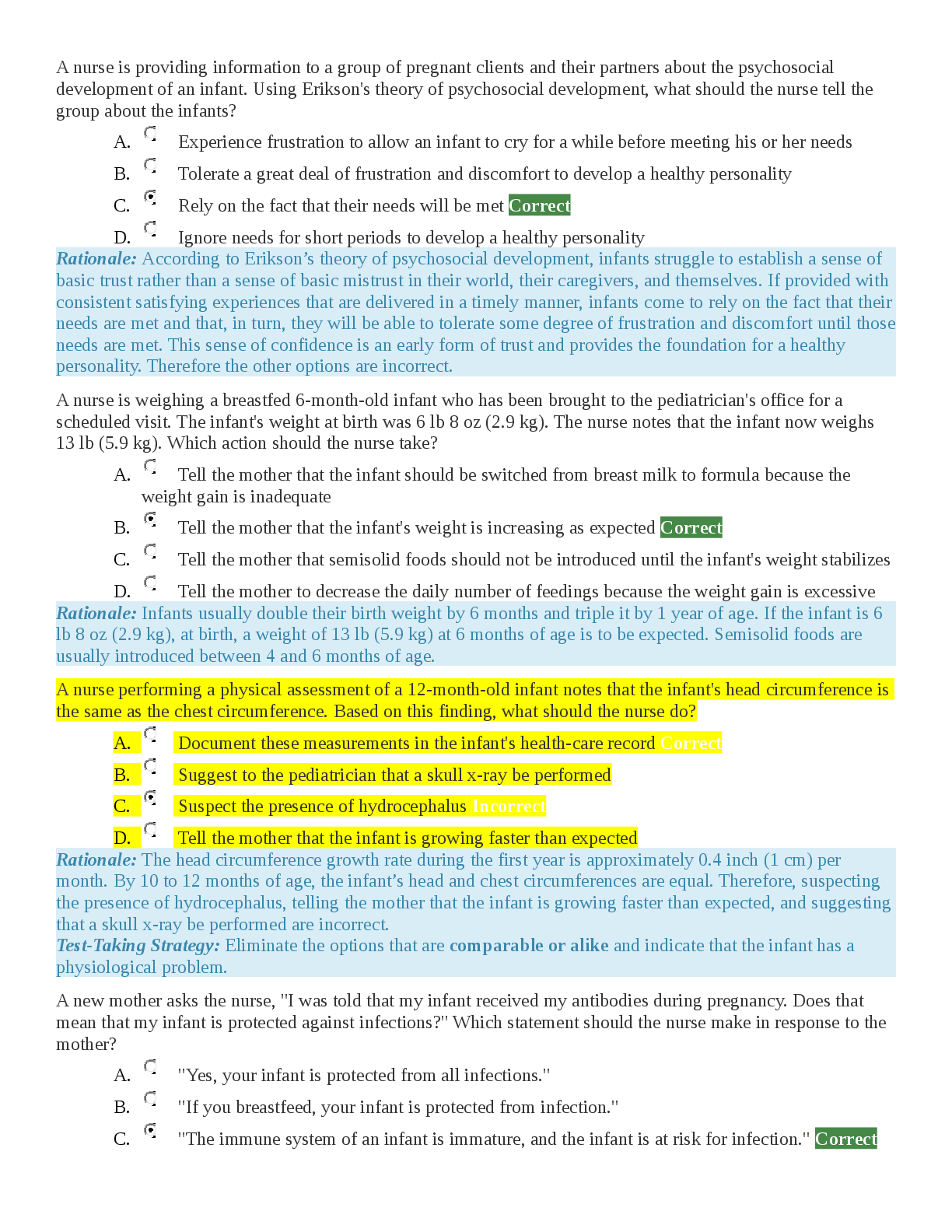
A nurse is providing information to a group of pregnant clients and their partners about the psychosocial
development of an infant. Using Erikson's theory of psychosocial development, what should the nurse tell the
...
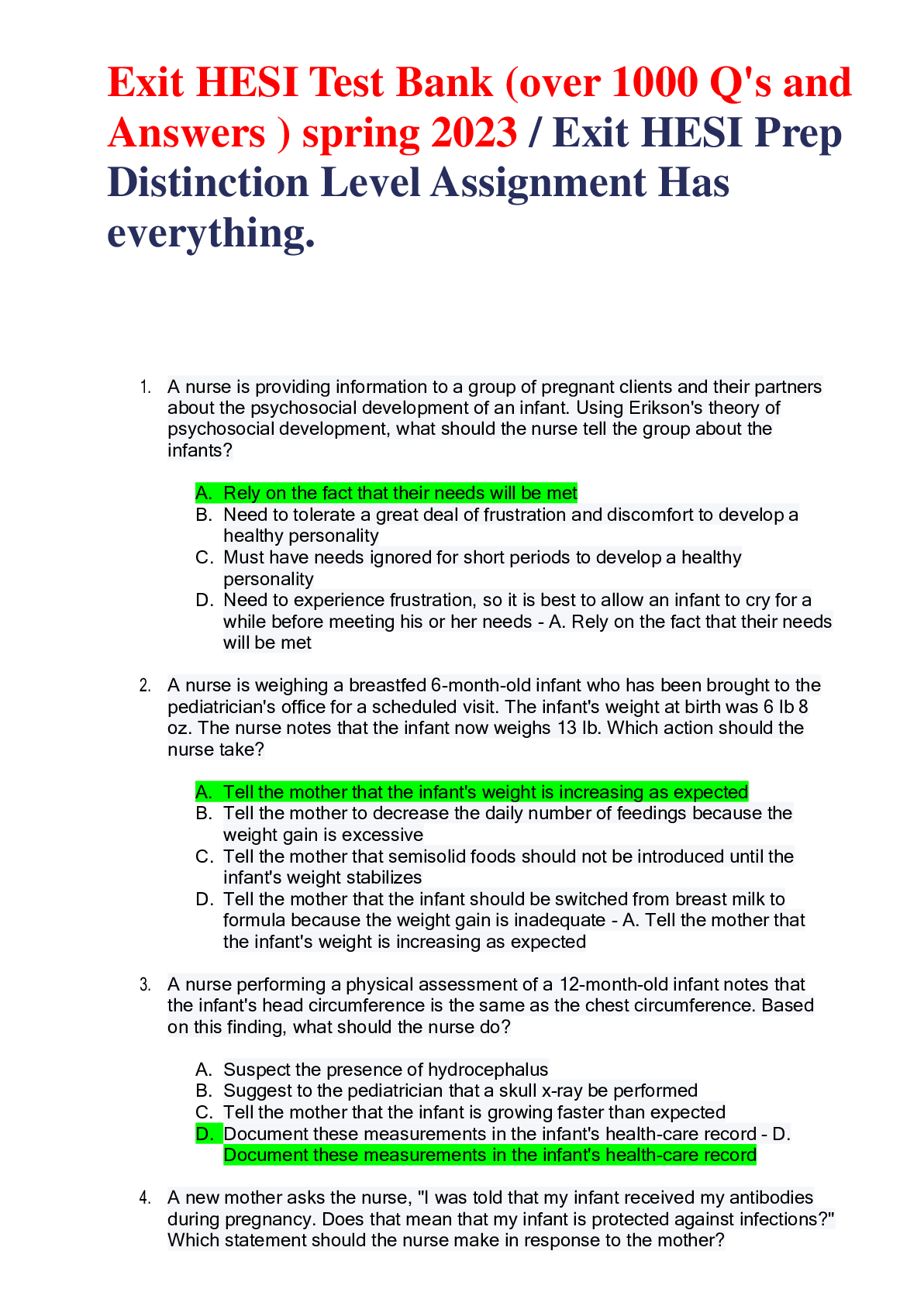
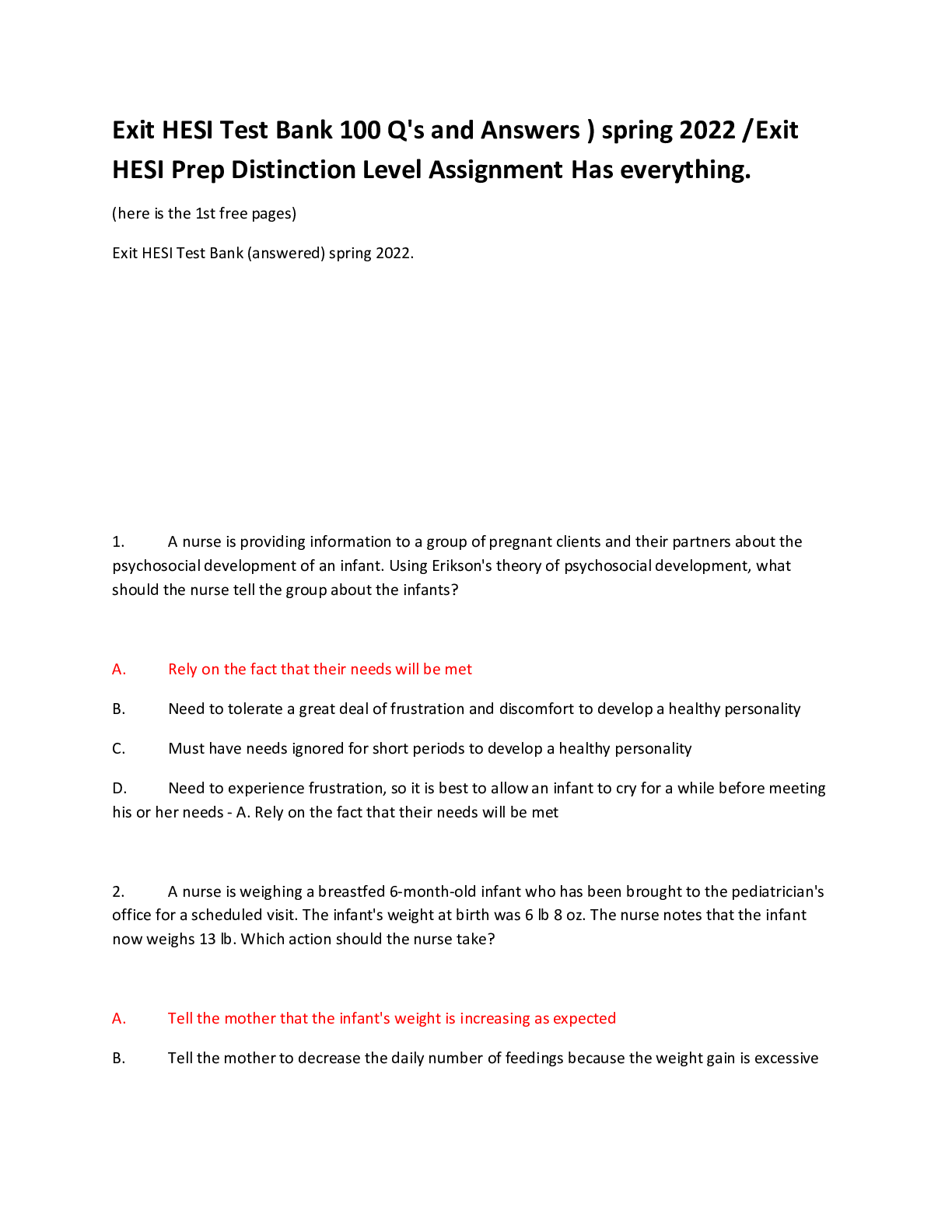
A nurse is providing information to a group of pregnant clients and their partners about the psychosocial
development of an infant. Using Erikson's theory of psychosocial development, what should the nurse tell the
group about the infants?
A. Experience frustration to allow an infant to cry for a while before meeting his or her needs
B. Tolerate a great deal of frustration and discomfort to develop a healthy personality
C. Rely on the fact that their needs will be met Correct
D. Ignore needs for short periods to develop a healthy personality
Rationale: According to Erikson’s theory of psychosocial development, infants struggle to establish a sense of
basic trust rather than a sense of basic mistrust in their world, their caregivers, and themselves. If provided with
consistent satisfying experiences that are delivered in a timely manner, infants come to rely on the fact that their
needs are met and that, in turn, they will be able to tolerate some degree of frustration and discomfort until those
needs are met. This sense of confidence is an early form of trust and provides the foundation for a healthy
personality. Therefore the other options are incorrect.
A nurse is weighing a breastfed 6-month-old infant who has been brought to the pediatrician's office for a
scheduled visit. The infant's weight at birth was 6 lb 8 oz (2.9 kg). The nurse notes that the infant now weighs
13 lb (5.9 kg). Which action should the nurse take?
A. Tell the mother that the infant should be switched from breast milk to formula because the
weight gain is inadequate
B. Tell the mother that the infant's weight is increasing as expected Correct
C. Tell the mother that semisolid foods should not be introduced until the infant's weight stabilizes
D. Tell the mother to decrease the daily number of feedings because the weight gain is excessive
Rationale: Infants usually double their birth weight by 6 months and triple it by 1 year of age. If the infant is 6
lb 8 oz (2.9 kg), at birth, a weight of 13 lb (5.9 kg) at 6 months of age is to be expected. Semisolid foods are
usually introduced between 4 and 6 months of age.
A nurse performing a physical assessment of a 12-month-old infant notes that the infant's head circumference is
the same as the chest circumference. Based on this finding, what should the nurse do?
A. Document these measurements in the infant's health-care record Correct
B. Suggest to the pediatrician that a skull x-ray be performed
C. Suspect the presence of hydrocephalus Incorrect
D. Tell the mother that the infant is growing faster than expected
Rationale: The head circumference growth rate during the first year is approximately 0.4 inch (1 cm) per
month. By 10 to 12 months of age, the infant’s head and chest circumferences are equal. Therefore, suspecting
the presence of hydrocephalus, telling the mother that the infant is growing faster than expected, and suggesting
that a skull x-ray be performed are incorrect.
Test-Taking Strategy: Eliminate the options that are comparable or alike and indicate that the infant has a
physiological problem.
A new mother asks the nurse, "I was told that my infant received my antibodies during pregnancy. Does that
mean that my infant is protected against infections?" Which statement should the nurse make in response to the
mother?
A. "Yes, your infant is protected from all infections."
B. "If you breastfeed, your infant is protected from infection."
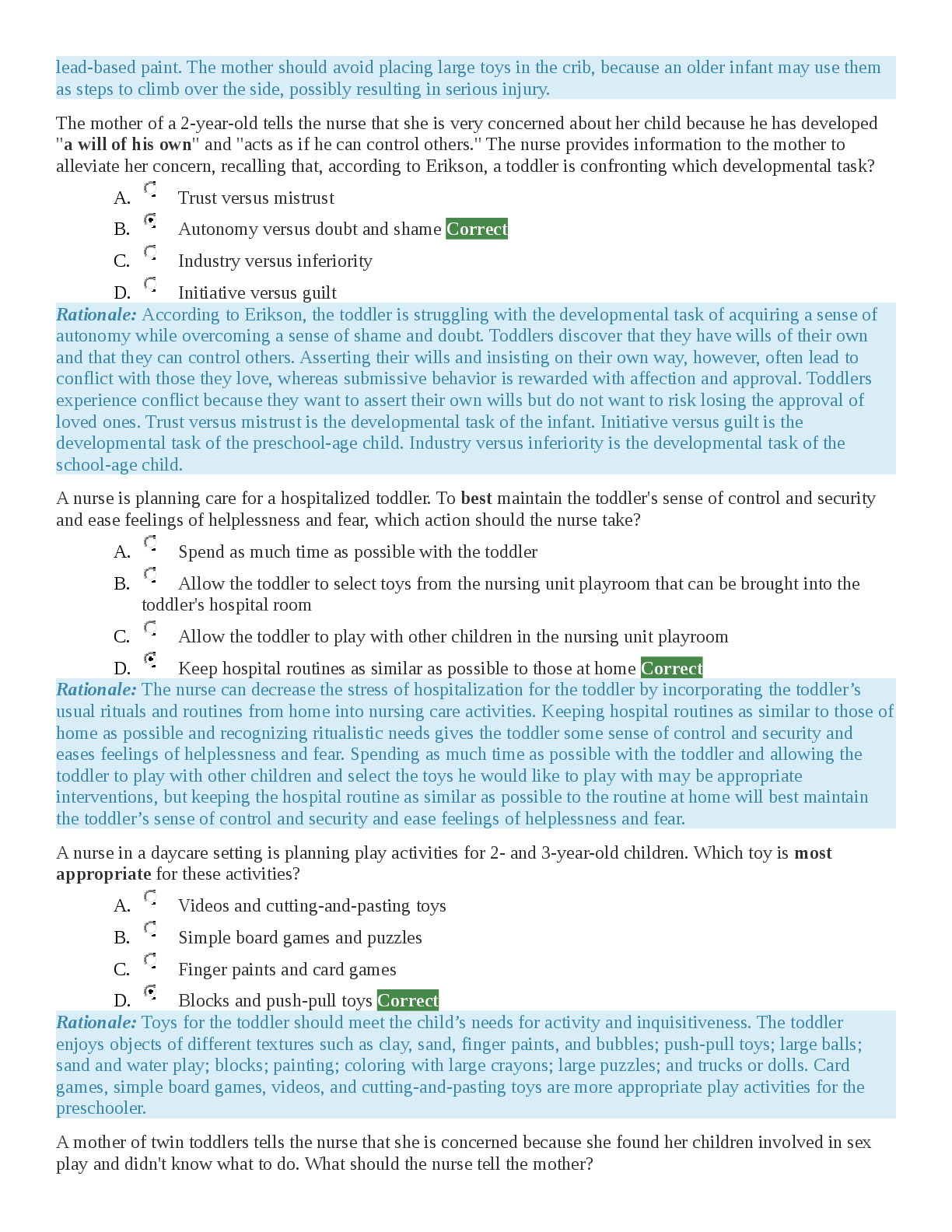
C. "The immune system of an infant is immature, and the infant is at risk for infection." Correct


.png)

 spring 2023 _ Exit HESI Prep Distinction Level Assignment Has everything.png)