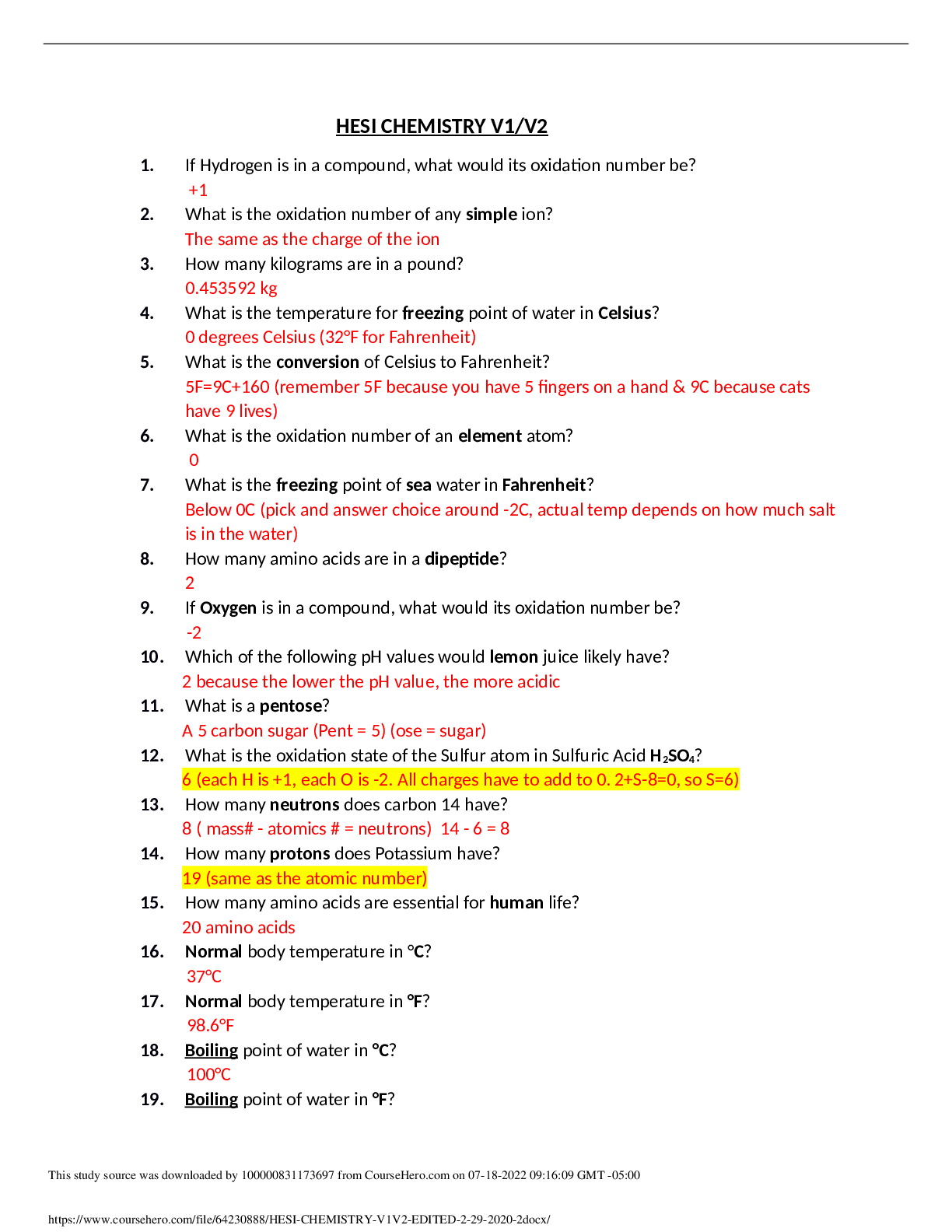
1. If Hydrogen is in a compound, what would its oxidation number be?
+1
2. What is the oxidation number of any simple ion?
The same as the charge of the ion
3. How many kilograms are in a pound?
0.453592 kg
4. What
...
1. If Hydrogen is in a compound, what would its oxidation number be?
+1
2. What is the oxidation number of any simple ion?
The same as the charge of the ion
3. How many kilograms are in a pound?
0.453592 kg
4. What is the temperature for freezing point of water in Celsius?
0 degrees Celsius (32°F for Fahrenheit)
5. What is the conversion of Celsius to Fahrenheit?
5F=9C+160 (remember 5F because you have 5 fingers on a hand & 9C because cats
have 9 lives)
6. What is the oxidation number of an element atom?
0
7. What is the freezing point of sea water in Fahrenheit?
Below 0C (pick and answer choice around -2C, actual temp depends on how much salt
is in the water)
8. How many amino acids are in a dipeptide?
2
9. If Oxygen is in a compound, what would its oxidation number be?
-2
10. Which of the following pH values would lemon juice likely have?
2 because the lower the pH value, the more acidic
11. What is a pentose?
A 5 carbon sugar (Pent = 5) (ose = sugar)
12. What is the oxidation state of the Sulfur atom in Sulfuric Acid H2SO4?
6 (each H is +1, each O is -2. All charges have to add to 0. 2+S-8=0, so S=6)
13. How many neutrons does carbon 14 have?
8 ( mass# - atomics # = neutrons) 14 - 6 = 8
14. How many protons does Potassium have?
19 (same as the atomic number)
15. How many amino acids are essential for human life?
20 amino acids
16. Normal body temperature in °C?
37°C
17. Normal body temperature in °F?
98.6°F
18. Boiling point of water in °C?
100°C
19. Boiling point of water in °F?
This study source was downloaded by 100000831988016 from CourseHero.com on 01-05-2022 04:39:38 GMT -06:00
https://www.coursehero.com/file/64230888/HESI-CHEMISTRY-V1V2-EDITED-2-29-2020-2docx/
212°F
20. 0°K is equal to ___°C? -273°C
21. The term Amphoteric means?
A substance that can act as both a base & acid
22. What is Kelvin based around?
Absolute zero
23. A compound that is a Hydrogen or proton donor, corrosive to metals, causes blue
litmus paper to become red and becomes less acidic when mixed with a base is?
Acid
24. Mixture of 2 or more metals are?
Alloys
25. Acids:
pH less than 7.0
sour/tart
Formulas begin with H (Hydrogen)
Proton Donor
26. 3 types of radiation in nuclear chemistry?
Alpha, Beta & Gamma
27. Alpha radiation:
* Emission of Helium (He) ions in the nuclei
* Contains 2 protons & 2 neutrons.
* +2 Charge
* Largest radiation particle.
* Can be stopped by piece of paper
28. Type of Alloy in which another metal is dissolved in Mercury (Hg)?
Amalgam
29. Proteins are made up of?
Amino Acids
30. Glycogen is what kind of starch?
Animal Starch
31. When an atom GAINS ONE or more electrons?
Anions (negative ion)
32. Basic building block of a molecule?
Atom
33. Atomic mass?
This study source was downloaded by 100000831988016 from CourseHero.com on 01-05-2022 04:39:38 GMT -06:00
https://www.coursehero.com/file/64230888/HESI-CHEMISTRY-V1V2-EDITED-2-29-2020-2docx/
Average mass of an elements isotope
34. Atomic #:
# of protons in nucleus of an atom
35. Base?
A Hydrogen or proton ACCEPTOR & has hydroxide group in the makeup of the
molecule
Produce -OH
Bitter, slippery, conduct electricity, formulas contain -OH
pH value greater than 7.0
Proton acceptor
36. Key note:
Acids are Proton donors and Bases are proton acceptors
37. Beta radiation:
Decomposition product of a proton or neutron
High speed/energy Electrons
EITHER - charged electrons or + charged positrons
Can be stopped by aluminum foil
38. What is Biochemistry?
Study of substances & processes occurring in living things
39. Fahrenheit is based off of?
Body temperature
40. How does ↑ Surface area speed up chemical reactions?
By ↑ areas of contact where chemical reactions can occur
41. How do catalyst accelerate a chemical reaction?
By reducing the amount of energy needed for a reaction to occur
A catalyst is a substance that accelerates a reaction by which of the following? -Finding
an alternative pathway for a reaction that requires less energy.
42. What does COOH symbolize?
[Show More]