HSCO 506 EXAM 2
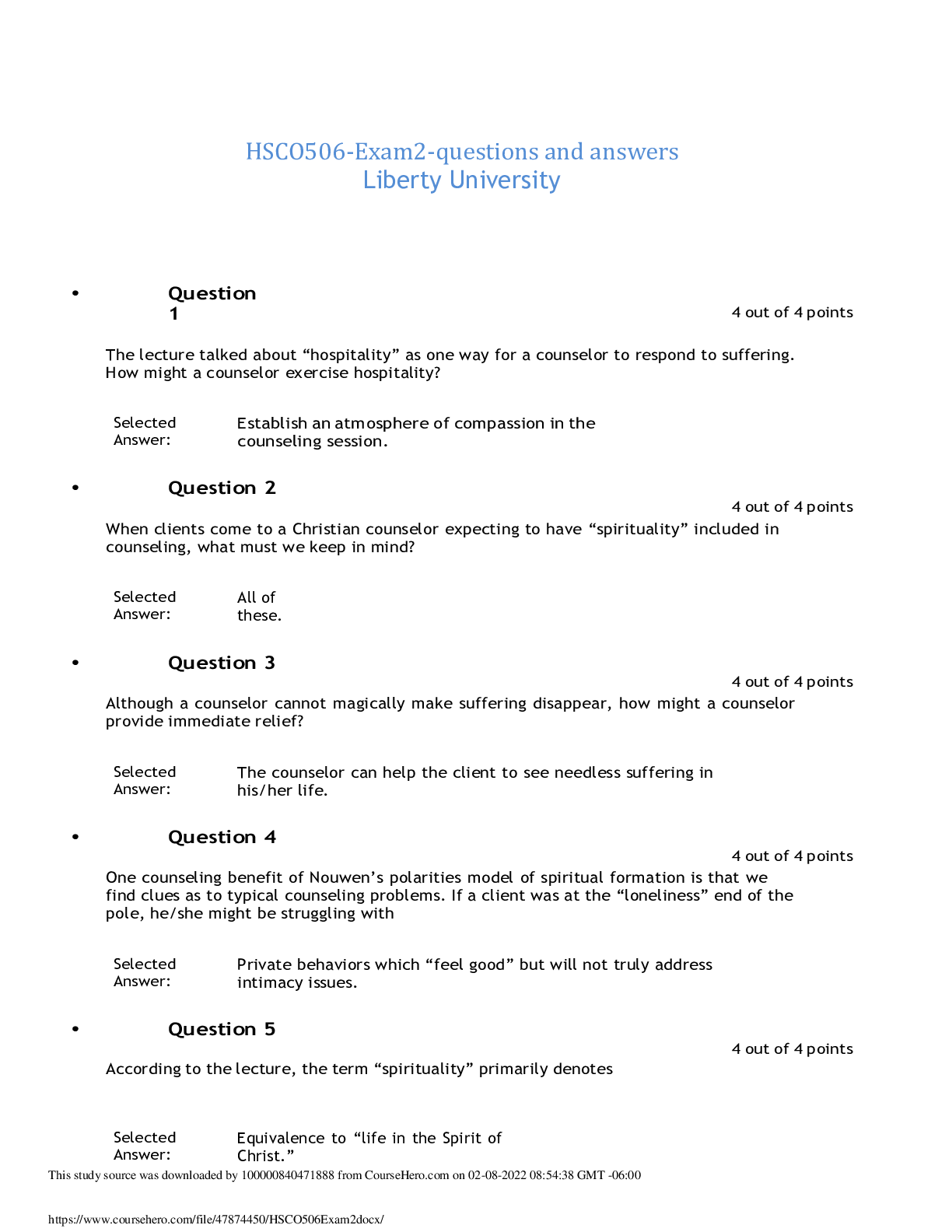
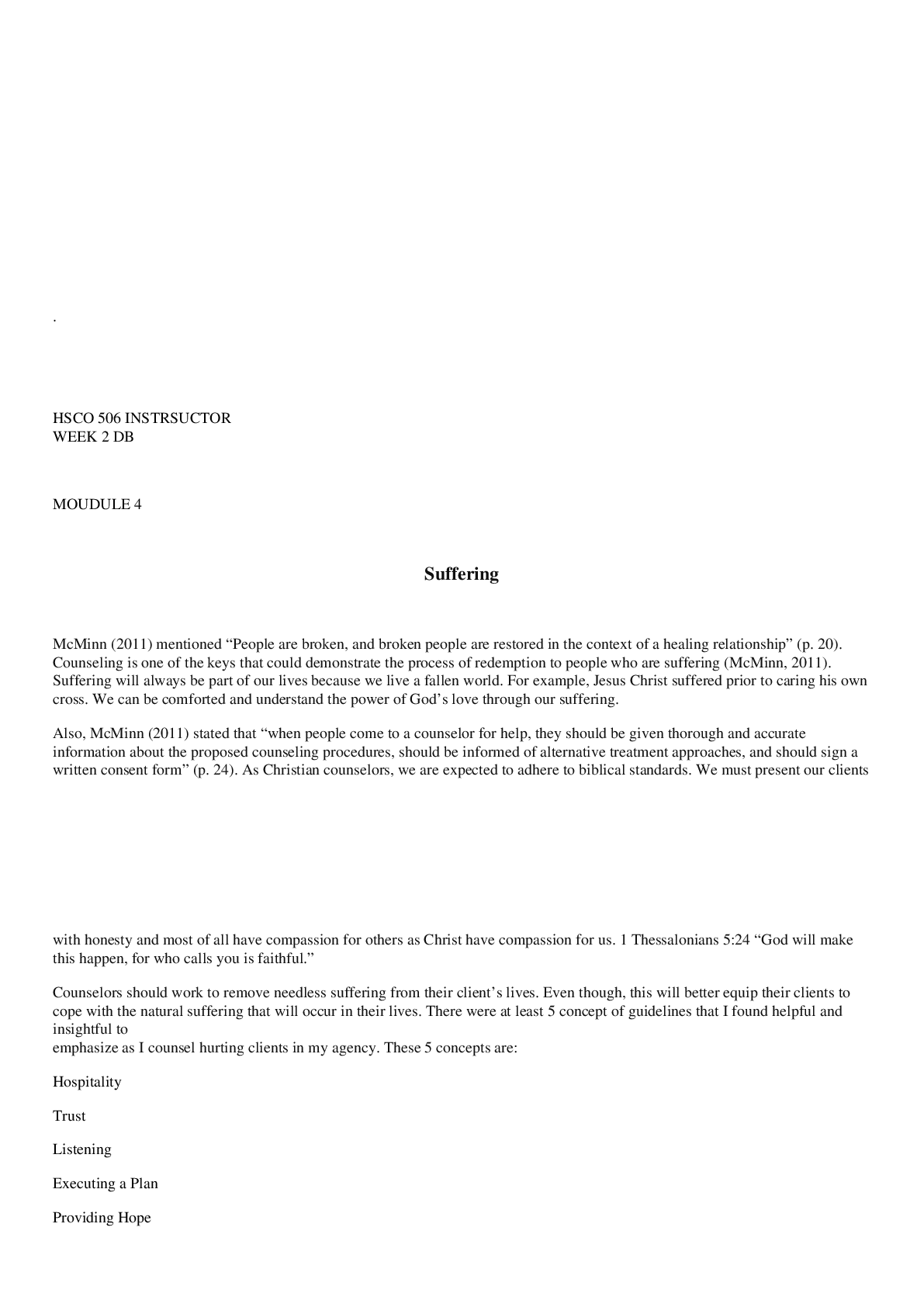
• Question 1 4 out of 4 points The lecture talked about “hospitality” as one way for a counselor to respond to suffering. How mig ht a counselor exercise hospitality?
• Question 2 4 out of 4 point
...
HSCO 506 EXAM 2
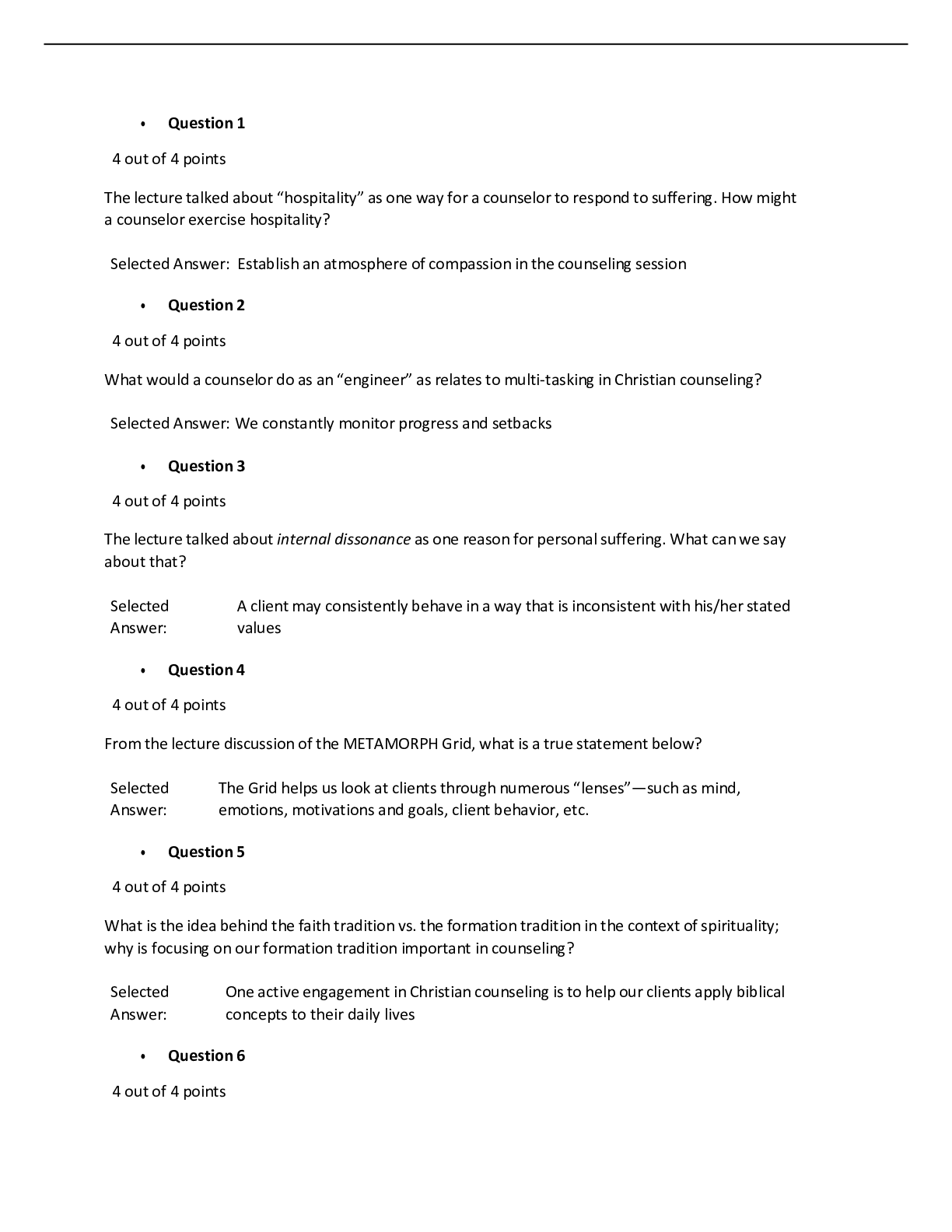
• Question 1 4 out of 4 points The lecture talked about “hospitality” as one way for a counselor to respond to suffering. How mig ht a counselor exercise hospitality?
• Question 2 4 out of 4 points When clients come to a Christian counselor expecting to have “spirituality” included in counseling, what must we keep in mind?
• Question 3 4 out of 4 points Although a counselor cannot magically make suffering disappear, how might a counselor provide immediate relief?
• Question 4 4 out of 4 points One counseling benefit of Nouwen’s polarities model of spiritual formation is that we find clues as to typical counseling problems. If a client was at the “loneliness” end of the pole, he/she might be struggling with
• Question 5 4 out of 4 points According to the lecture, the term “spirituality” primarily denotes
• Question 6 4 out of 4 points What is the idea behind the faith tradition vs. the formation tradition in the context of spirituality; why is focusing on our formation tradition important in counseling?
• Question 7 4 out of 4 points What is a main insight in Nouwen’s polarities model?
• Question 8 4 out of 4 points From the lecture discussion of the METAMORPH grid, what is a true statement below?
• Question 9 4 out of 4 points What determines what you emphasize in counseling and the techniques you choose?
• Question 10 4 out of 4 points With regard to how a counselor’s temperament affects counseling, what can we say?
• Question 11 4 out of 4 points The lectures talked about creating “free space” in the process of counseling suffering clients. What is a true statement from that discussion?
• Question 12 4 out of 4 points All of the models of spiritual formation have one of the same elements, which is • Question 13 4 out of 4 points What propels a level of professionalism in Christian counseling?
• Question 14 4 out of 4 points In providing hospitality and solidarity to a suffering client, what is true?
• Question 15 4 out of 4 points In the context of the discussion of Christian counseling as a spiritual enterprise, the lecture talked about “receiving grace” and “refining grace.” What is the main idea behind that discussion?
• Question 16 4 out of 4 points The lecture talked about internal dissonance as one reason for personal suffering. What can we say about that?
• Question 17 4 out of 4 points From the lecture, when we define Christian counseling as a spiritual enterprise, what can we say?
• Question 18 4 out of 4 points From the lecture, McMinn discusses “Three Continuous Assessment Dimensions.” Which statement below is NOT one of them?
• Question 19 4 out of 4 points From the METAMORPH perspective, what does it mean when the grid follows the idea of “many theories and techniques in service of a Christian worldview?”
• Question 20 4 out of 4 points According to the lecture, if someone were asked “What is spirituality?” how would they answer if they were coming from a post-modern point of view?
• Question 21 2 out of 2 points One way to move your counselee from “stranger” to friend, is to ask the tough questions. • Question 22 2 out of 2 points There is rarely a cost to the counselor in the process of moving a counselee from stranger to friend .
• Question 23 2 out of 2 points With regard to attribution theory, as counselors we need to recognize that people are responsible for their own behavior but at the same time also respond to external events.
• Question 24 2 out of 2 points In counseling suffering clients, looking at body language may help the counselor identify some of the clients’ faulty thinking about suffering.
• Question 25 2 out of 2 points Clarifying your role as a counselor can actually contribute to healing for a suffering client.
• Question 26 2 out of 2 points A purpose of the METAMORPH grid is to help a Christian counselor focus on factors that affect human behavior and emotions.
• Question 27 2 out of 2 points It is not really important that a counselor assess his/her own feelings toward a potential client.
• Question 28 2 out of 2 points There is little connection between a counselor’s worldview and the theory that a counselor chooses to promote healing.
• Question 29 2 out of 2 points The lecture emphasized that a characteristic of Christian counseling was an absolute reliance on technique.
• Question 30 0 out of 2 points Consistent with the concept of hospitality is the expectation that there should always be conversation in the counseling relationship. Continued..................
[Show More]