• Question 1
4 out of 4 points
The lecture talked about “hospitality” as one way for a counselor to respond to suffering. How might a counselor exercise hospitality?
Selected Answer: Establish an atmosphere of com
...
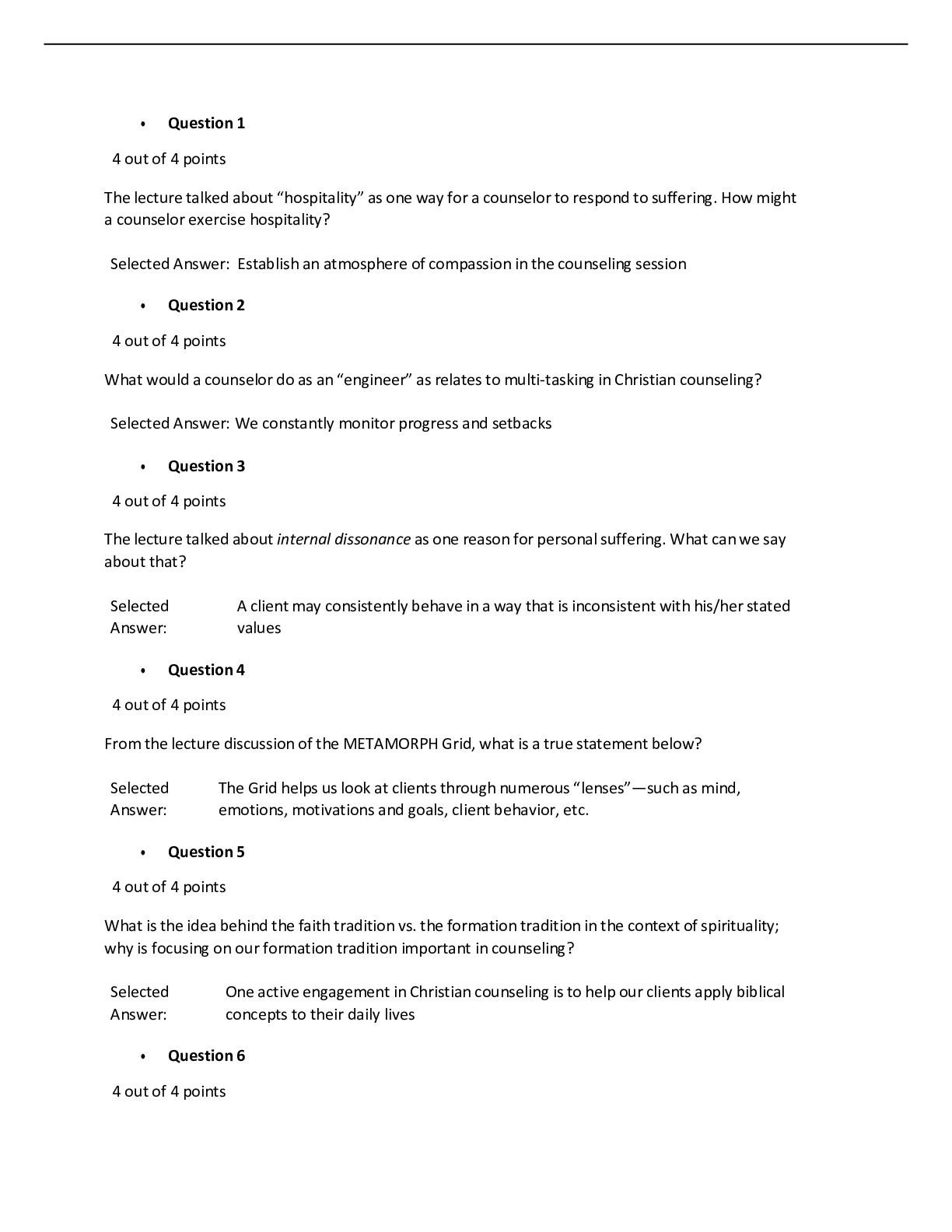
• Question 1
4 out of 4 points
The lecture talked about “hospitality” as one way for a counselor to respond to suffering. How might a counselor exercise hospitality?
Selected Answer: Establish an atmosphere of compassion in the counseling session
• Question 2
4 out of 4 points
What would a counselor do as an “engineer” as relates to multi-tasking in Christian counseling? Selected Answer: We constantly monitor progress and setbacks
• Question 3
4 out of 4 points
The lecture talked about internal dissonance as one reason for personal suffering. What can we say about that?
Selected Answer:
A client may consistently behave in a way that is inconsistent with his/her stated values
• Question 4
4 out of 4 points
From the lecture discussion of the METAMORPH Grid, what is a true statement below?
Selected Answer:
The Grid helps us look at clients through numerous “lenses”—such as mind, emotions, motivations and goals, client behavior, etc.
• Question 5
4 out of 4 points
What is the idea behind the faith tradition vs. the formation tradition in the context of spirituality; why is focusing on our formation tradition important in counseling?
Selected Answer:
One active engagement in Christian counseling is to help our clients apply biblical concepts to their daily lives
• Question 6
4 out of 4 points
If we take into account the Formation Field approach to spiritual formation in our counseling, what is true?
Selected Answer:
One way to relate to non-Christians in Christian counseling is by appealing to their transcendent desires—desire to be a part of something bigger, etc.
• Question 7
4 out of 4 points
How does the rate limiting factor mentioned in the lecture and by McMinn relate to counseling?
Selected Answer:
Our own recognition of our strengths and weaknesses as a counselor will relate to the potential rate of change in our counselee
• Question 8
4 out of 4 points
What determines what you emphasize in counseling and the techniques you choose Selected Answer: All of these
• Question 9
4 out of 4 points
Which list below provides some of the best suggestions for building a therapeutic relationship in a Christian counseling session?
Selected Answer:
Recognizing that we are “wounded healers,” providing the sense of “hospitality,” clarifying your role and listening.
• Question 10
4 out of 4 points
When clients come to a Christian counselor expecting to have “spirituality” included in counseling, what must we keep in mind?
Selected Answer: All of these
• Question 11
4 out of 4 points
In counseling suffering people, what principle is true from the lectures?
Selected Answer:
Before we confront sin in the life of our counselee, proper trust must be established
• Question 12
4 out of 4 points
From the METAMORPH perspective, what does it mean when the grid follows the idea of “many theories and techniques in service of a Christian worldview?”
Selected Answer: Responsible eclecticism
• Question 13
0 out of 4 points
Although a counselor cannot magically make suffering disappear, how might a counselor provide immediate relief?
Selected Answer: The counselor can prescribe anti-depressant medications.
• Question 14
4 out of 4 points
The lectures talked about creating “free space” in the process of counseling suffering clients. What is a true statement from that discussion?
Selected Answer: Free space is connected to recognition of God’s full knowledge of us
• Question 15
4 out of 4 points
According to the lecture, if someone were asked: “What is spirituality?”, how would they answer if they were coming from a post-modern point of view?
Selected Answer: Spirituality as a private alternative to religion.
• Question 16
4 out of 4 points
With regard to how a counselor’s temperament affects counseling, what can we say?
Selected Answer:
Counselors need to be adequately aware of the implications of differences in their need to control and that of the client and make adjustments in counseling
• Question 17
4 out of 4 points
In the context of the discussion of Christian counseling as a spiritual enterprise, the lecture talked about “receiving grace” and “refining grace.” What is the main idea behind that discussion?
Selected Answer:
For the Christian counselor, God’s grace needs to be constantly at work to develop the godly characteristics necessary in the counseling process.
• Question 18
4 out of 4 points
Brewer’s model of spiritual formation emphasizes the necessary relationships in the life of our counselee. What is true of his approach?
Selected Answer: It is really important that we have someone for whom we can offer guidance
• Question 19
4 out of 4 points
[Show More]