ENG 115 Unit 3 Milestone 3 Sophia Course English Composition I
1
Select the statement about writing in the informative mode that is
TRUE.
The writer should reserve informative writing for academic contexts only.
...
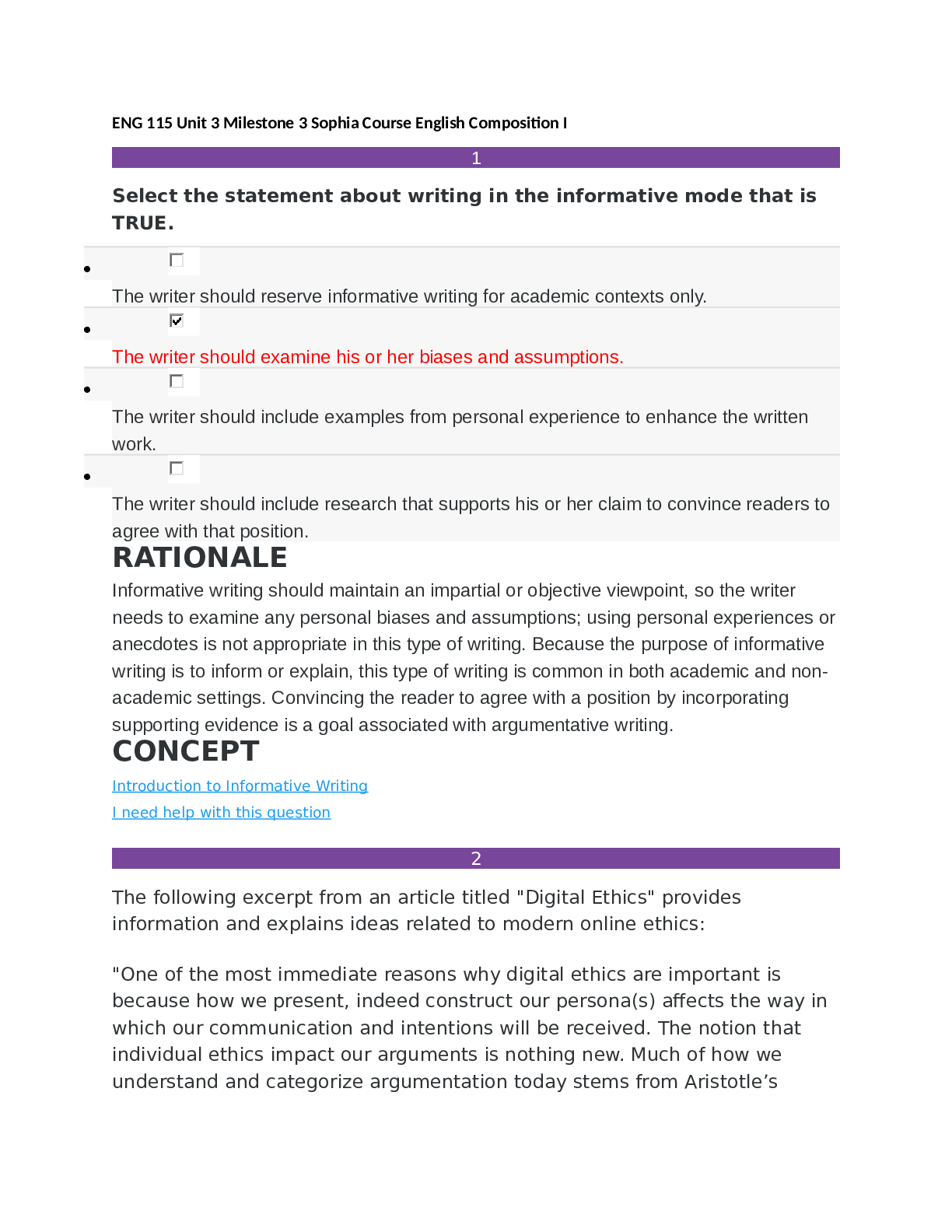
ENG 115 Unit 3 Milestone 3 Sophia Course English Composition I
1
Select the statement about writing in the informative mode that is
TRUE.
The writer should reserve informative writing for academic contexts only.
The writer should examine his or her biases and assumptions.
The writer should include examples from personal experience to enhance the written
work.
The writer should include research that supports his or her claim to convince readers to
agree with that position.
RATIONALE
Informative writing should maintain an impartial or objective viewpoint, so the writer
needs to examine any personal biases and assumptions; using personal experiences or
anecdotes is not appropriate in this type of writing. Because the purpose of informative
writing is to inform or explain, this type of writing is common in both academic and nonacademic settings. Convincing the reader to agree with a position by incorporating
supporting evidence is a goal associated with argumentative writing.
CONCEPT
Introduction to Informative Writing
I need help with this question
2
The following excerpt from an article titled "Digital Ethics" provides
information and explains ideas related to modern online ethics:
"One of the most immediate reasons why digital ethics are important is
because how we present, indeed construct our persona(s) affects the way in
which our communication and intentions will be received. The notion that
individual ethics impact our arguments is nothing new. Much of how we
understand and categorize argumentation today stems from Aristotle’s
“appeals," which are generally understood as the means of persuasion —
how we support our arguments for specific audiences."
From which type of informative essay has this excerpt been taken?
How do you know?
Analysis, because it analyzes Aristotle's "appeals"
Analysis, because it discusses how to break down an argument
Definition, because it redefines the term "ethics" in a digital context
Definition, because it provides the dictionary definition of "digital ethics"
RATIONALE
This excerpt is taken from a definition essay because it explores an alternate definition
of a word or phrase (in this instance, "ethics"), as opposed to simply explaining the
established definition. The writer explains that although the concept of ethics is not new,
the way in which it applies to the digital world is.
The writer mentions Aristotle's "appeals," but they are not analyzed in depth, or used to
break down an argument; therefore, this is not an analytical essay.
CONCEPT
Model Informative Essays
I need help with this question
3
Zora Neale Hurston s novel Their Eyes were Watching God is rich in imagery
and a sense of place and time. Hurston perfectly captures the cadence of
black Southern dialect and leads the reader to understand the raw power of
language. Janie is a woman struggling to find her voice and by novel's end,
she has succeeded--through pain and loss and suffering--in defining herself
and knowing her place in the world.
Select the word that best describes the tone of the paragraph.
informal
tragic
positive
humorous
RATIONALE
Remember that tone is the writer's attitude toward the subject, as conveyed through a
piece of writing. The paragraph reads like a scholarly book review, so the tone is not
informal or humorous. A tragic tone would use negatively charged language, which this
piece does not. In fact, the writer uses phrases like "rich in imagery" and "succeeded--
through pain and loss and suffering--in defining herself," indicating a positive view of the
novel.
CONCEPT
Tone and Personal Style
I need help with this question
4
When writing in the informative mode, all of the following actions
are unethical EXCEPT __________.
[Show More]