1. A nurse is caring for a client who has uterine atony and
is experiencing postpartum hemorrhage. Which of the
following actions is the nurse’s priority?
• Massage the client’s fundus
Uterine atony and postpartum hm
...
1. A nurse is caring for a client who has uterine atony and
is experiencing postpartum hemorrhage. Which of the
following actions is the nurse’s priority?
• Massage the client’s fundus
Uterine atony and postpartum hmorrhage indicate
that this
client is at the greatest risk for hypovolemic shock.
This can compromise the client’s vital organs, which
can lead to death. Therefore, the nurse’s priority is
to massage the client’s fundus to minimize blood
loss.
2. A nurse is caring for a client who is to receive oxytocin to
augment her labor. Which of the following findings
contraindicates the initiation of the oxytocin infusion and
should be reported to the provider?
• Late decelerations
Late decelerations are indicative of uteroplacental
insufficiency. Therefore, this is a contraindication
for the administration of oxytocin and should be
reported to the provider.
3. A nurse is assessing a client who has severe
preeclampsia. Which of the following manifestations should
the nurse expect?
• Blurred vision
The nurse should identify that a client who has
severe
preeclampsia can have arteriolar vasospasms and
decreased blood flow to the retina which can lead to
visual disturbances, such as blurred vision, double
vision, or dark spots in the visual field.
4. A nurse is assessing a client who is 1 day-postpartum
and has a vaginal hematoma. Which of the following
manifestation should the nurse expect?
• Vaginal pressure
• The nurse should expect a client who has a
vaginal hematoma to report pressure in the
vagina due to the
blood that leaked into the tissues.
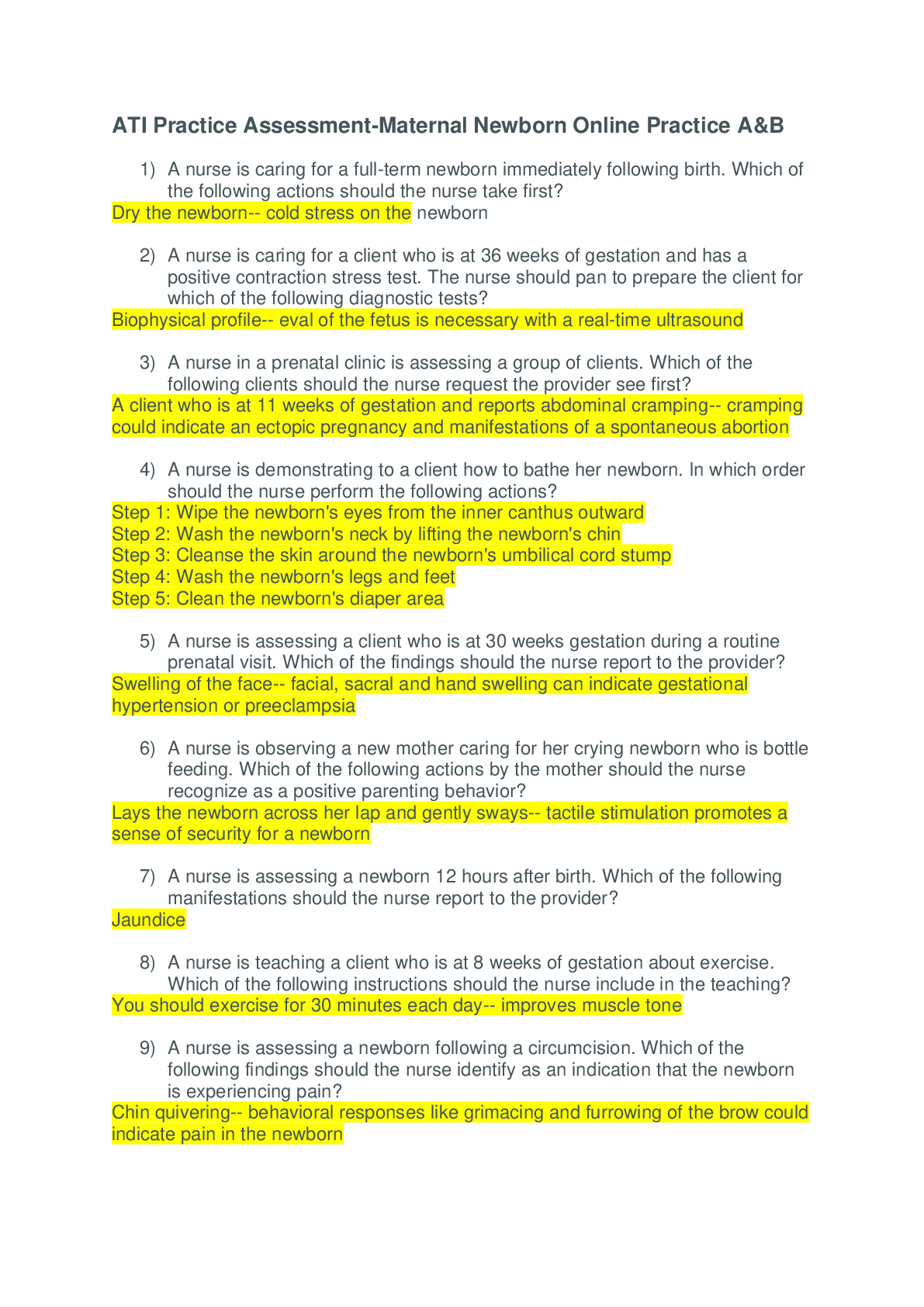
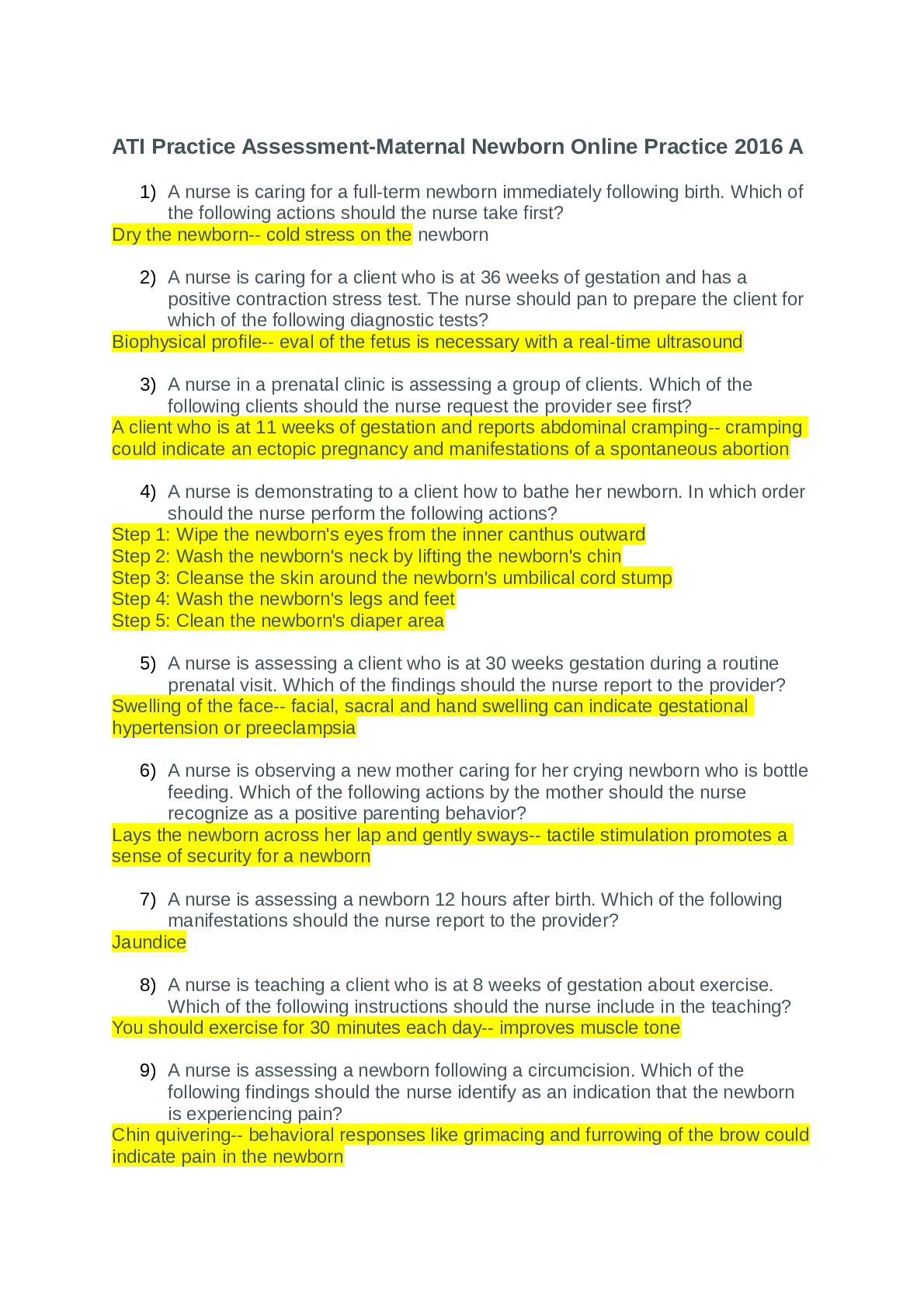
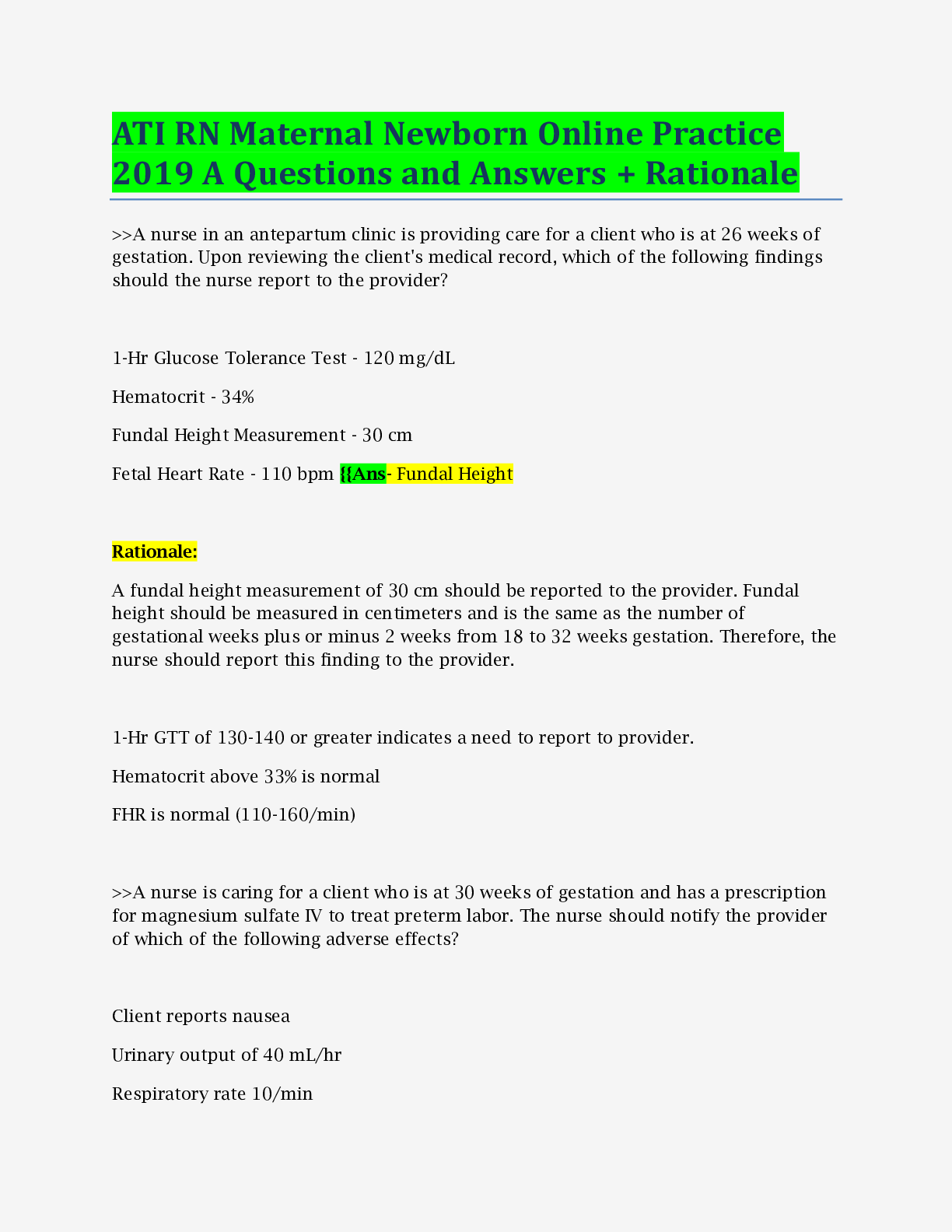
5. A nurse is caring for a client who is at 36 weeks of
gestation and has a positive contraction stress test. The
nurse should plan to prepare the client for which of the
following diagnostic tests?
This study source was downloaded by 100000831988016 from CourseHero.com on 02-09-2022 13:50:37 GMT -06:00
https://www.coursehero.com/file/94390210/ATI-RN-Maternal-Newborn-Online-Practice-2019-Adocx/
• Biophysical profile
• A positive contraction stress test indicates that
further evaluation of the fetus is necessary. A
biophysical profile
will provide further evaluation with a real-time
ultrasound.
This study source was downloaded by 100000831988016 from CourseHero.com on 02-09-2022 13:50:37 GMT -06:00
https://www.coursehero.com/file/94390210/ATI-RN-Maternal-Newborn-Online-Practice-2019-Adocx/
6. A nurse is providing teaching for a client who has a new
prescription for combined oral contraceptives. Which of
the following findings should the nurse include as an
adverse effect of this medication?
• Depression
• The nurse should instruct the client that depression
is a common adverse effect of combined oral
contraceptives.
Other common adverse effects of the medication
include amenorrhea, weight gain, headache,
nausea, breatkthrough bleeding, and breast
tenderness.
7. A nurse is caring for a postpartum client who is receiving
heparin via a continuous IV infusion for thrombophlebitis in
her left calf. Which of the following actions should the
nurse take?
• Maintain the client on bed rest
• The client should remain on bed rest to decrease the
risk of dislodging the clot, which could cause a
pulmonary
emoblism. Elevation of the affected leg is
recommended.
8. A nurse is providing teaching to a client who is at 40
weeks of gestation and has a new prescription for
misoprostol. Which of the following instructions should
the nurse include in the teaching?
• “I can administer oxytocin 4 hours after the insertion
of the medication.”
• The nurse can administer oxytocin no sooner
than 4 hr after the last dose of misoprostol.
Oxytocin can be administered following
misoprostol for clients who have
cervical ripening and have not begun labor.
[Show More]