HSM 410 Final Exam
Score for this quiz: 150 out of 200
This attempt took 44 minutes.
Question 1
10 / 10 pts
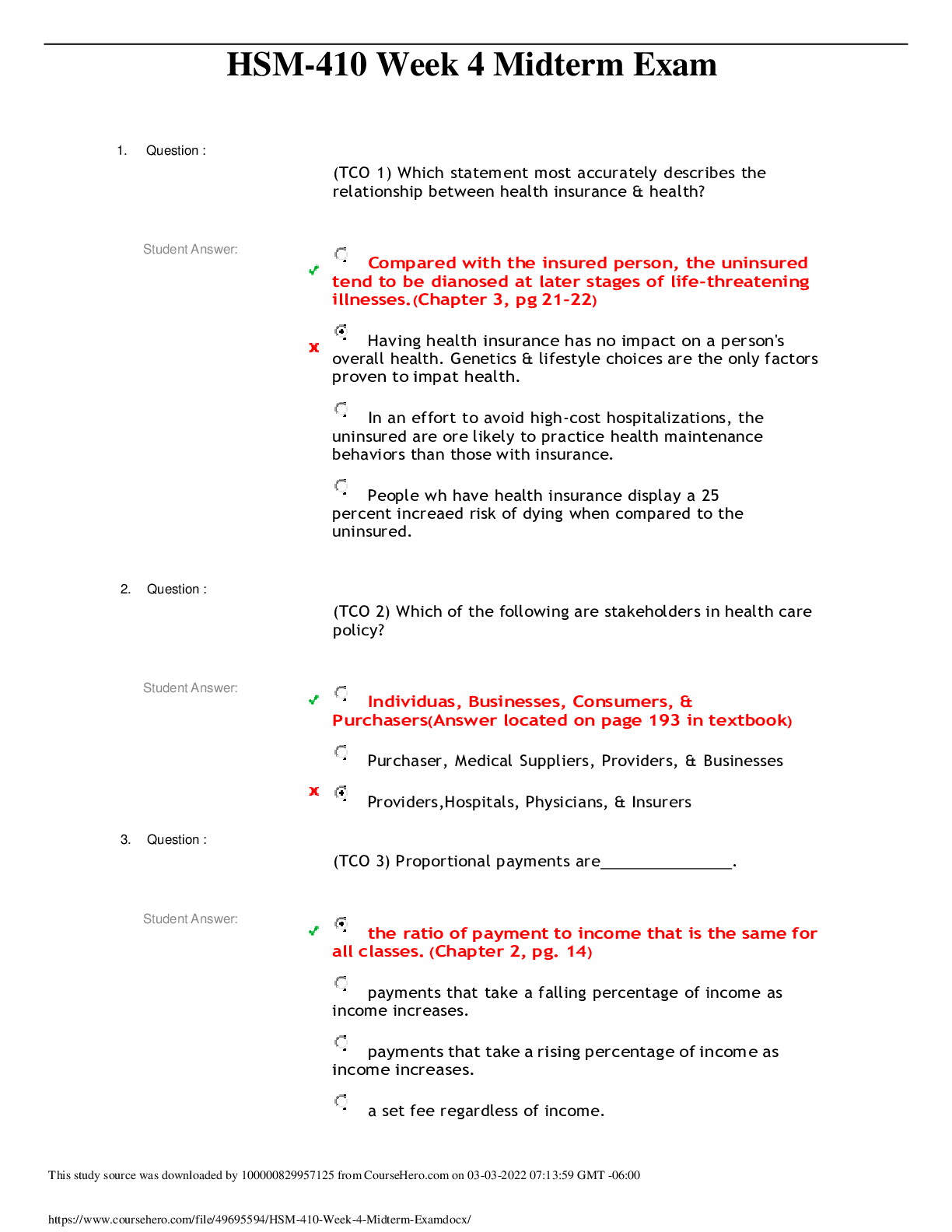
(CO 1) Which statement most accurately describes the relationship between health insurance and health?
...
HSM 410 Final Exam
Score for this quiz: 150 out of 200
This attempt took 44 minutes.
Question 1
10 / 10 pts
(CO 1) Which statement most accurately describes the relationship between health insurance and health?
Correct!
Compared with the insured person, the uninsured tend to be diagnosed at later stages of life-threatening illnesses.
Having health insurance has no impact on a person's overall health. Genetics and lifestyle choices are the only factors proven to impact health.
In an effort to avoid high-cost hospitalizations, the uninsured are more likely to practice health- maintenance behaviors than those with insurance.
People who have health insurance display a 25% increased risk of dying when compared to the uninsured.
Question 2
10 / 10 pts
(CO 1) What do the health systems of Japan, Germany, Canada, and the United Kingdom have in common?
All provide health insurance though an employment-based, private insurance system.
All provide government-financed healthcare systems.
Correct!
All provide universal healthcare coverage to their citizens.
All provide sickness finds for their citizens.
Question 3
10 / 10 pts
(CO 3) Progressive payments are .
the ratio of payment to income that is the same for all classes.
payments that take a falling percentage of income as income increases.
Correct!
payments that take a rising percentage of income as income increases.
a set fee regardless of income.
Question 4
10 / 10 pts
(CO 2) Fee-for-service reimbursement is different than the other units of payment for healthcare. This statement is:
Correct!
true because all other forms of reimbursement group together several services into one payment.
true because it is the oldest and simplest form of reimbursement for care provided.
false because the Medicare/Medicaid systems reimburse healthcare providers in the same method as fee for service.
false because the per diem payment to hospitals method pays for services on an "as-needed" basis.
Question 5
10 / 10 pts
(CO 4) What are non-financial barriers to healthcare?
Language, lack of insurance coverage, availability of services
Correct!
Literacy, culture, factors of gender and race
Transportation, language, employment
Inability to access care, culture, insurance coverage
Question 6
10 / 10 pts
(CO 2) In the 1990s, the push for cost containment changed how physicians and hospitals are paid. The changes:
replaced fee-for-service payments with prospective payment methods.
bundled services into one payment to shift risk away from payers.
had payment be negotiated between providers and payers.
Correct!
All of the above
Question 7
10 / 10 pts
(CO 3) Proportional payments are:
Correct!
the ratio of payment to income that is the same for all classes.
payments that take a falling percentage of income as income increases.
payments that take a rising percentage of income as income increases.
a set fee regardless of income.
Question 8
10 / 10 pts
(CO 4) The uninsured are less likely to:
obtain needed healthcare.
have low incomes.
afford medications.
Correct!
A and C
Question 9
10 / 10 pts
(CO 3) Which of the following is an effective cost control mechanism?
Raising physician fees
Correct!
Capitation payments
Patient cost sharing
Risk transfer
Question 10
0 / 10 pts
(CO 2) The 1990s introduced to healthcare the concept of cost containment. Which statement best outlines the goal of healthcare cost reform?
Correct Answer
One of the challenges in designing an optimal payment system is striking the right balance between economic incentives for "overtreatment" and "undertreatment" of patients.
Simply limiting the amount of money paid for expenses related to the diagnosis and treatment of illness has been working for the past 20 years. If the outpouring of funds can be slowed, the quality of care will increase.
The bundling of services into one payment tends to shift financial risk away from physicians and hospitals toward payers.
You Answered
All of the above
Chapter 4, pg. 40
Question 11
10 / 10 pts
(CO 5) Nursing home care is typically paid for by:
Correct!
Medicare part A
Medicare part B
Medicare part D
All of the above
Question 12
0 / 10 pts
(CO 7) Which of the following is not a category of national health insurance plans?
Government-financed health insurance
Employer-mandated private health insurance
Correct Answer
Individual-mandated public health insurance plans
You Answered
Hybrid plans
Chapter 15, pg. 184
Question 13
0 / 10 pts
(CO 6) Which of the following is not a strategy of prevention?
You Answered
Improvement in the standard of living and social equity
Public health interventions
Correct Answer
Promotion of diagnostic testing
Preventative medical care
Chapter 11, pg. 129
Question 14
10 / 10 pts
(CO 6) Nonmaleficence means:
obligation of healthcare providers to help people in need.
Correct!
duty of healthcare providers to do no harm.
rights of patients to make choices about their healthcare.
treat everyone in a fair manner.
Question 15
10 / 10 pts
(CO 6) Which of the following terms means trating everyone in a fair manner?
autonomy
Correct!
justice
beneficence
nonmaleficence
Question 16
10 / 10 pts
(CO 1) Which of the followings best explains the paradox of excess and deprivation
too much technology but not much healthcare
people in the United States are always able to access healthcare
Correct!
some people receive too little care and some others receive too much healthcare
although people have health insurance, they receive too little healthcare
Question 17
10 / 10 pts
(CO 4) What is a category of underinsurance?
Limits to insurance coverage
Gaps in Medicare coverage
Lack of coverage for long-term care services
Correct!
All of the above
Question 18
0 / 10 pts
(CO 2) The 1990s introduced to healthcare the concept of cost containment. Which statement best outlines the goal of healthcare cost reform?
Correct Answer
One of the challenges in designing an optimal payment system is striking the right balance between economic incentives for "overtreatment" and "undertreatment" of patients.
Simply limiting the amount of money paid for expenses related to the diagnosis and treatment of illness has been working for the past 20 years. If the outpouring of funds can be slowed, the quality of care will increase.
The bundling of services into one payment tends to shift financial risk away from physicians and hospitals toward payers.
You Answered
All of the above
Chapter 4, pg. 40
Question 19
10 / 10 pts
(CO 3) Which of the following are modes of paying for healthcare?
Capitation, fee-for-service, and salary
Correct!
Out-of-pocket payments, individual private insurance, employment-based private insurance, and government financing
Private insurance and government financing
Medicare, Medicaid, private insurance
Question 20
0 / 10 pts
(CO 7) Which of the following is a main component of the Affordable Care Act of 2010?
Correct Answer
Individual manadate
Medicare mandate
You Answered
Medicad mandate
All of the above
Chapter 15
Quiz Score: 150 out of 200 Previous
Submission Details:
Time: 44 minutes
Current Score: 150 out of 200
Kept Score: 150 out of 200
[Show More]