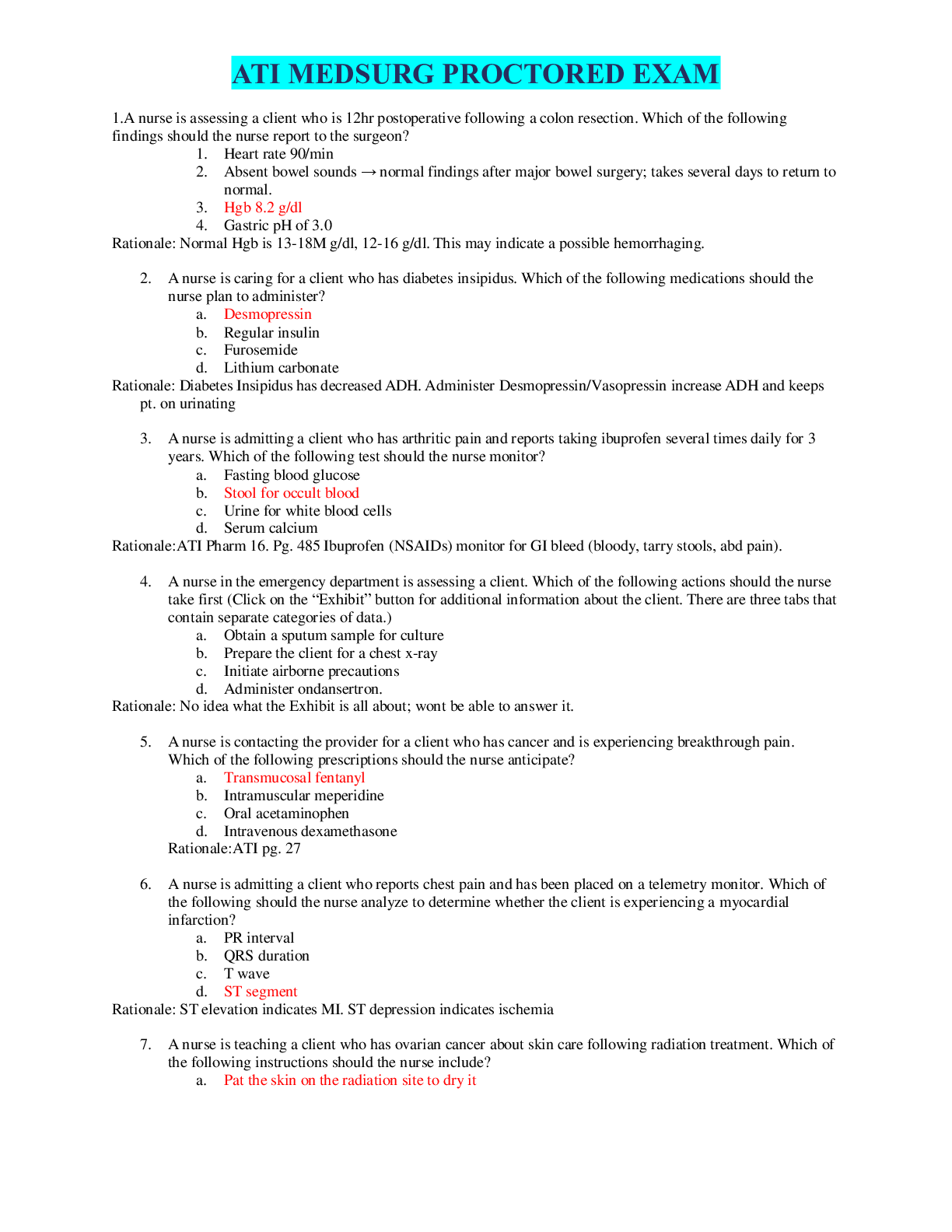
ATI MEDSURG PROCTORED EXAM 1 2019 STUDY GUIDE
*Make sure that you understand all of the terms you are studying, if you don’t know what a term means, look it up before you continue studying. Take your thinking a step fur
...
ATI MEDSURG PROCTORED EXAM 1 2019 STUDY GUIDE
*Make sure that you understand all of the terms you are studying, if you don’t know what a term means, look it up before you continue studying. Take your thinking a step further by asking yourself “why” as you are reviewing material you are studying. This will lead to understanding of the material versus memorization which will better help you answer application questions. Remember, this study guide does not mirror the exam and you are responsible for all course content; ensure that you have an understanding of concepts. That being said, if you complete and understand this study guide, you will be well prepared for the next exam.
Chapter 17: Fluid, Electrolyte, and Acid-Base Imbalances
1.What are possible causes of hypervolemia?
Excessive intake of fluids, abnormal retention of fluids (heart failure, renal failure), SIADH,
Cushing’s.
2.What are the clinical manifestations of hypervolemia?
Increased BP, bounding pulse Edema
HA
Polyuria
Crackles, dyspnea
3.What are remarks that a patient might say if they are experiencing fluid volume overload?
4.What are the vital signs changes you’ll see with hypervolemia?
BP, pulse, JVD distention, LOC
5.What are specific nursing assessments to assess for hypervolemia?
24-hour intake and output, assess cardio changes, Resp changes, LOC, PEERLA, daily weights,
skin.
6.What is the treatment for these patients? Diet, fluid/sodium restriction, fluids, diuretics
oWhat are the different types of diuretics? Loop diuretics: Furosemide – Lasix Thiazides: Hydrochlorothiazide
Potassium sparing: Spiro lactone Quinzoline: metolazone
oHow would you educate your patient with each type?
Loop diuretics cause the kidneys to increase flow of urine. This helps reduce the amount
of water in your body and lower your blood pressure. Take this med in the morning. Thiazides reduce the amount of sodium and water in the body. Thiazides are the only
type of diuretic that dilates (widens) the blood vessels, which also helps to lower blood pressure.
[Show More]
 (1).png)








.png)
.png)
.png)

.png)

