Lisa is considering whether it is morally permissible to eat meat.
Which branch of philosophy can help her answer this question?
Ethics
Metaphysics
Cosmology
Epistemology
RATIONALE
Ethics is the branch
...
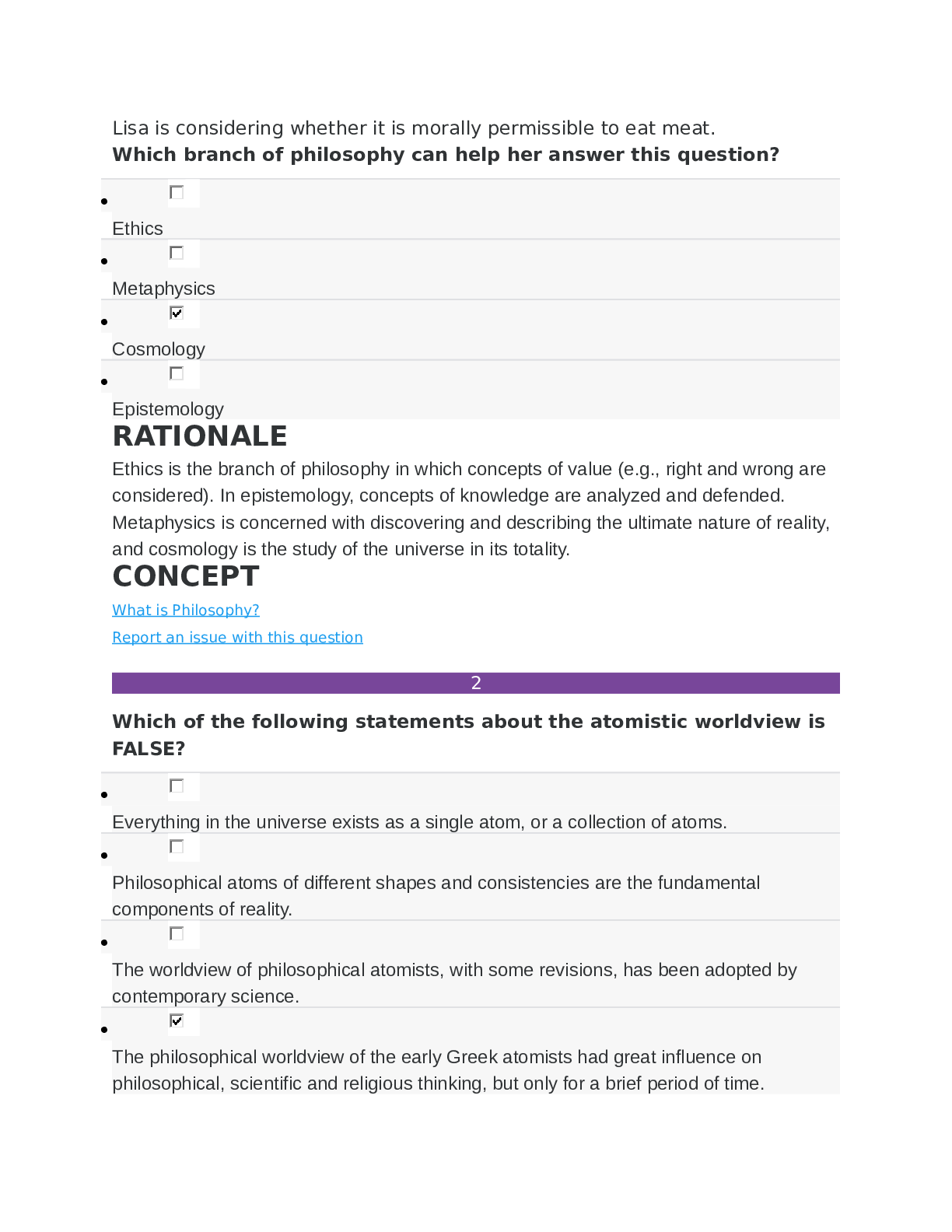
Lisa is considering whether it is morally permissible to eat meat.
Which branch of philosophy can help her answer this question?
Ethics
Metaphysics
Cosmology
Epistemology
RATIONALE
Ethics is the branch of philosophy in which concepts of value (e.g., right and wrong are
considered). In epistemology, concepts of knowledge are analyzed and defended.
Metaphysics is concerned with discovering and describing the ultimate nature of reality,
and cosmology is the study of the universe in its totality.
CONCEPT
What is Philosophy?
Report an issue with this question
2
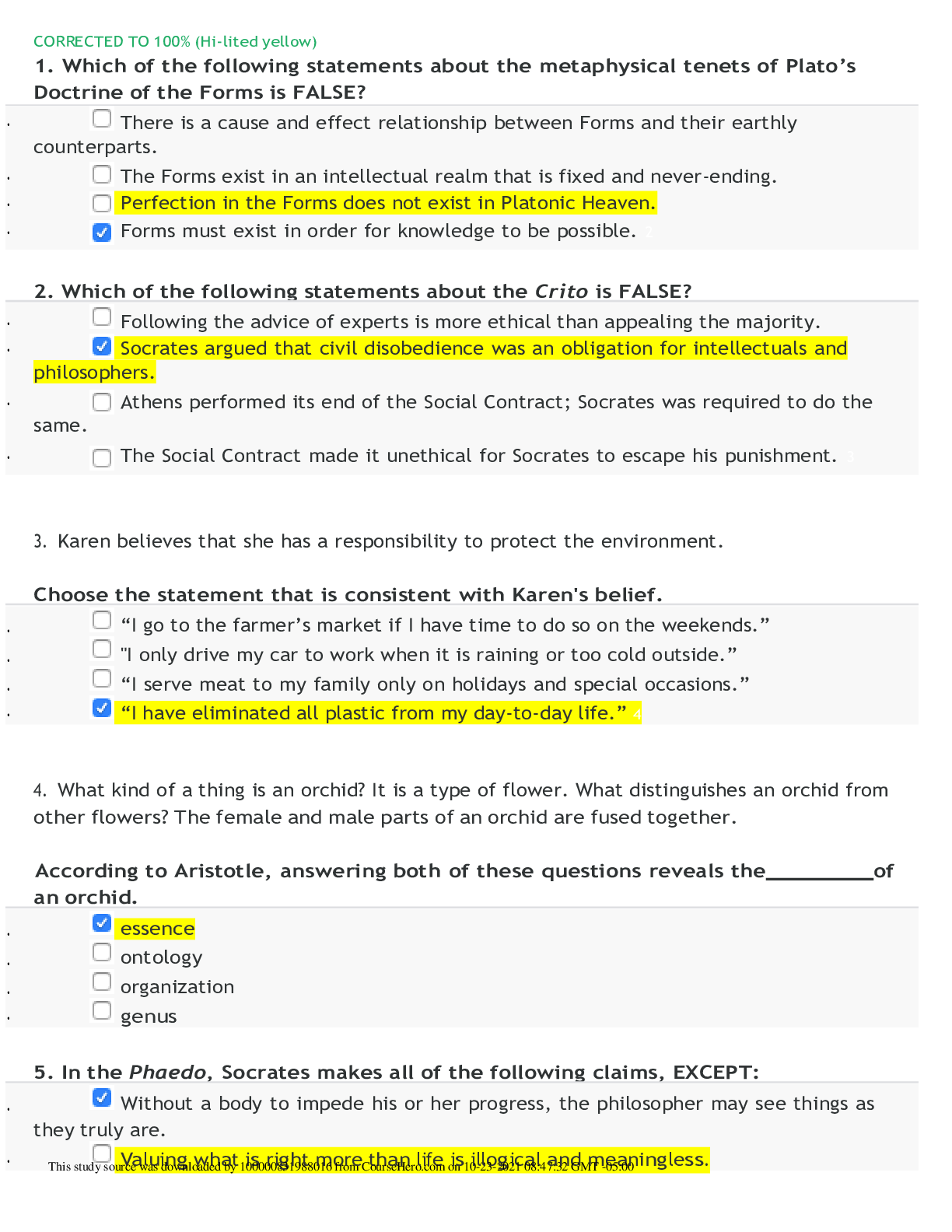
Which of the following statements about the atomistic worldview is
FALSE?
Everything in the universe exists as a single atom, or a collection of atoms.
Philosophical atoms of different shapes and consistencies are the fundamental
components of reality.
The worldview of philosophical atomists, with some revisions, has been adopted by
contemporary science.
The philosophical worldview of the early Greek atomists had great influence on
philosophical, scientific and religious thinking, but only for a brief period of time.
RATIONALE
The philosophical worldview of the early Greek atomists has continued to have an
impact throughout history. Atomism has been adopted and modified by contemporary
science, and has had a lasting influence on religion and theology.
CONCEPT
The Atomistic Worldview
Report an issue with this question
3
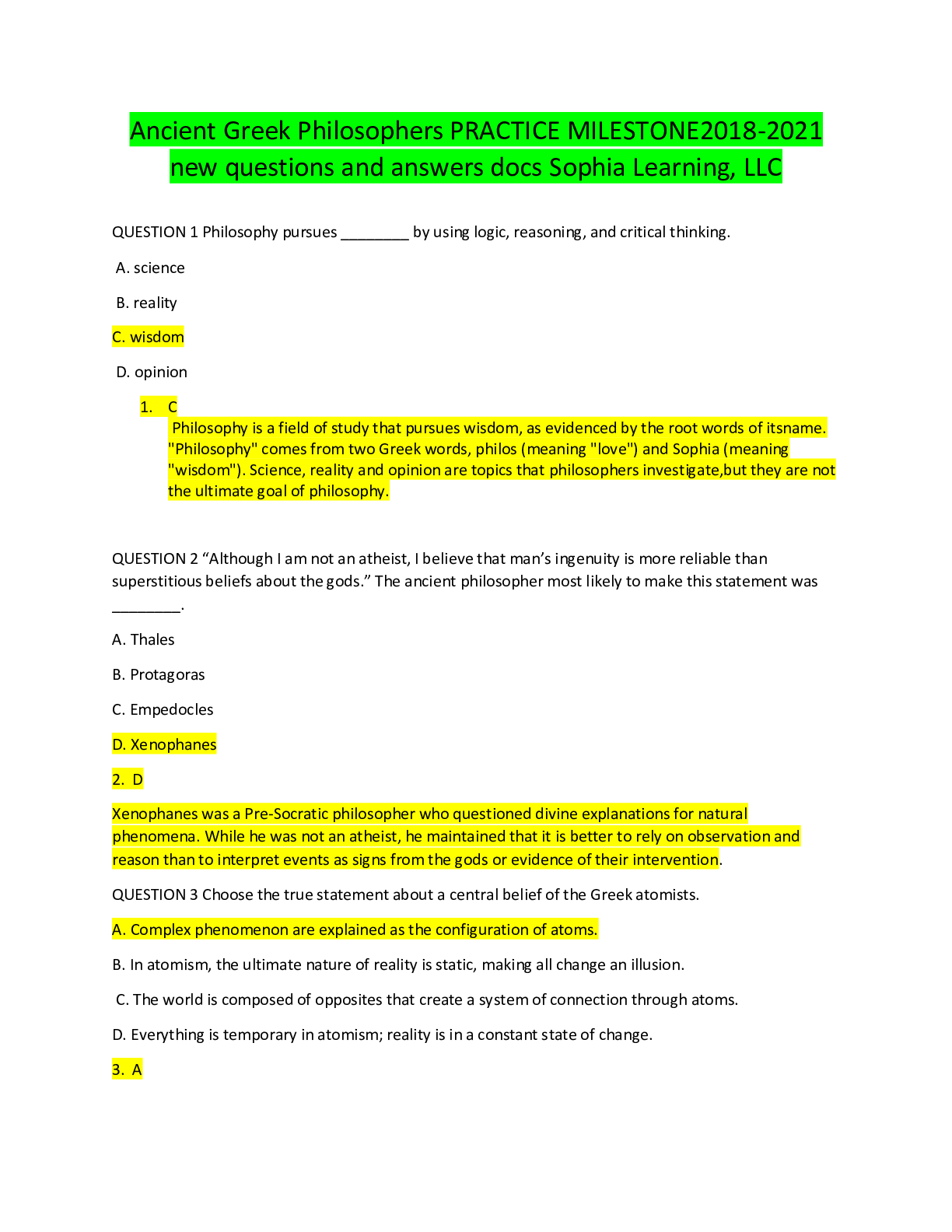
When Crito tries to convince Socrates that he must not betray his
own life, how does Socrates respond?
He says that all life has value, but society determines the fate of man.
He says that what is right is often misunderstood by mortals and must be left to the
gods.
He says that he is not afraid of dying and knows that his followers will restore his good
name.
He says that life would not be worth living if the principle of justice was violated.
RATIONALE
In the Crito, Socrates' friend (Crito) tried to convince him to escape and avoid execution.
Socrates refused to do so, and explained why escape would be wrong. Socrates
asserted that not all life has intrinsic value; only the good life does. Since he believed
that he would violate the principle of justice (established by the Social Contract) by
avoiding death, Socrates refused to avoid it.
CONCEPT
The Crito: The Duties of the Social Contract
Report an issue with this question
4
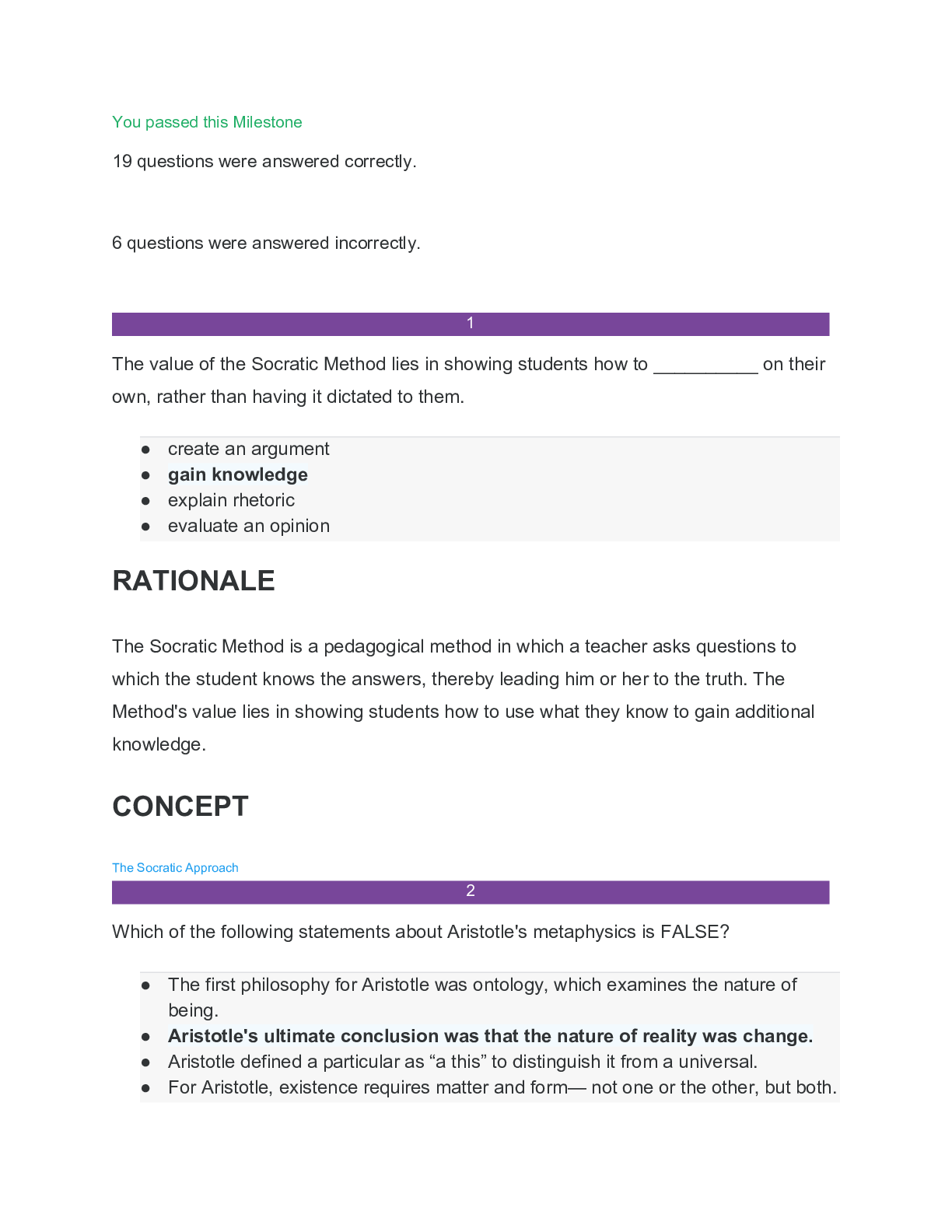
In the Apology, Socrates states that a good person does what he
knows to be right despite __________.
negative personal consequences
the laws of man
the wisdom of the gods
risking fame and fortune
RATIONALE
The Apology is Plato's transcription of the defense Socrates presented at his trial on
charges of "denying the gods" and "corrupting the youth of Athens." In it, Socrates
asserts that he does not fear death, because he has lived as he believed was right. To
Socrates, it is more important to live rightly than to avoid death and other negative
personal consequences
[Show More]