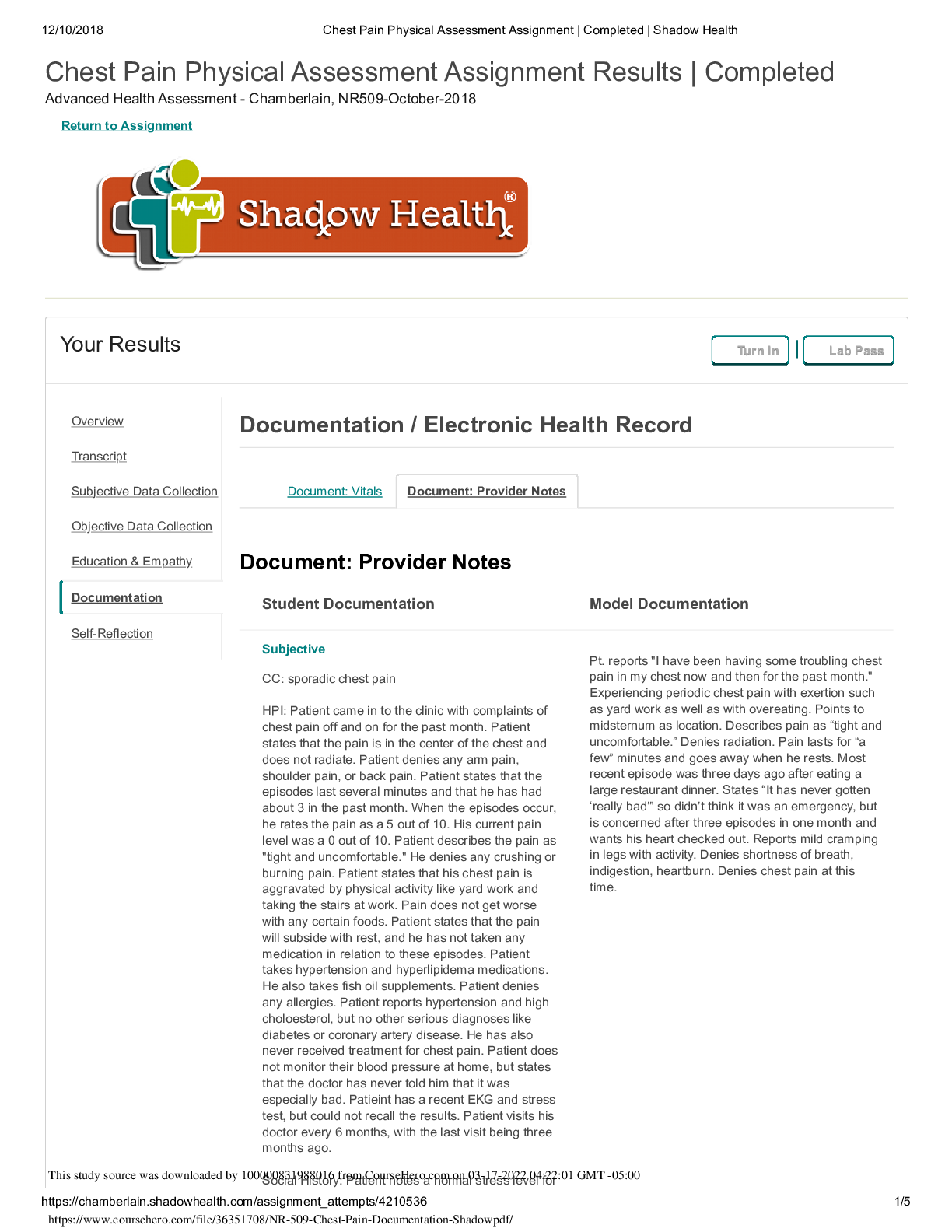
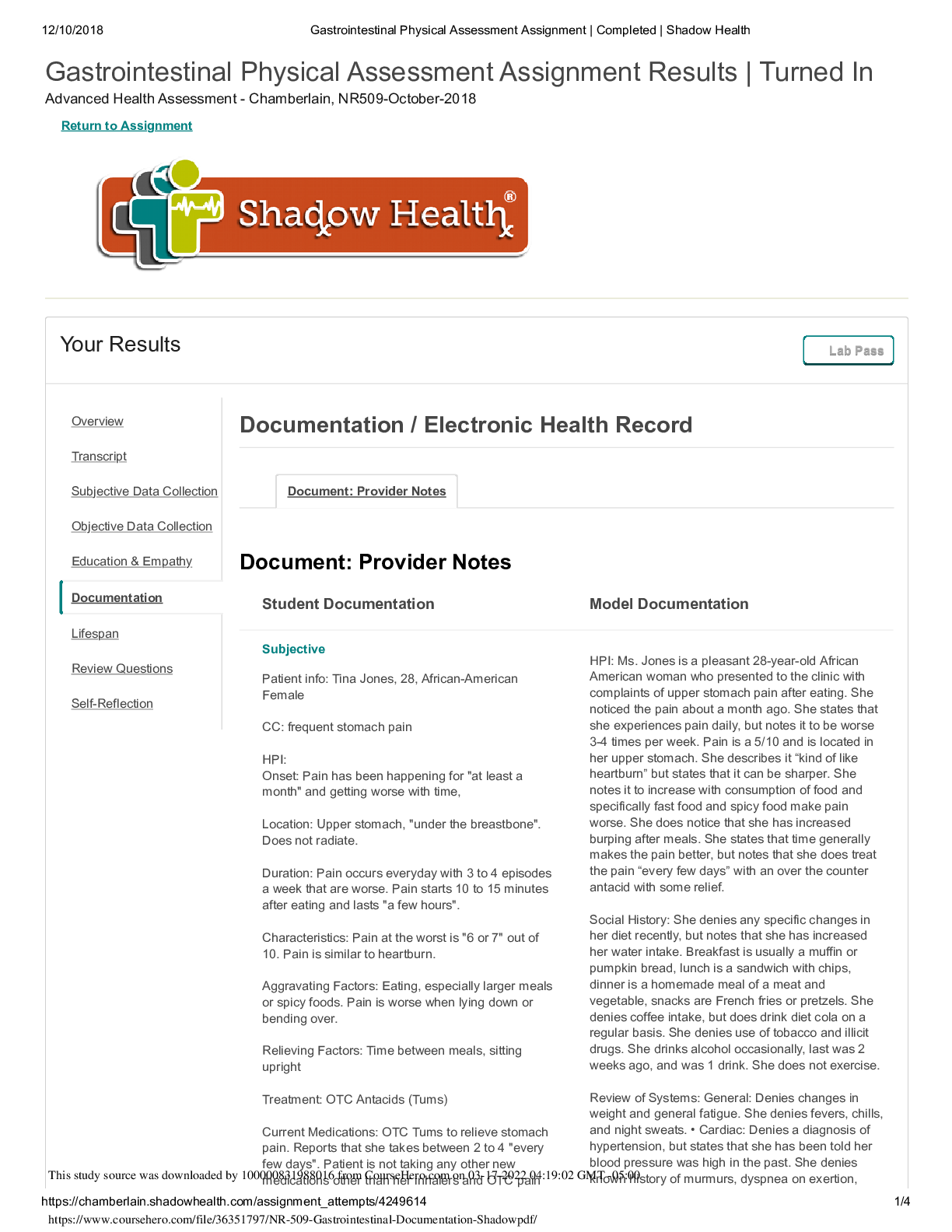
Each relevant diagnosis is scored on a four-point scale:
Priority (1 point): the correct priority of the diagnosis was chosen
Evidence (up to 2 points): the strength of the patient cue(s) selected as evidence for t
...
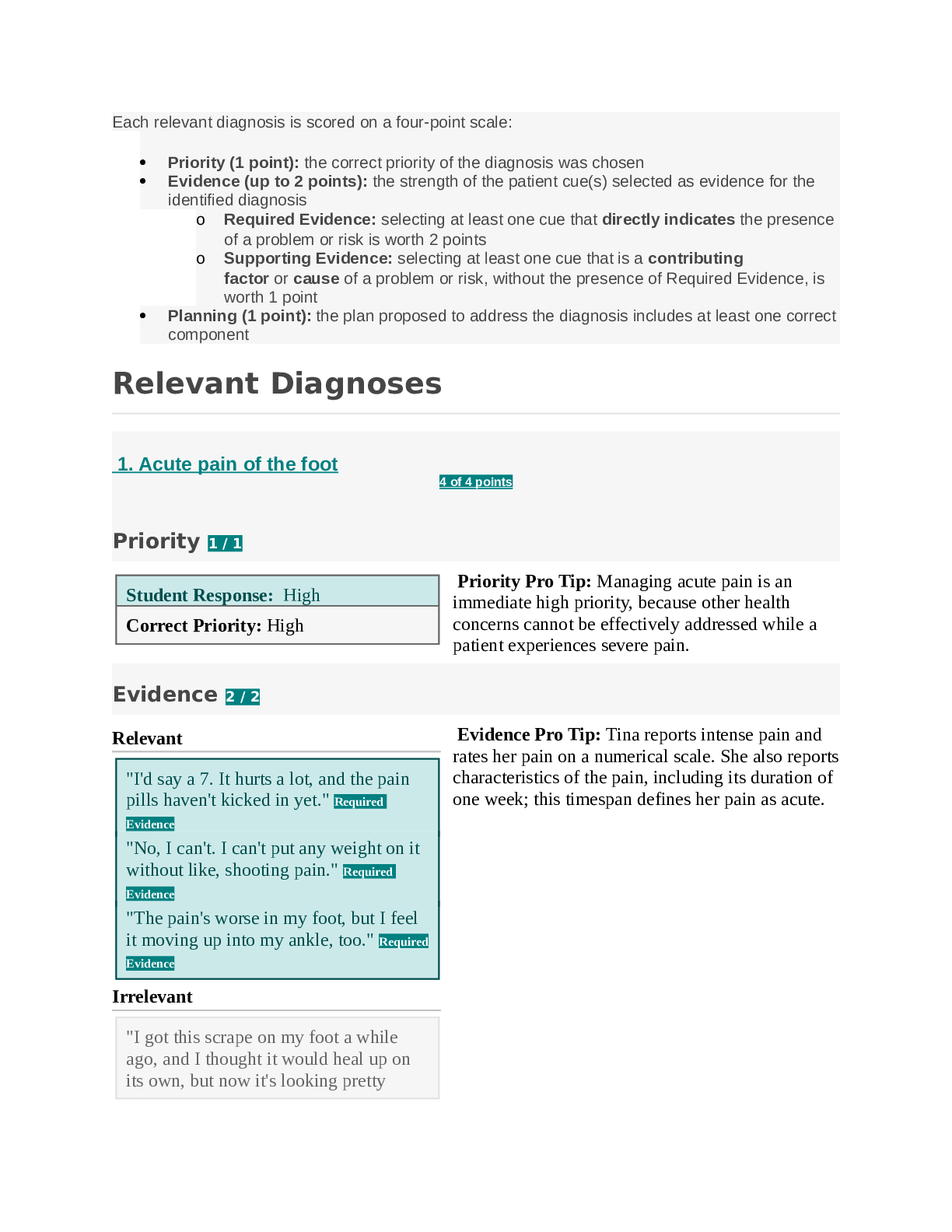
Each relevant diagnosis is scored on a four-point scale:
Priority (1 point): the correct priority of the diagnosis was chosen
Evidence (up to 2 points): the strength of the patient cue(s) selected as evidence for the
identified diagnosis
o Required Evidence: selecting at least one cue that directly indicates the presence
of a problem or risk is worth 2 points
o Supporting Evidence: selecting at least one cue that is a contributing
factor or cause of a problem or risk, without the presence of Required Evidence, is
worth 1 point
Planning (1 point): the plan proposed to address the diagnosis includes at least one correct
component
Relevant Diagnoses
1. Acute pain of the foot
4 of 4 points
Priority 1 / 1
Student Response: High
Correct Priority: High
Priority Pro Tip: Managing acute pain is an
immediate high priority, because other health
concerns cannot be effectively addressed while a
patient experiences severe pain.
Evidence 2 / 2
Relevant
"I'd say a 7. It hurts a lot, and the pain
pills haven't kicked in yet." Required
Evidence
"No, I can't. I can't put any weight on it
without like, shooting pain." Required
Evidence
"The pain's worse in my foot, but I feel
it moving up into my ankle, too." Required
Evidence
Irrelevant
"I got this scrape on my foot a while
ago, and I thought it would heal up on
its own, but now it's looking pretty
Evidence Pro Tip: Tina reports intense pain and
rates her pain on a numerical scale. She also reports
characteristics of the pain, including its duration of
one week; this timespan defines her pain as acute.
nasty. And the pain is killing me!"
"Lately, just the tramadol...and I used
my inhaler a few days ago."
Planning 1 / 1
Relevant
Intervene - Prescribe: Prescribe
medications to treat pain.
Educate - Medication: Educate the
patient on medications used for pain
relief.
Educate - Medication: Educate the
patient on non-pharmaceutical methods
to reduce pain intensity.
Irrelevant
Assess - Integumentary: Assess wound
parameters (size, depth).
Intervene - Labs: Obtain a wound
culture.
Intervene - Prescribe: Prescribe
antibiotics.
Intervene - Other: Clean wound and
cover with sterile dressing.
Educate - Medication: Educate the
patient on the course of antibiotics,
importance of taking all prescribed
antibiotics, and side-effects.
Planning Pro Tip: Intervene to reduce the pain by
prescribing an appropriate analgesic and educating
the patient on its effective use and potential side
effects. Provide the patient with options for nonpharmacological pain relief, such as RICE (rest,
ice, compression, elevation).
2. Local infection of skin and subcutaneous tissue of the foot
4 of 4 points
Priority 1 / 1
Student Response: High
Correct Priority: High
Priority Pro Tip: Treating this infection is a high
priority, as failure to treat the infection may lead to it
spreading to surrounding tissues or systemically.
Treating the infection can prevent adverse events
such as osteomyelitis and bacteremia.
Evidence 2 / 2
Relevant
"Temperature: 101.1 F" Required Evidence
Irrelevant
"Yeah, there's definitely pus."
Evidence Pro Tip: Tina presents with an open
wound on the plantar surface of the foot. The wound
is red, swollen, warm, and produces purulent
discharge. Tina reports that the appearance and level
of discomfort have worsened with time- all of these
factors support a diagnosis of acute infection.
Planning 1 / 1
Relevant
Assess - Integumentary: Assess
wound parameters (size, depth).
Intervene - Labs: Obtain a wound
culture.
Intervene - Labs: Obtain blood for
culture x2 (blood from two sites).
Intervene - Labs: Order a complete
blood count test (CBC).
Intervene - Prescribe: Prescribe
antibiotics.
Intervene - Other: Clean wound and
cover with sterile dressing.
Educate - Medication: Educate the
patient on the course of antibiotics,
importance of taking all prescribed
antibiotics, and side-effects.
Educate - Health
Maintenance: Educate the patient on
wound care procedure.
Educate - Disease Process: Educate
the patient on the role of diabetes
mellitus in the healing of wounds.
Educate - Disease Process: Educate
the patient on the signs and symptoms
of worsening infection.
Irrelevant
Planning Pro Tip: Assess the wound directly and
obtain a culture so that the infectious organism may
be identified, then clean and re-dress the wound.
Regional lymph nodes may be swollen. Because the
infection is the root cause of Tina's other acute issues,
prescribing an anti-infective will begin to resolve the
issues; after receiving culture results, the specific
anti-infective given may be changed. Ensure that
Tina understands how to treat the wound, use the
anti-infective effectively, and to report symptoms of a
worsening infection. Foot care is especially important
for diabetics, so you should help Tina better
understand diabetes' impact on wound healing and
the need to proactively monitor her foot health
[Show More]








.png)