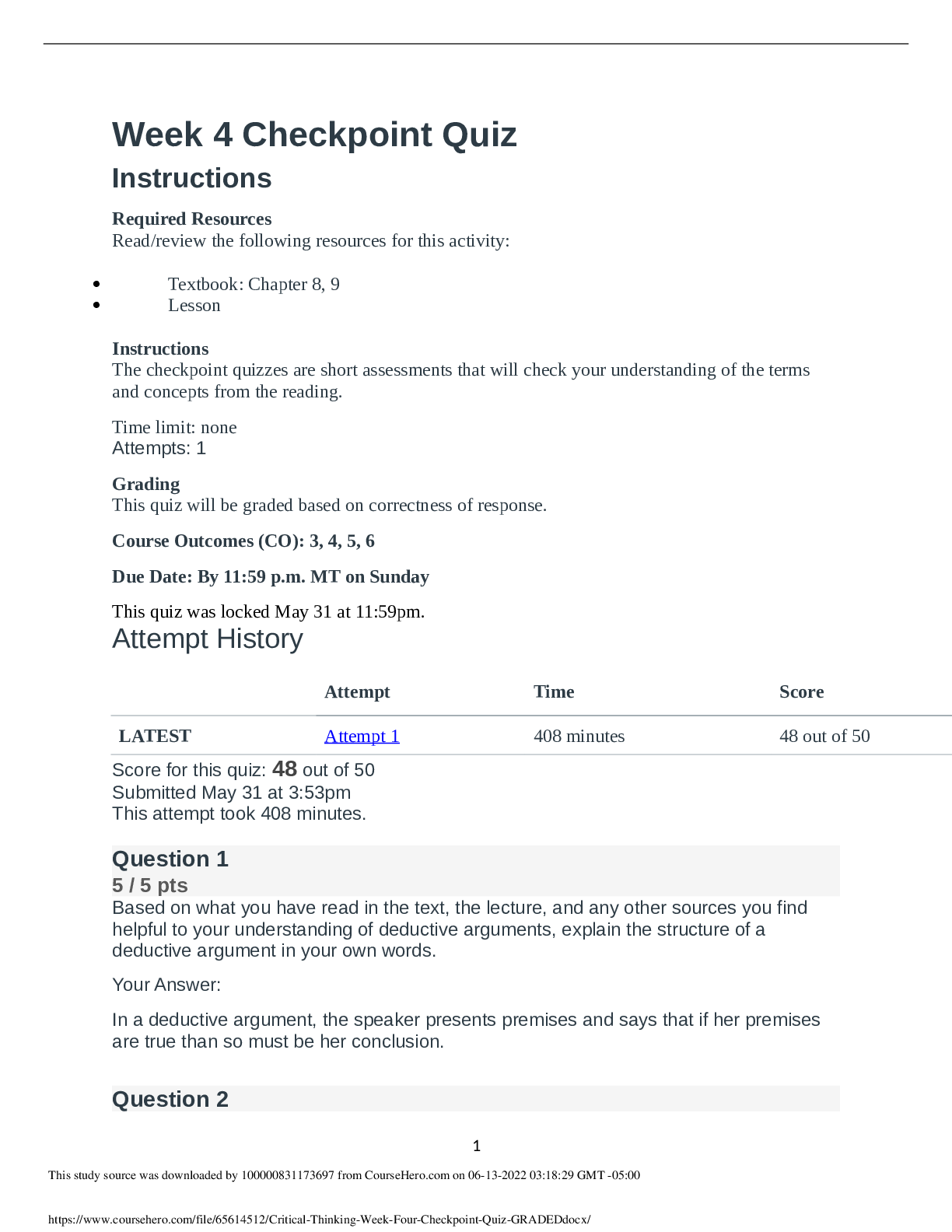
1. According to the text, how do the views of stronger, more developed critical thinkers
toward authority differ from those in earlier stages of cognitive development? (pg. 116-
117)
Our text explains that folks in th
...
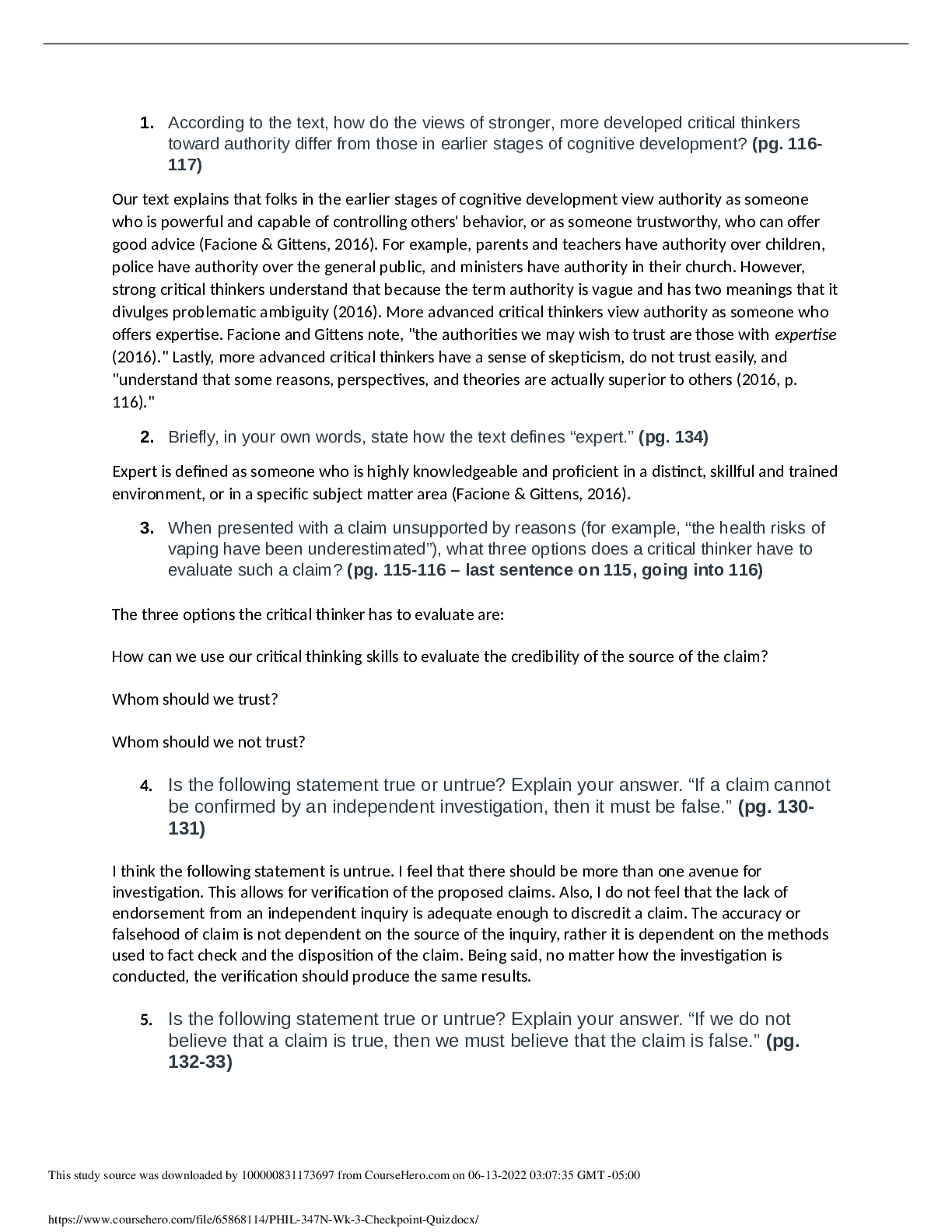
1. According to the text, how do the views of stronger, more developed critical thinkers
toward authority differ from those in earlier stages of cognitive development? (pg. 116-
117)
Our text explains that folks in the earlier stages of cognitive development view authority as someone
who is powerful and capable of controlling others' behavior, or as someone trustworthy, who can offer
good advice (Facione & Gittens, 2016). For example, parents and teachers have authority over children,
police have authority over the general public, and ministers have authority in their church. However,
strong critical thinkers understand that because the term authority is vague and has two meanings that it
divulges problematic ambiguity (2016). More advanced critical thinkers view authority as someone who
offers expertise. Facione and Gittens note, "the authorities we may wish to trust are those with expertise
(2016)." Lastly, more advanced critical thinkers have a sense of skepticism, do not trust easily, and
"understand that some reasons, perspectives, and theories are actually superior to others (2016, p.
116)."
2. Briefly, in your own words, state how the text defines “expert.” (pg. 134)
Expert is defined as someone who is highly knowledgeable and proficient in a distinct, skillful and trained
environment, or in a specific subject matter area (Facione & Gittens, 2016).
3. When presented with a claim unsupported by reasons (for example, “the health risks of
vaping have been underestimated”), what three options does a critical thinker have to
evaluate such a claim? (pg. 115-116 – last sentence on 115, going into 116)
The three options the critical thinker has to evaluate are:
How can we use our critical thinking skills to evaluate the credibility of the source of the claim?
Whom should we trust?
Whom should we not trust?
4. Is the following statement true or untrue? Explain your answer. “If a claim cannot
be confirmed by an independent investigation, then it must be false.” (pg. 130-
131)
I think the following statement is untrue. I feel that there should be more than one avenue for
investigation. This allows for verification of the proposed claims. Also, I do not feel that the lack of
endorsement from an independent inquiry is adequate enough to discredit a claim. The accuracy or
falsehood of claim is not dependent on the source of the inquiry, rather it is dependent on the methods
used to fact check and the disposition of the claim. Being said, no matter how the investigation is
conducted, the verification should produce the same results.
5. Is the following statement true or untrue? Explain your answer. “If we do not
believe that a claim is true, then we must believe that the claim is false.” (pg.
132-33)
This study source was downloaded by 100000831988016 from CourseHero.com on 03-10-2022 12:49:33 GMT -06:00
https://www.coursehero.com/file/65868114/PHIL-347N-Wk-3-Checkpoint-Quizdocx/
I believe the following statement is untrue, because the claim could simply be lacking some supporting
evidence; however, that does not necessarily deem the claim to be false. Personally, I may hear a claim
and not quite feel convinced, or that claim may be dependent on the outcome of an event, making me
skeptical until I can disconfirm the claim (Facione & Gittens, 2016). By doing so, we are also conducting
an independent investigation. For example, my daughter might tell me, on Sunday night, that she is
going to make her bed every morning for the next five days. If she is successful, she feels she deserves a
reward. Though I do not believe her claim is true, because I think she will forget to do it at least once, it
is not untrue, because the claim's veracity is dependent on her performance. Therefore, we can
conclude that some claims have dependent variables, making us skeptical until we disconfirm the claim,
and making the original statement untrue.
[Show More]



![Preview of [eBook] [ORG PDF] (ISE) Critical Thinking A Student´s Introduction 7th Edition By Gregory](https://scholarfriends.com/storage/aHMkzBzA2026-01-03-08-45695955ad3d311.png)
![Preview of [eBook] [EPUB] [PDF] Critical Thinking A Students Introduction 7th Edition By Gregory Bass](https://browseimages.nyc3.digitaloceanspaces.com/paper-images/2025/Sep/27/fdxca2RQ2025-09-27-01-2068d711c62a3de.png)
.png)
.png)