Test Bank
to accompany
Neuroscience, Sixth Edition
Purves • Augustine • Fitzpatrick • Hall • LaMantia • Mooney • Platt • White
Chapter 10: Pain
Multiple Choice
1. Which pathway represents a route that pain informat
...
Test Bank
to accompany
Neuroscience, Sixth Edition
Purves • Augustine • Fitzpatrick • Hall • LaMantia • Mooney • Platt • White
Chapter 10: Pain
Multiple Choice
1. Which pathway represents a route that pain information could take in the nervous
system?
a. Free nerve ending nociceptor, unmyelinated C fiber axon, spinal cord
b. Free nerve ending nociceptor, myelinated C fiber axon, spinal cord
c. Unspecialized, unmyelinated A axon, spinal cord
d. Specialized pain receptor, partially myelinated A axon, brainstem
e. Mechanoreceptor, myelinated axons, cranial nerve, spinal cord
Answer: a
Textbook Reference: Nociceptors
Bloom’s Level: 3. Applying
2. What do nociceptor neurons and non-nociceptor somatosensory neurons have in
common?
a. Unspecialized nerve endings
b. Specialized nerve endings
c. Conduction velocity
d. Highly-myelinated axons
e. Cell body located in the dorsal root ganglia
Answer: e
Textbook Reference: Nociceptors
Bloom’s Level: 3. Applying
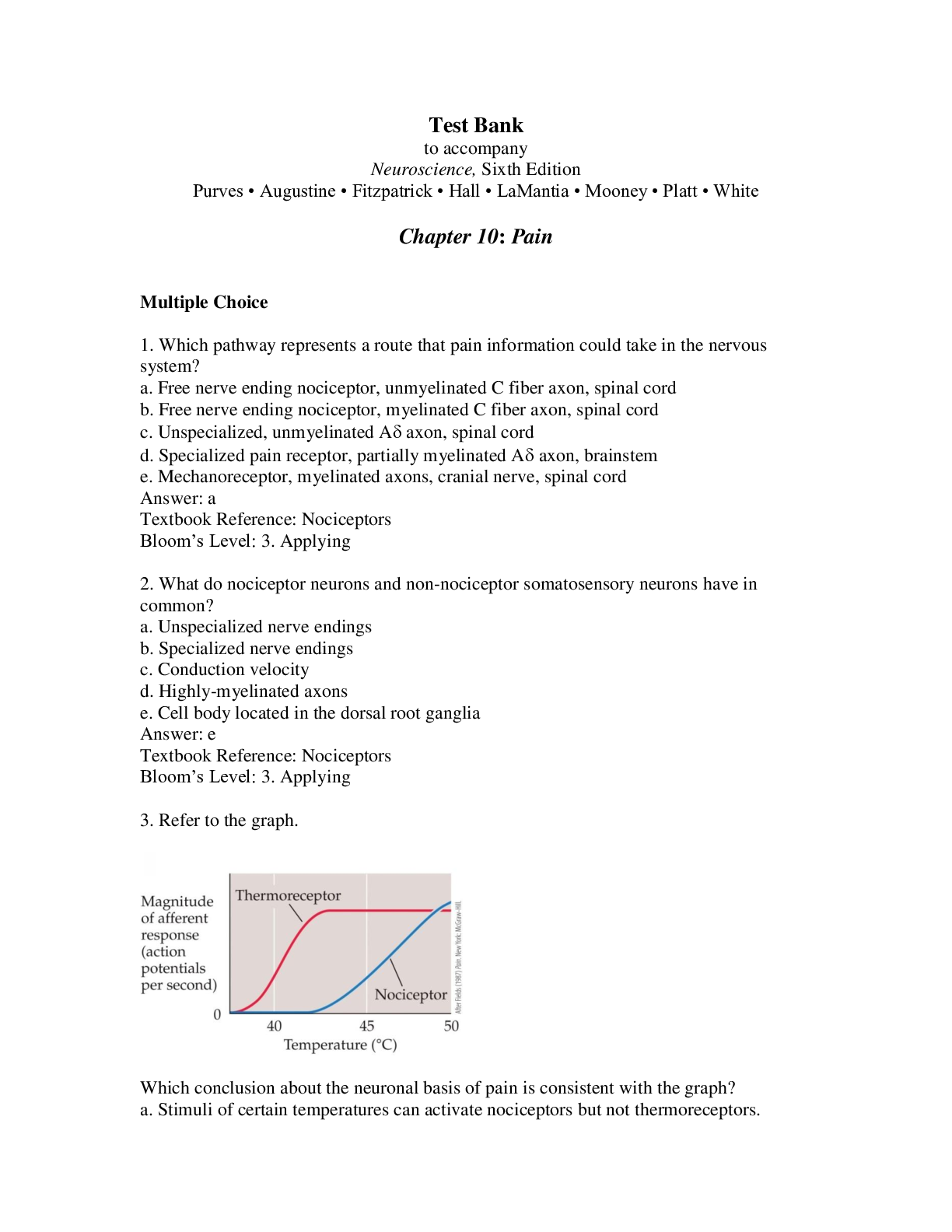
3. Refer to the graph.
Which conclusion about the neuronal basis of pain is consistent with the graph?
a. Stimuli of certain temperatures can activate nociceptors but not thermoreceptors.
b. These nociceptors respond only to stimuli that are sufficiently warm (approximately
43°C or above).
c. There is a linear relationship between thermoreceptor response and temperature of the
stimulus.
d. The nociceptors and thermoreceptors respond to a thermal stimulus by decreasing the
frequency of action potentials
e. Any thermal stimulus can activate both the nociceptors and the thermoreceptors.
Answer: b
Textbook Reference: Nociceptors
Bloom’s Level: 4. Analyzing
4. Which fibers conduct the sensation of first pain?
a. Unmyelinated C
b. Myelinated Aδ
c. Myelinated Ia
d. Unmyelinated II
e. Myelinated Aβ
Answer: b
Textbook Reference: Nociceptors
Bloom’s Level: 1. Remembering
5. Which sensation would an individual with anesthetized C fibers report when exposed
to intense heat?
a. Sharp pain followed by a dull burning
b. Sharp pain only
c. Dull burning only
d. Tingling
e. No sensation
Answer: b
Textbook Reference: Nociceptors
Bloom’s Level: 3. Applying
6. Which channel is responsible for transmitting information about chemical irritants,
such as components of cigarette smoke, in the environment?
a. TRPV1
b. TRPA1
c. TRPV4
d. Piezo 2
e. ASIC3
Answer: b
Textbook Reference: Transduction and Transmission of Nociceptive Signals
Bloom’s Level: 1. Remembering
7. ASIC channels are involved in generating the sensation of pain associated with heart
attack because, during heart attack,
a. pH of the tissue increases, which activates the channels.
b. pH of the tissue decreases, which activates the channels.
c. heart tissue undergoes necrosis, the products of which activate the channels.
d. heart muscle contracts, and this mechanical force activates the channels.
e. capsaicin produced in the heart muscle activates the channels.
Answer: b
Textbook Reference: Transduction and Transmission of Nociceptive Signals
Bloom’s Level: 4. Analyzing
8. What makes neurons of Rexed’s lamina V a likely substrate for referred pain?
a. They receive nociceptive information.
b. They receive somatosensory information.
c. They receive converging information from somatosensory and nociceptive axons.
d. They project directly to cortical structures.
e. They receive descending inputs from the locus coeruleus.
Answer: c
Textbook Reference: Central Pain Pathways are Distinct from Mechanosensory Pathways
Bloom’s Level: 4. Analyzing
9. Which deficit would a lesion restricted to the right side of the spinal cord produce?
a. Mechanosensory deficit on the right side of the body only
b. Mechanosensory deficit on the left side of the body only
c. Pain deficit on the right side of the body only
d. Pain deficit on the left side and mechanosensory deficit on the right side of the body
e. Pain deficit on the right side and mechanosensory deficit on the left side of the body
Answer: d
Textbook Reference: Central Pain Pathways are Distinct from Mechanosensory Pathways
Bloom’s Level: 3. Applying
10. Which structure contributes to the sensory-discriminative aspect of pain?
a. Anterior cingulate cortex
b. Ventral posterior medial nucleus of thalamus
c. Ventral posterior lateral nucleus of thalamus
d. Amygdala
e. Ventral posterior medial and lateral nuclei of the thalamus
Answer: e
Textbook Reference: Parallel Pain Pathways
Bloom’s Level: 1. Remembering
11. The small receptive fields of SI nociceptor neurons make possible the
a. perception of affective-motivational aspects of pain.
b. perception of extreme pain.
c. perception of weak pain.
d. precise localization of pain.
e. All of the above
Answer: d
Textbook Reference: Parallel Pain Pathways
Bloom’s Level: 3. Applying
12. Disruption of the _______ system prevents the transmission of _______ information.
a. dorsal column-mediated lemniscal; visceral pain
b. anterolateral; vibration
c. dorsal column-mediated lemniscal; temperature
d. anterolateral; visceral pain
e. anterolateral; mechanosensory
Answer: a
Textbook Reference: Box 10C: A Dorsal Column Pathway for Visceral Pain
Bloom’s Level: 1. Remembering
13. Colon cancer pain has been shown to be relieved by disruption of the visceral pain
pathway at the level of the
a. spinal cord near the midline at the sacral level.
b. spinal cord near the midline at the thoracic level.
c. ventral horn ipsilateral to the site of pain at the thoracic level.
d. dorsal horn contralateral to the site of pain at the thoracic level.
e. insular cortex ipsilateral to the site of pain.
Answer: b
Textbook Reference: Box 10C: A Dorsal Column Pathway for Visceral Pain
Bloom’s Level: 4. Analyzing
14. Where are the bodies of first-order neurons that conduct pain and thermal information
from the face located?
a. Pars interpolaris
b. Ventral posterior medial nucleus
c. Brainstem
d. Thalamus
e. Trigeminal ganglia and ganglia of cranial nerves VII, IX, and X
Answer: e
Textbook Reference: Pain and Temperature Pathways for the Face
Bloom’s Level: 1. Remembering
15. Which perception is an example of hyperalgesia?
a. Pain following a small paper cut
b. Pain following sunburn
c. Sensitivity to innocuous stimulus like the sound of scratching a plate with a fork
d. Increased sensitivity to light during a migraine episode
e. Increased sensitivity to temperature after sunburn
Answer: e
Textbook Reference: Sensitization
Bloom’s Level: 2. Understanding
16. Which mechanism contributes to peripheral sensitization following tissue damage?
a. Release of peptides and neurotransmitters from nociceptors
[Show More]