Test Bank
to accompany
Neuroscience, Sixth Edition
Purves • Augustine • Fitzpatrick • Hall • LaMantia • Mooney • Platt • White
Chapter 11: Vision: The Eye
Multiple Choice
1. Which eye structure is paired with an ap
...
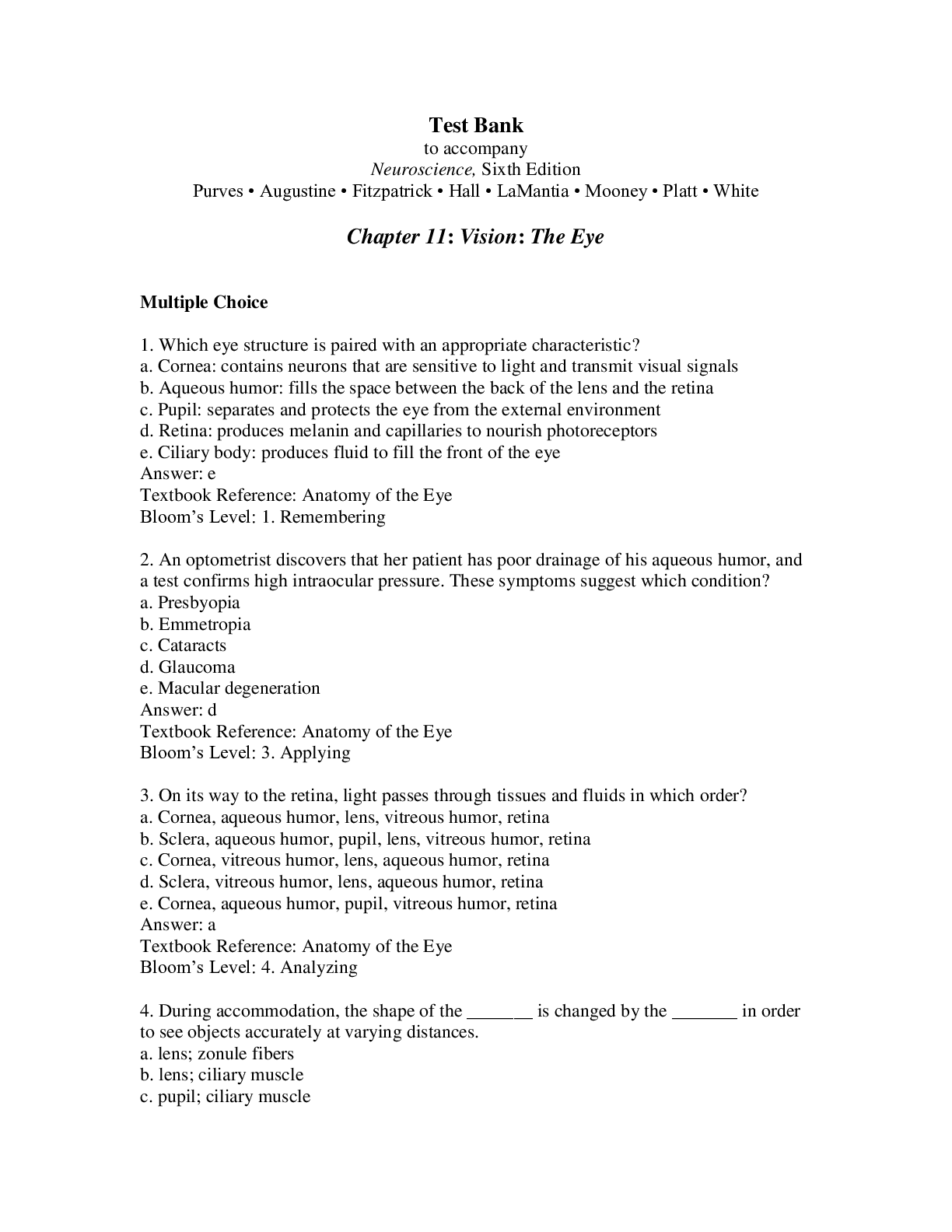
Test Bank
to accompany
Neuroscience, Sixth Edition
Purves • Augustine • Fitzpatrick • Hall • LaMantia • Mooney • Platt • White
Chapter 11: Vision: The Eye
Multiple Choice
1. Which eye structure is paired with an appropriate characteristic?
a. Cornea: contains neurons that are sensitive to light and transmit visual signals
b. Aqueous humor: fills the space between the back of the lens and the retina
c. Pupil: separates and protects the eye from the external environment
d. Retina: produces melanin and capillaries to nourish photoreceptors
e. Ciliary body: produces fluid to fill the front of the eye
Answer: e
Textbook Reference: Anatomy of the Eye
Bloom’s Level: 1. Remembering
2. An optometrist discovers that her patient has poor drainage of his aqueous humor, and
a test confirms high intraocular pressure. These symptoms suggest which condition?
a. Presbyopia
b. Emmetropia
c. Cataracts
d. Glaucoma
e. Macular degeneration
Answer: d
Textbook Reference: Anatomy of the Eye
Bloom’s Level: 3. Applying
3. On its way to the retina, light passes through tissues and fluids in which order?
a. Cornea, aqueous humor, lens, vitreous humor, retina
b. Sclera, aqueous humor, pupil, lens, vitreous humor, retina
c. Cornea, vitreous humor, lens, aqueous humor, retina
d. Sclera, vitreous humor, lens, aqueous humor, retina
e. Cornea, aqueous humor, pupil, vitreous humor, retina
Answer: a
Textbook Reference: Anatomy of the Eye
Bloom’s Level: 4. Analyzing
4. During accommodation, the shape of the _______ is changed by the _______ in order
to see objects accurately at varying distances.
a. lens; zonule fibers
b. lens; ciliary muscle
c. pupil; ciliary muscle
d. pupil; zonule fibers
e. iris; zonule fibers
Answer: b
Textbook Reference: Image Formation on the Retina
Bloom’s Level: 2. Understanding
5. Which statement about the optic disc is false?
a. It is a region without photoreceptors.
b. It is where retinal nerves leave the eye to reach targets in the thalamus and midbrain.
c. It contains a small depression known as the fovea.
d. It can be an indicator for intracranial pressure.
e. It creates a blind spot.
Answer: c
Textbook Reference: The Retinal Surface
Bloom’s Level: 1. Remembering
6. A 68-year-old man notices that the boxes of his crossword puzzle look wavy and
blurry for the word he is working on, but the boxes in the periphery of his focus remain
clear. This symptom suggests that the man has which condition?
a. Presbyopia
b. Emmetropia
c. Cataracts
d. Glaucoma
e. Macular degeneration
Answer: e
Textbook Reference: The Retinal Surface
Bloom’s Level: 4. Analyzing
7. What is the most direct path that light information travels on its way to the optic nerve?
a. Photoreceptor cell; bipolar cell; ganglion cell; optic nerve
b. Photoreceptor cell; ganglion cell; bipolar cell; optic nerve
c. Bipolar cell; photoreceptor cell; ganglion cell; optic nerve
d. Bipolar cell; ganglion cell; photoreceptor cell; optic nerve
e. Ganglion cell; photoreceptor cell; bipolar cell; optic nerve
Answer: a
Textbook Reference: Retinal Circuitry
Bloom’s Level: 3. Applying
8.Which of the following statements about the location photoreceptors in the outermost
layer of the retina is true.
a. This placement allows light to stimulate the photoreceptors via the most direct path.
b. The proximity to the pigment epithelium allows nourishment for the photoreceptor
cells and recycling of photopigment.
c. This placement allows more synapses to be formed between amacrine cells and
ganglion cells.
d. The proximity to the pigment epithelium determines if a photoreceptor cell
differentiates into a rod or a cone.
e. This placement allows a light stimulus to be filtered when it travels through the other
layers of the retina to reach the outermost layer.
Answer: b
Textbook Reference: The Pigment Epithelium
Bloom’s Level: 2. Understanding
9. Applying a drug that increases cGMP levels in photoreceptors would cause which
effect on a photoreceptor’s response to a photon of light?
a. An intensified depolarization from normal
b. An attenuated depolarization from normal
c. An intensified hyperpolarization from normal
d. An attenuated hyperpolarization from normal
e. There would be no effect
Answer: d
Textbook Reference: Phototransduction
Bloom’s Level: 4. Analyzing
10. Which mechanism decreases sensitivity in a photoreceptor as levels of illumination
increase?
a. The retinoid cycle
b. Accommodation
c. Transducin
d. Rhodopsin
e. Light adaptation
Answer: e
Textbook Reference: Phototransduction
Bloom’s Level: 1. Remembering
11. If a person had a mutation in the gene that codes for interphotoreceptor retinoid
binding protein, what would be the most likely downstream effects?
a. Arrestin would not be able to bind to rhodopsin.
b. Opsin would not be able to activate the intracellular messenger transducin.
c. Retinal could not be transported to and from
[Show More]









.png)