Module 2: Review/Quiz
Due May 30 at 11:59pm
Points 100
Questions 15
Available after May 18 at 8am
Time Limit 20 Minutes
Instructions
Module 2 Quiz Review: Approaches to Community Health and Population
Vul
...
Module 2: Review/Quiz
Due May 30 at 11:59pm
Points 100
Questions 15
Available after May 18 at 8am
Time Limit 20 Minutes
Instructions
Module 2 Quiz Review: Approaches to Community Health and Population
Vulnerabilities
1. Define Epidemiology, and apply examples, (Pgs. 222-223 and 255-258).
2. Describe Epidemiologist investigation, (Pgs. 258-259).
3. Define the following Epidemiological terms, and apply examples of each,
(Pgs. 262):
o Proportions,
o Risk, and
o Rates.
4. Describe the Epidemiological Triangle, and apply examples,(Pgs. 266-268).
5. Define toxicology, and provide examples, (Pgs. 221-222).
6. List the environmental multidisciplinary team members and their role, (Pg.
222).
7. Compare the environmental investigation process with the nursing process,
(Pgs. 223-228.
8. Discuss the leading causes of pollution, (Pgs. 226-227).
9. Define each level of prevention (Pgs. 268-269, 922-925) ,and apply examples
within the Community, (i.e. School: Pg. 925-929, Workplace: Pg. 948, Church: Pg.
976-979, and Public Health Departments:(Pgs.1006).
10. Describe the qualifications and role/functions of nurses in local, state, and
national public health departments, (Pgs. 994-996 and 998-1001), school health
(Pgs. 917-919), occupational health (Pgs. 939-940 and 948-953), and parish or
church-based health, (Pgs. 976-980). Be able to apply these roles in each
setting. Note the nursing roles are multifaceted including:
o Clinician (BSN, NP, CNS, MPH) a largely autonomous practice including
assessments, diagnosis, screening, surveillance, primary care, case finding
and management, health promotion and protection, counseling, advocate,
administering medications, and treatment.
o Educator (MPH, MSPH, MSN) client, family and population education,
community and political officials, media educator, risk education, others.
o Leader/Administrator: (MPH MSN MBA) organizational and fiscal
skills, political and negotiator skills, allocator coordinator, liaison
Consultant (MSN, MPH, MSPH, DrPH, DNP, PhD) clinical expertise and
leadership skills, and possibly research skills.
11. Researcher (DrPH, PhD, DNP) clinical research, grant writing, publishing,
developing protocols, etc.
12.
o Describe the roles of Federal Public Health agencies, and apply
examples, (Pgs. 994-996).
o Discuss the functions of OSHA, (Pgs. 953-955).
o Analyze the unique self-nurturing and renewal needs of Parish nurses,
(Pgs. 988-990).
Module 2 Quiz Instructions
The following quiz will allow you to test your understanding of the content
presented this week and to monitor your progress in the course. This is a timed
quiz. You will have one minute to answer each question. Select the best answer and
mark your response accordingly. This quiz does not allow backtracking. Changes to
the question answer after submission of each question is prohibited.
Complete this quiz by 23:59 Saturday of Module 2. You will be able to review
rationales within the allotted time for the quiz. Following quiz closure, Coaches and
faculty are available by email should students have specific questions from the
quiz. Note: it is considered academic dishonesty to capture screen shots
using any method.
By submitting this quiz, "I certify these responses are entirely my own work. I have
not copied the work of any other student (past or present) or collaborated with
anyone on this quiz. In addition, I will not share the questions or answers from this
quiz with other students. I understand that academic dishonesty is grounds for
dismissal from the program.
You have a time limit of 20 minutes.
Attempt History
Attempt Time Score
LATEST Attempt 1 5 minutes 100 out of 100
Correct answers are hidden.
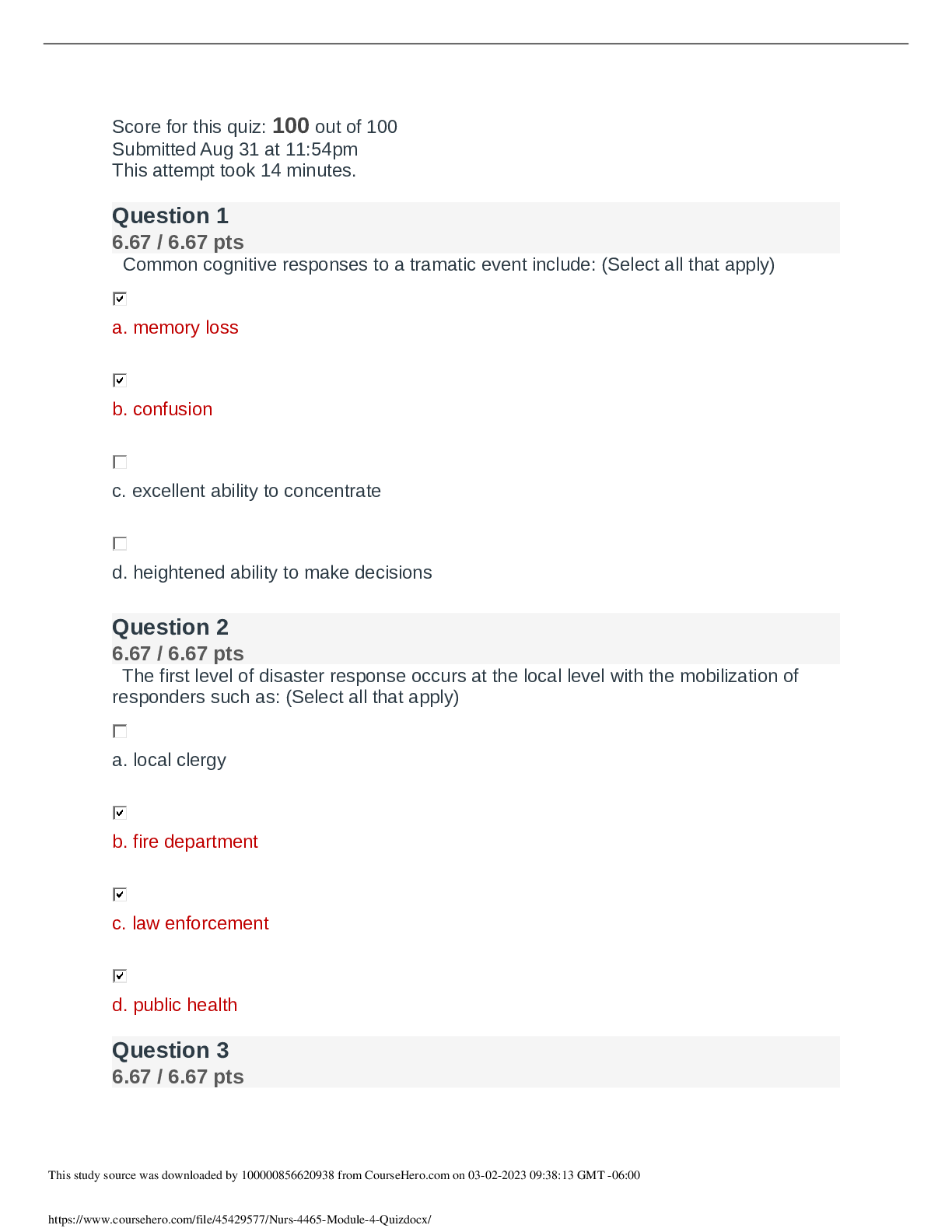
Score for this quiz: 100 out of 100
Submitted May 22 at 4:31pm
This attempt took 5 minutes.
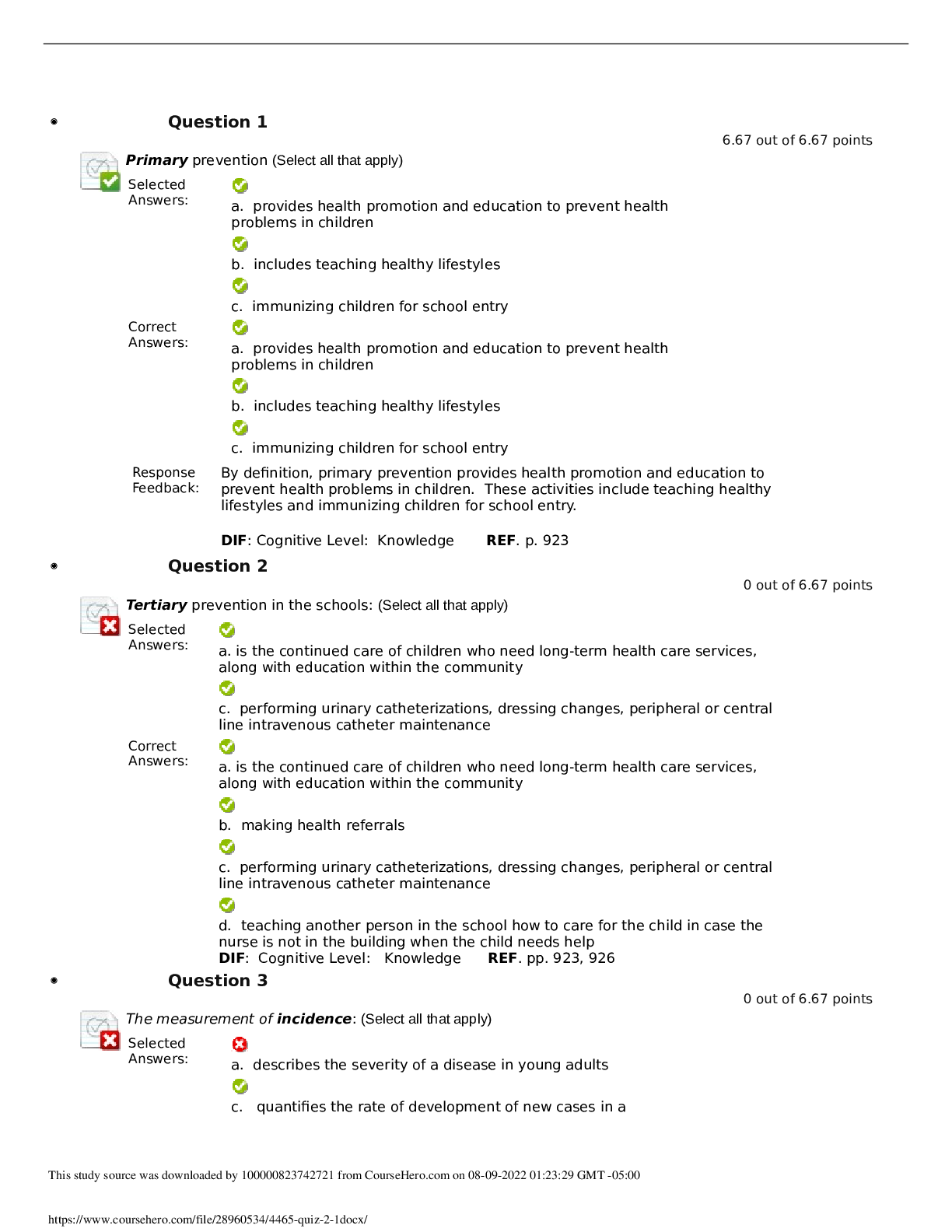
Question 1
6.67 / 6.67 pts
Primary prevention (Select all that apply)
a. provides health promotion and education to prevent health problems in children
b. includes teaching healthy lifestyles
c. immunizing children for school entry
d. is limited to children ages from 8 to 12 years old
By definition, primary prevention provides health promotion and education to
prevent health problems in children. These activities include teaching healthy
lifestyles and immunizing children for school entry.
DIF: Cognitive Level: Knowledge REF. p. 923
Question 2
6.67 / 6.67 pts
Tertiary prevention in the schools: (Select all that apply)
a. is the continued care of children who need long-term health care services, along
with education within the community
b. making health referrals
c. performing urinary catheterizations, dressing changes, peripheral or central line
intravenous catheter maintenance
d. teaching another person in the school how to care for the child in case the nurse
is not in the building when the child needs help DIF: Cognitive Level: Knowledge REF.
pp. 923, 926
By definition, tertiary prevention in the schools is the continued care of children who
need long-term health care services, along with education within the community.
The school nurse makes health referrals, performs urinary catheterizations, dressing
changes, peripheral or central line intravenous catherter maintenance and teaches
another person in the school how to care for the child in case the nurse is not in in
the building when the child needs help.
DIF: Cognitive Level: Knowledge REF. p. 923, 926
Question 3
6.67 / 6.67 pts
The measurement of incidence: (Select all that apply)
a. describes the severity of a disease in young adults
b. does not take into consideration a specified time as part of an incidence rate
c. quantifies the rate of development of new cases in a population at risk
d. does take into consideration a specified time as part of an incidence rate
An incidence measurement quantifies the number of new cases or events in a
population at risk during a specified time.
DIF: Cognitive Level: Knowledge REF. p. 263
Question 4
6.67 / 6.67 pts
A windshield survey is a helpful first step in understanding the potential
environmental health risks in a community. Nursing observations can determine the
following characteristics of the community: (Select all that apply)
a. urban or rural in nature
b. the age and condition of the housing stock
c. proximity to factories, dump sites, major transportation routes
d. the presence of contaminated waterways
A windshield survey is a helpful first step in understanding the potential
environmental health risks in a communty. Nursing observations can determine the
following characteristics of the community: urban or rural in nature, the age and
[Show More]