Raising the Bar for Success
First Semester
Functional Ability
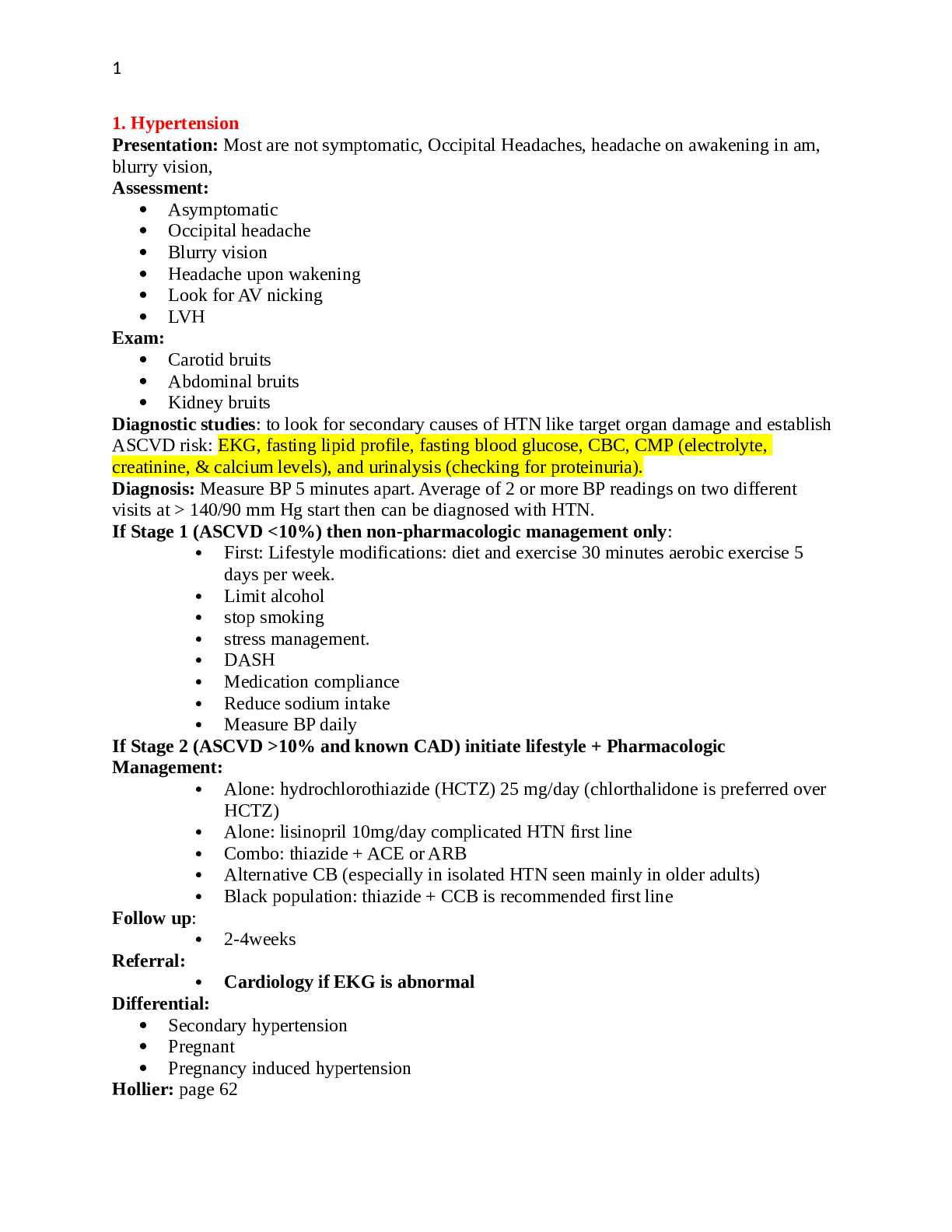
How does a nurse assess a patient’s functional ability?
Involves a multidimensional and interdisciplinary approach
o IMPACT
Impairment—dementia, Alz
...
Raising the Bar for Success
First Semester
Functional Ability
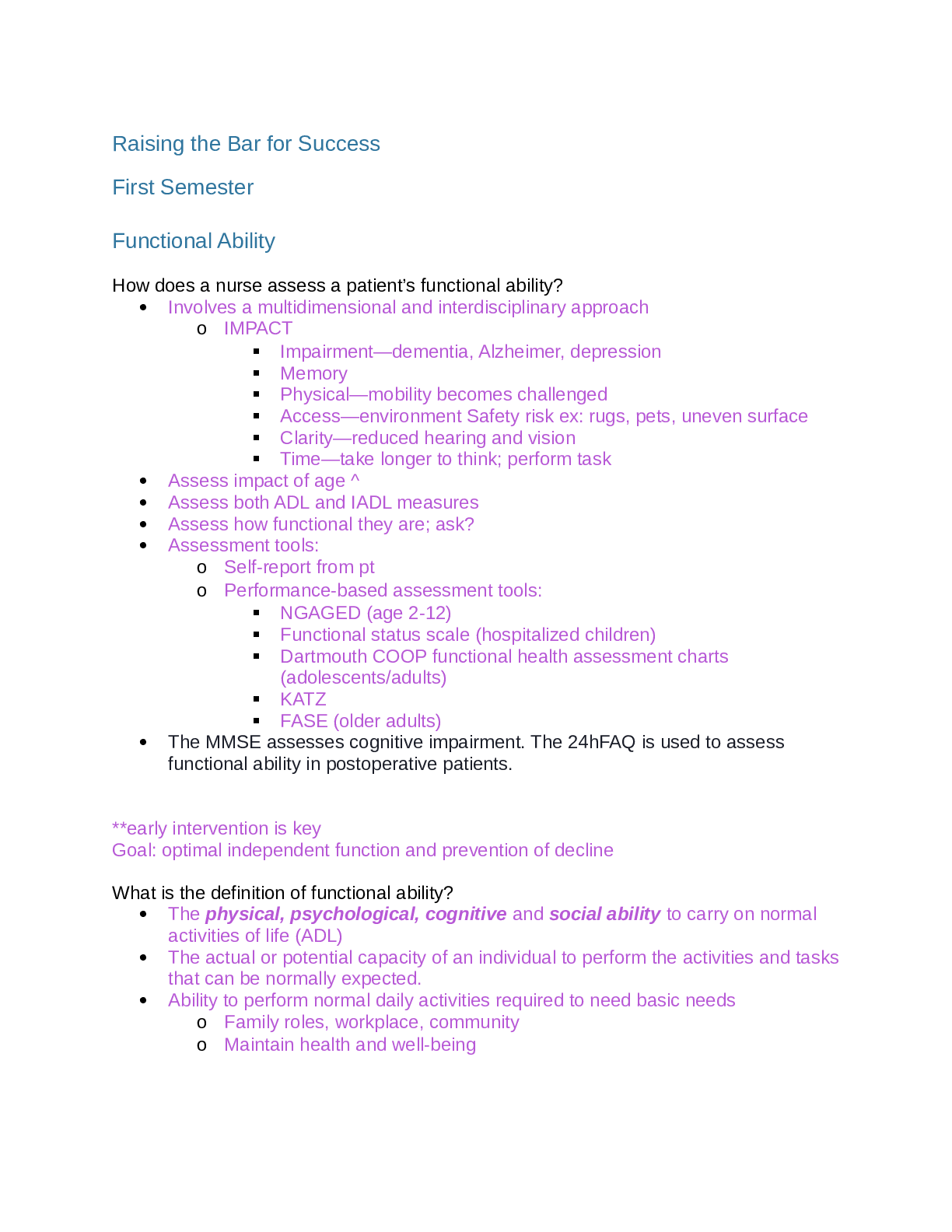
How does a nurse assess a patient’s functional ability?
Involves a multidimensional and interdisciplinary approach
o IMPACT
Impairment—dementia, Alzheimer, depression
Memory
Physical—mobility becomes challenged
Access—environment Safety risk ex: rugs, pets, uneven surface
Clarity—reduced hearing and vision
Time—take longer to think; perform task
Assess impact of age ^
Assess both ADL and IADL measures
Assess how functional they are; ask?
Assessment tools:
o Self-report from pt
o Performance-based assessment tools:
NGAGED (age 2-12)
Functional status scale (hospitalized children)
Dartmouth COOP functional health assessment charts
(adolescents/adults)
KATZ
FASE (older adults)
The MMSE assesses cognitive impairment. The 24hFAQ is used to assess
functional ability in postoperative patients.
**early intervention is key
Goal: optimal independent function and prevention of decline
What is the definition of functional ability?
The physical, psychological, cognitive and social ability to carry on normal
activities of life (ADL)
The actual or potential capacity of an individual to perform the activities and tasks
that can be normally expected.
Ability to perform normal daily activities required to need basic needs
o Family roles, workplace, community
o Maintain health and well-being
Know the difference a primary functional ability deficit and secondary functional ability
deficit.
Primary: (never had)
o Caused by genetic, injury, trauma, or disease early in life
Autism
Cerebral Palsy
Fetal alcohol syndrome
Down syndrome
Duchennes’ muscular dystrophy
Malnutrition
Fetal drug exposure
Secondary: (you had and lost)
o Progressive, musculoskeletal or neurological
Multiple sclerosis
Rheumatoid arthritis
Stroke (cva)
Parkinson’s
Alzheimers
Primary=Prevention (education to prevent)
Secondary=Screening (screenings to catch something early)
Tertiary=Treatment (treating something they already have been diagnosed with)
What is the difference between Basic Activities of Daily Living and Instrumental
Activities of Daily Living?
Basic activities of daily living
o The six basic ADLs are eating, bathing, dressing, toileting, mobility, and
grooming
o Skills required to manage basic physical needs
Instrumental activities of daily living
o are more complex sets of skills we need in order to live independently.
o These skills are: using the telephone, shopping, preparing meals,
housekeeping, using transportation, taking medication(s), and managing
finances.
How does age relate to functional ability?
Changes related to normal aging, acute illnesses, worsening chronic illnesses,
and hospitalization can contribute to a decline in the ability to perform tasks
necessary to live independently in the community
A person’s age and degree of neuromuscular development markedly
influence body proportions, posture, body mass, movements, and
reflexes.
Older people face an increased risk of falling and injury. Age-related conditions,
such as arthritis, dementia, heart disease and/or stroke can make it difficult for
people to perform daily living activities (e.g., cooking, cleaning, driving, walking)
and may present safety risks.
How does sensory perception relate to functional ability?
If unable to feeling/sensation, ex: feet, then you are unable to walk or stand on your own
limited adl, or driving, can’t feel the pressure.
How does having poor vision affect a person’s ability to function?
Vision loss can increase your risk of death. Vision loss interferes with
a person's ability to complete basic tasks, also known as instrumental activities
of daily living (IADL) – like grocery shopping, using the telephone, or doing
housework – which are measures of the ability to live independently.
Visual impairment can limit people's ability to perform everyday tasks and can
affect their quality of life and ability to interact with the surrounding world.
What are the domains of functional ability and how do they relate to patient care?
1. Physical
2. Psychological
3. Cognitive
4. Social ability
How does decreased cognitive ability relate to functional ability?
A decline in cognitive function could also influence quality of life and
independent living of older adults
Cognitive impairment is when a person has trouble remembering, learning new
things, concentrating, or making decisions that affect their everyday life.
What affects cognitive function?
Factors affecting cognitive impairment that have been identified so far include
age, educational period, gender, health life factors such as drinking and
smoking, depression, social factors such as social activity and occupation,
history of disease, and body mass index (BMI)
Cognitive impairment is when a person has trouble remembering, learning new
things, concentrating, or making decisions that affect their everyday
life. Cognitive impairment ranges from mild to severe.
-Alzheimer’s
How does helplessness relate to functional ability?
Those unable to be independent and complete ADLs often feel a sense of loss self
worth, helpless
A person’s mental health influences body appearance and movement as much as the
person’s physical health. Body processes tend to slow down in depression, and there is
a lack of visible energy and enthusiasm. Body posture also may be affected. For
example, the person with depression often sits with head bowed and shoulders
slumped, and may lack the energy to eat or even to use the toilet.
You don’t want to do anything; eat, walk, shower..etc..just sleep
Psychological well-being—risk for decreased sensory stimulation, altered sleep-wake
pattern, risk for depression, risk for learned helplessness
How can a nurse assist a patient to cope with decreased functional ability?
used coping mechanisms include changing one's perception of the issue at
hand, using humor, using problem solving skills, employing stress management
and relaxation techniques, seeking out and using the support of others,
ventilating feelings, embarking on a physical exercise and activity routine,
decreasing personal expectations, and avoiding self-blame.
Providing additional care for loved ones — arranging sleeping at the hospital, etc.
Answering questions in detail. Offering emotional support and listening.
Pt education, addressing concerns
Therapeutic communication (active listening, giving recognition, offering self,
giving broad openings, encouraging, etc.)
How does a nurse evaluate progress when working towards patient goals related to
functional ability?
The nurse evaluates by observing/monitoring pt’s activity tolerance and progress
limitations.
Compare response with outcomes, timeliness of outcome and progress.
What are the differences in Primary, Secondary and Tertiary Prevention measures when
caring for a patient with a functional ability deficit?
Prevention: Risk recognition
o Good functional ability vs functional deficits
Secondary: Functional assessment
Tertiary: Care delivery
Prevention, screening, treatment
What is important to consider when caring for a patient with CVA (cerebral vascular
accident) especially when transferring the patient from the bed to a wheelchair?
There may be long term results/effects:
o 1. Motor function changes
o 2. Flaccidity to spastic l
[Show More]




.png)