Midterm study guide
1. Principles of nursing informatics
Nursing Science a building block of NI
NI is a specialty that integrates nursing science, computer science, cognitive
science and information science to ma
...
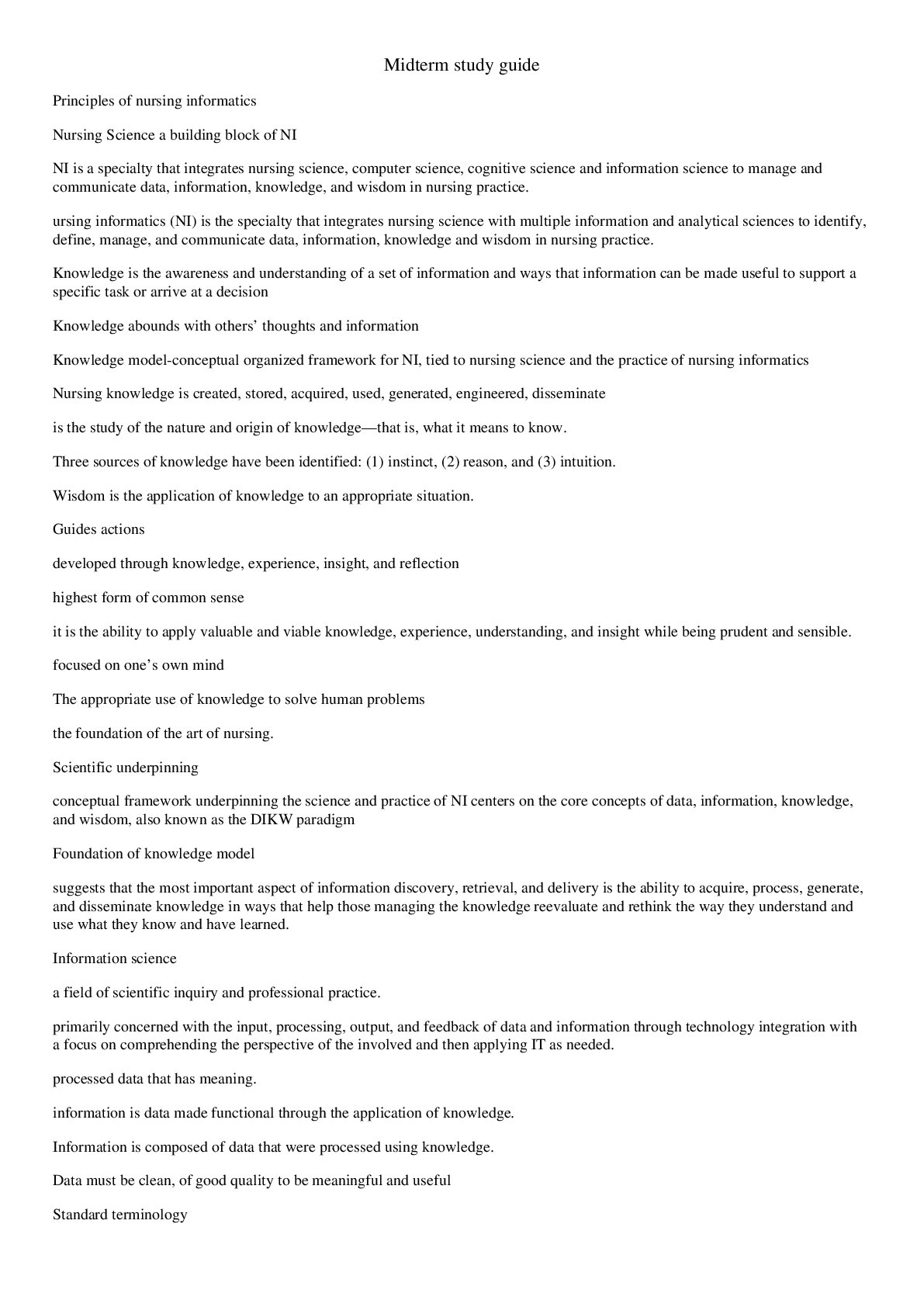
Midterm study guide
1. Principles of nursing informatics
Nursing Science a building block of NI
NI is a specialty that integrates nursing science, computer science, cognitive
science and information science to manage and communicate data, information,
knowledge, and wisdom in nursing practice.
ursing informatics (NI) is the specialty that integrates nursing science with
multiple information and analytical sciences to identify, define, manage, and
communicate data, information, knowledge and wisdom in nursing practice.
2. Knowledge is the awareness and understanding of a set of information and ways that
information can be made useful to support a specific task or arrive at a decision
Knowledge abounds with others’ thoughts and information
Knowledge model-conceptual organized framework for NI, tied to nursing
science and the practice of nursing informatics
Nursing knowledge is created, stored, acquired, used, generated, engineered,
disseminate
Epistemology is the study of the nature and origin of knowledge—that is, what it
means to know.
Three sources of knowledge have been identified: (1) instinct, (2) reason, and (3)
intuition.
3. Wisdom is the application of knowledge to an appropriate situation.
Guides actions
developed through knowledge, experience, insight, and reflection
highest form of common sense
it is the ability to apply valuable and viable knowledge, experience,
understanding, and insight while being prudent and sensible.
focused on one’s own mind
The appropriate use of knowledge to solve human problems
the foundation of the art of nursing.
4. Scientific underpinning
conceptual framework underpinning the science and practice of NI centers on the
core concepts of data, information, knowledge, and wisdom, also known as the
DIKW paradigm
5. Foundation of knowledge model
suggests that the most important aspect of information discovery, retrieval, and
delivery is the ability to acquire, process, generate, and disseminate knowledge in
ways that help those managing the knowledge reevaluate and rethink the way they
understand and use what they know and have learned.
This study source was downloaded by 100000831988016 from CourseHero.com on 04-14-2022 01:07:25 GMT -05:00
https://www.coursehero.com/file/52260410/Informatics-Midterm-study-guide-docx/
6. Information science
a field of scientific inquiry and professional practice.
primarily concerned with the input, processing, output, and feedback of data and
information through technology integration with a focus on comprehending the
perspective of the stakeholders involved and then applying IT as needed.
processed data that has meaning.
information is data made functional through the application of knowledge.
Information is composed of data that were processed using knowledge.
Data must be clean, of good quality to be meaningful and useful
7. Standard terminology
International Council of Nurses’ International Classification of Nursing Practice
(ICNP) initiative to standardize the language of nursing practice
a nursing terminology that is in some way approved by an appropriate authority
(de jure standardization) or by general consent (de facto standardization).
Once standardized, a term can be measured and coded.
Measurement of the nursing care through a standardized vocabulary by way of an
ED [electronic documentation] will lead to the development of large databases.
8. Informatics competencies
nurses should have the following critical skills: use e-mail, operate Windows
applications, search databases, and know how to work with the institution-specific
nursing software used for charting and medication administration.
NI competency categories: (1) computer skills, (2) informatics knowledge, and (3)
informatics skills
NI competency skill levels: beginning nurse (basic knowledge), (2) experienced
nurse (proficient), (3) informatics nurse specialist (advance), and (4) informatics
innovator (generate research and theory).
Level 1 and Level 2 competencies assessment: TANIC tool
Level 3 and 4 competencies assessment: NICA L3/L4 tool
9. Information literacy
an intellectual framework for finding, understanding, evaluating, and using
information
Determine the extent of information needed
Access the needed information effectively and efficiently
Evaluate information and its sources critically
Incorporate selected information into one’s knowledge base
Use information effectively to accomplish a specific purpose
Understand the economic, legal, and social issues surrounding the use of
information and access and use information ethically and legally
10. Health literacy
This study source was downloaded by 100000831988016 from CourseHero.com on 04-14-2022 01:07:25 GMT -05:00
https://www.coursehero.com/file/52260410/Informatics-Midterm-study-guide-docx/
The degree to which individuals have the capacity to obtain, process, and
understand basic health information and services needed to make appropriate
health decisions’
ability to locate and evaluate health information for credibility and quality, to
analyze the various risks and benefits of treatments, and to calculate dosages and
interpret test results are among the tasks Almader-Douglas identified as essential
for health literacy
ability to negotiate complex healthcare environments and understand the
economics of payment for services
third of all Americans have health literacy problems
11. Computer science
facilitate the acquisition and manipulation of data and information by nurses
computers first developed in 1940s
Users are also able to contribute to the development of knowledge through the use
of productivity, creativity, and communication software.
Health care networks: client-focused (telenursing, e-health), client supported,
work-related, virtual and social networks
12. Cognitive science
studies the mind, intelligence, and behavior from an information-processing
perspective.
H. Christopher Longuet-Higgins originated the term “cognitive science” in his
1973
Cognitive informatics an emerging transdisciplinary field of study that bridges the
gap in understanding regarding how information is processed in the mind and in
the computer
13. Human technology interface
anytime a human uses technology, some type of hardware or software enables and
supports the interaction
Can be computer, smart phone, printer
Can be in images, text or sound
Can mimic human face to face such as video conferencing, telehealth
14. Health Information Technology
Key element in achieving 3 objectives: better care, affordable care, and healthy
populations and communities
15. Digital natives
digital natives (patients who have grown up with technology) need to be taught
differently than digital immigrants (those who are late adopters of technology
typically born after 1982 and may also be referred to as “Generation Y.”
This study source was downloaded by 100000831988016 from CourseHero.com on 04-14-2022 01:07:25 GMT -05:00
https://www.coursehero.com/file/52260410/Informatics-Midterm-study-guide-docx/
refers to learn using technology and learns quite well if information is presented
in a format to which they are accustomed, such as an interactive video game to
introduce them to a topic.
comfortable using information that they can access via their handheld devices,
such as smartphones and tablets, as well as wearable devices such as
smartwatches
16. Alarm fatigue
low response times to legitimate alarms and multiple false alarms (promoting
alarm fatigue) created by alarm parameters that were too sensitive.
17. Electronic medical records
systematic documentation of a client’s health status and health care in a secured
digital format, meaning that they can be processed, stored, transmitted, and
accessed by authorized interdisciplinary professionals for the purpose of
supporting efficient, high-quality health care across the client’s healthcare
continuum
provide immediate detection and reporting of notifiable conditions.
incorporation of geographic information systems allows public health data to be
mapped to specific locations that may indicate an immediate need for intervention
18. HITECH Act of 2011,
part of the American Recovery and Reinvestment Act (ARRA)
two sets of standards established as regulatory requirements by the Office of the
National Coordinator for Health Information Technology (ONC, 2013a) to help
providers meet the meaningful use (MU) of electronic health records (EHRs).
which set the 2014 deadline for implementing EHRs and provided the impetus for
HIE initiatives.
19. Meaningful use
primary purpose of the MU standards is to ensure that the EHRs across the nation
meet an adequate standard for performance and that this standard increases in
complexity over time to meet the expanded needs of the nation
The first standard defined the MU of EHRs, and the second specified how EHRs
are to be developed and certified to meet the MU criteria
The Centers for Medicare & Medicaid Services (CMS) coupled this infrastructure
regulation with an EHR incentive program to encourage providers and hospitals
to adopt and implement certified technology
96% of U.S. hospitals have a certified EHR, and as of 2015, more than 87% of
providers have adopted an EHR in their practice
Phase 1 was focused on the implementation of certified EHRs meeting basic
requirements, such as electronic exchange of information through ePrescribing
(electronic prescriptions) and the ability to capture and report quality metrics.
[Show More]