Review Test Submission:
Week 11 Final Exam
Course NURS-6640 Psychotherapy
Individ
Attempt Score 74 out of 75 points
Results
Displayed
Submitted Answers
Question 1
1 out of 1 points
A PMHNP is using Gestalt th
...
Review Test Submission:
Week 11 Final Exam
Course NURS-6640 Psychotherapy
Individ
Attempt Score 74 out of 75 points
Results
Displayed
Submitted Answers
Question 1
1 out of 1 points
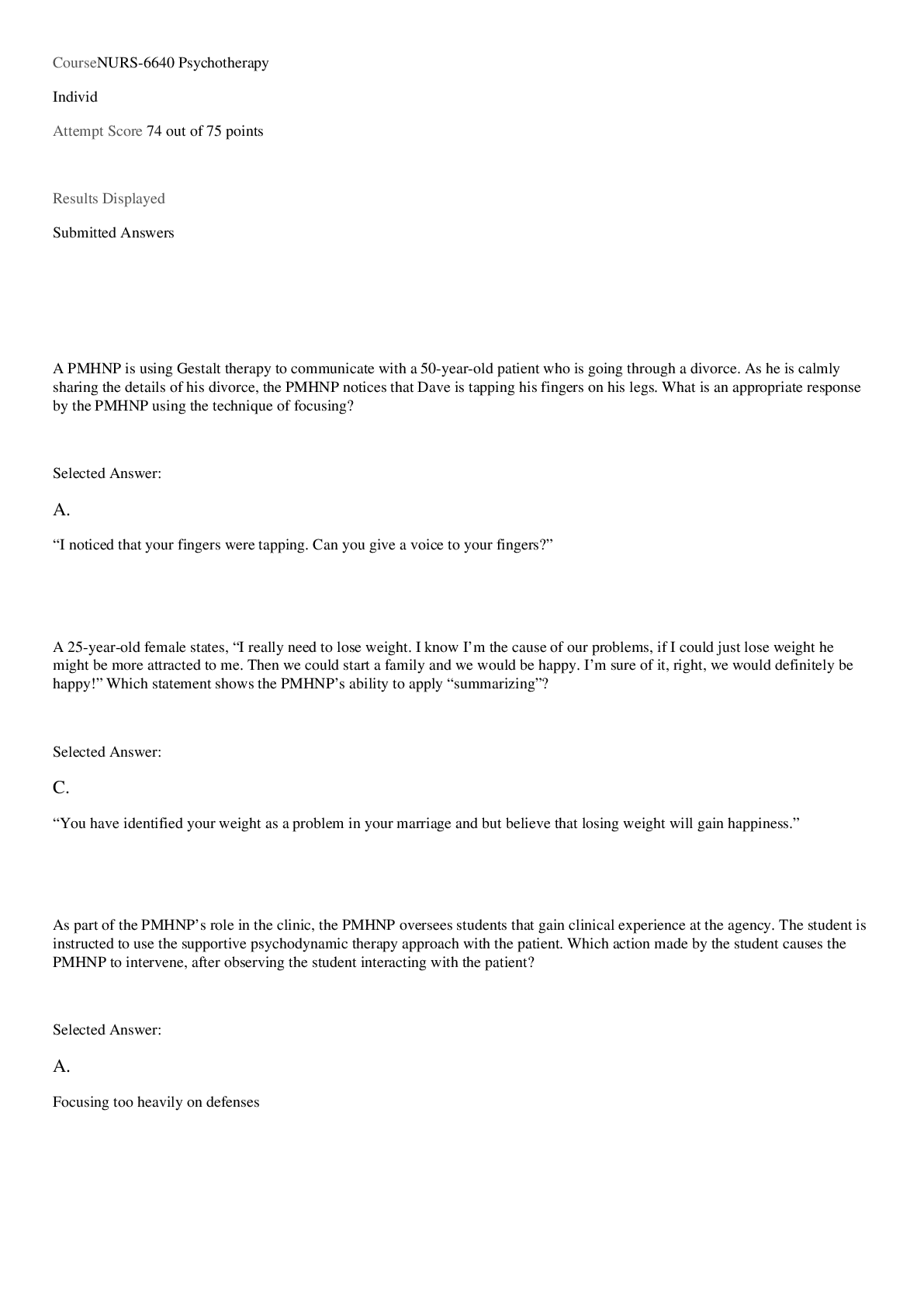
A PMHNP is using Gestalt therapy to communicate with a 50-year-old patient who is
going through a divorce. As he is calmly sharing the details of his divorce, the
PMHNP notices that Dave is tapping his fingers on his legs. What is an appropriate
response by the PMHNP using the technique of focusing?
Selected
Answer:
A.
“I noticed that your fingers were tapping. Can you give a voice to
your fingers?”
Question 2
1 out of 1 points
A 25-year-old female states, “I really need to lose weight. I know I’m the cause of our
problems, if I could just lose weight he might be more attracted to me. Then we
could start a family and we would be happy. I’m sure of it, right, we would definitely
be happy!” Which statement shows the PMHNP’s ability to apply “summarizing”?
Selected
Answer:
C.
“You have identified your weight as a problem in your marriage and
but believe that losing weight will gain happiness.”
Question 3
1 out of 1 points
As part of the PMHNP’s role in the clinic, the PMHNP oversees students that gain
clinical experience at the agency. The student is instructed to use the supportive
psychodynamic therapy approach with the patient. Which action made by the student
causes the PMHNP to intervene, after observing the student interacting with the
patient?
Selected
Answer:
A.
Focusing too heavily on defenses
Question 4
1 out of 1 points
A PMHNP is using motivational interviewing (MI) with a 50-year-old patient named
Dave to commit to a healthy drug-free lifestyle. By using “change talk,” the PMHNP
hopes to help the patient build self-esteem and hope.
True or false: If Dave is resisting change, the PMHNP should challenge his
resistance in order for MI to be successful.
Selected
Answer:
Fals
e
Question 5
1 out of 1 points
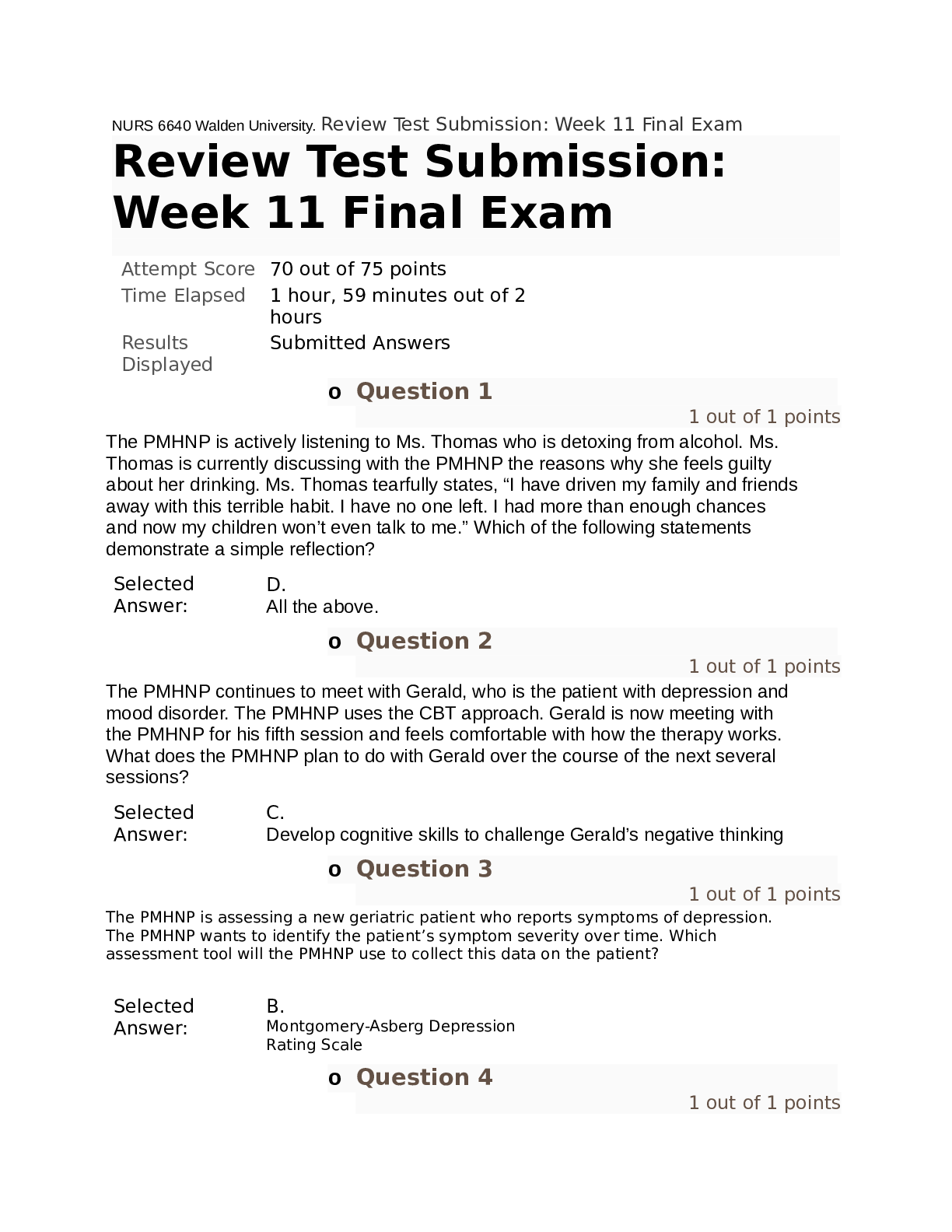
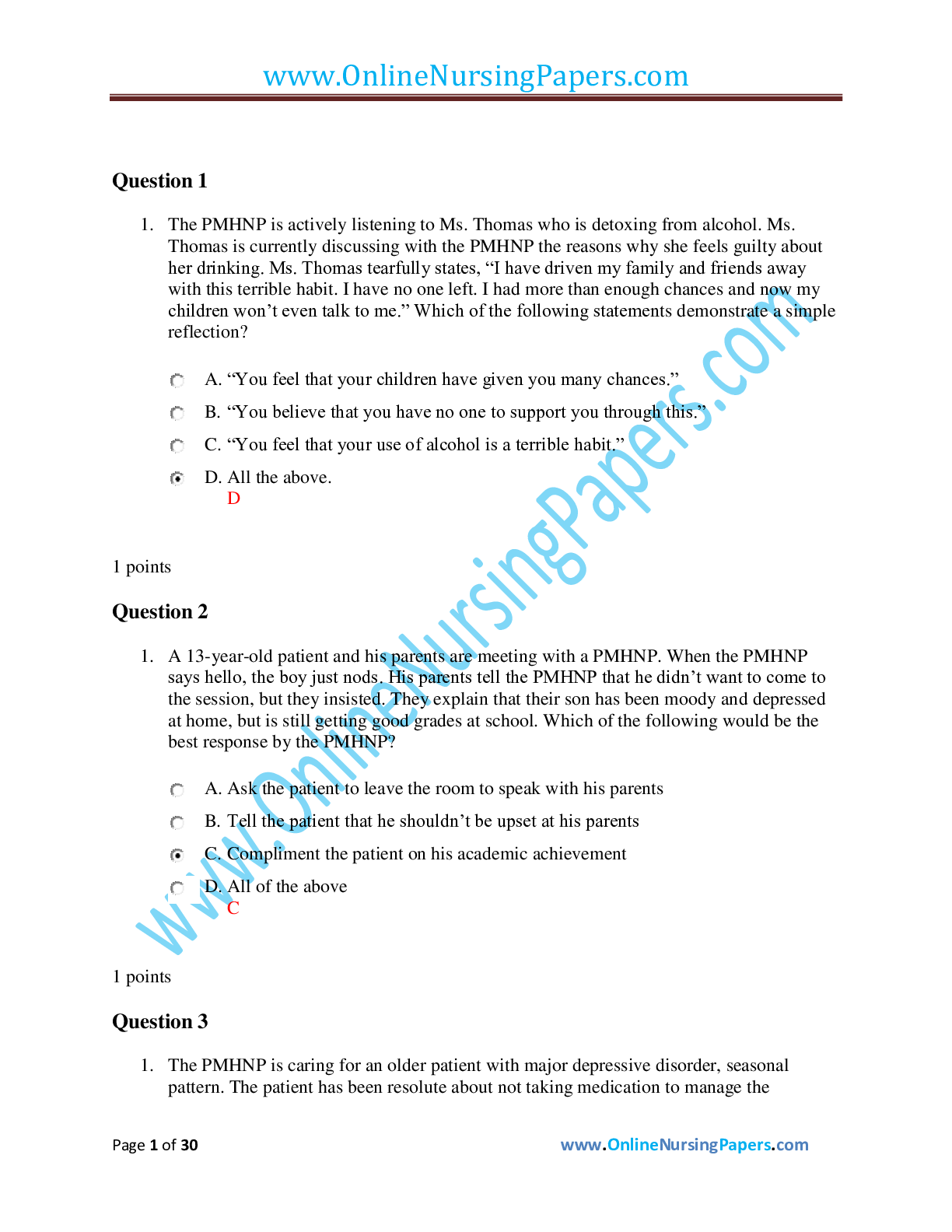
The PMHNP is actively listening to Ms. Thomas who is detoxing from alcohol. Ms.
Thomas is currently discussing with the PMHNP the reasons why she feels guilty
about her drinking. Ms. Thomas tearfully states, “I have driven my family and friends
away with this terrible habit. I have no one left. I had more than enough chances and
now my children won’t even talk to me.” Which of the following statements
demonstrate a simple reflection?
Selected
Answer:
D.
All the above.
Question 6
1 out of 1 points
A PMHNP is using Gestalt therapy to communicate with a 42-year-old patient who is
upset with her mother. She says, “I want to tell her how hurt I feel when she doesn’t
call me, but I don’t want to upset her.” What technique can the PMHNP use to help
Sasha express herself?
Selected
Answer:
B.
Empty-chair dialogue
Question 7
1 out of 1 points
The PMHNP is meeting with an older, female adult patient and her daughter. The
patient has early onset dementia. The daughter expresses concern, saying, “I don’t
want you to just stick my mother in a home and give her medicine. I’m worried that’s
what people are going to want to do.” What is the best response by the PMHNP to
the daughter?
Selected
Answer:
B.
“The type of treatment depends on the stage of dementia and safety
considerations.”
Question 8
1 out of 1 points
The PMHNP meets with a 31-year-old woman who reports feeling as though she is
“at her breaking point” with work. The PMHNP learns that the woman works 12-hour
days, including one day on the weekend, because she is nervous about company
layoffs. “I feel like I need to work myself to death in order to prove that I am valuable
to the organization,” the woman says. Using the supportive psychodynamic therapy
approach, how does the PMHNP respond?
Selected
Answer:
D.
“That must be a very tiring work schedule. How do you feel about
working so much?”
Question 9
1 out of 1 points
When preparing to terminate a patient, what does the PMHNP do to organize
thoughts about the patient’s progress made during treatment?
Selected
Answer:
B.
Reviews the patient’s file to identify issues and important themes that
were highlighted throughout treatment
Question 10
1 out of 1 points
Linda is a 65-year-old patient who has completed initial treatment for alcohol
addiction and anxiety problems. She is motivated to continue her treatment gains
and have a healthy lifestyle. How would the PMHNP apply a mindfulness approach
to this case?
Selected
Answer:
A.
Help Linda develop an awareness of triggers in order to have greater
control over physical and emotional responses
Question 11
1 out of 1 points
The PMHNP is caring for a young adult patient with whom the PMHNP decides to
use a dynamic supportive therapy approach in addition to pharmacological
intervention. Which therapeutic action will the PMHNP take to employ the strategy of
holding and containing the patient?
Selected
Answer:
B.
Asking the patient how the patient feels
Question 12
1 out of 1 points
The PMHNP is caring for an adult male patient whose wife left him several months
ago. He recently learned that his ex-wife is dating someone much younger. The man
feels belittled, sad, and lonely. He talks about trying to meet other women, but says,
“I can’t compete with the younger guys these days, with the cool clothes and the
vegan diets. I’m bald and overweight, and what woman is going to want to be with
me?” How does the PMHNP help raise the man’s self-esteem?
Selected
Answer:
D.
All of the above
Question 13
1 out of 1 points
A 43-year-old single mother is seeing the PMHNP at the request of her sister. “My
sister thinks I need to come here to talk about my feelings,” the patient reports. The
PMHNP learns that the patient has three children from three different men, but is
unable to collect appropriate child support payments from any of the biological
fathers. Additionally, the woman is barely able to afford her apartment or utilities
payments. What is the appropriate response from the PMHNP when using the
psychodynamic psychotherapy technique?
Selected
Answer:
C.
Suggesting that the patient seek professional legal help
Question 14
1 out of 1 points
The PMHNP has been providing interpersonal psychotherapy (IPT) for a patient who
the PMHNP observes implementing new ways of being, such as interacting more
with peers and being less isolated in social scenarios. The PMHNP understands that
the patient is approaching termination. How does the PMHNP address termination
with this patient?
Selected
Answer:
C.
Embed the termination into the work of the therapeutic phase
Question 15
1 out of 1 points
A PMHNP has been treating a 14-year-old patient using interpersonal psychotherapy.
The patient has been depressed since the death of his grandmother. To help the
patient recover, the PMHNP has told the parents:
Selected
Answer:
B.
“Modify your expectations at home and school until the depression
lifts.”
Question 16
1 out of 1 points
In the planning phase of change, a 42-year-old male client who struggles with
gambling discusses how he plans to abstain from gambling. He tells the PMHNP, “I
am no longer going to carry cash to the casino because you can’t spend what you
don’t have.” The PMHNP uses an affirming communication skill when she states:
Selected
Answer:
A.
“Not gambling is a tough habit to break; not carrying cash is a big
step in the right direction.”
Question 17
1 out of 1 points
The PMHNP is assessing a patient who has been receiving months of outpatient
psychotherapy. According to the PMHNP’s assessment, the patient is nearing the
termination phase of their therapeutic relationship because the patient’s symptoms
have improved, and the patient shows progress managing behaviors and decisionmaking abilities according to the diagnosis. How does the PMHNP approach
termination with this patient?
Selected
Answer:
B.
Manage terminatio
[Show More]