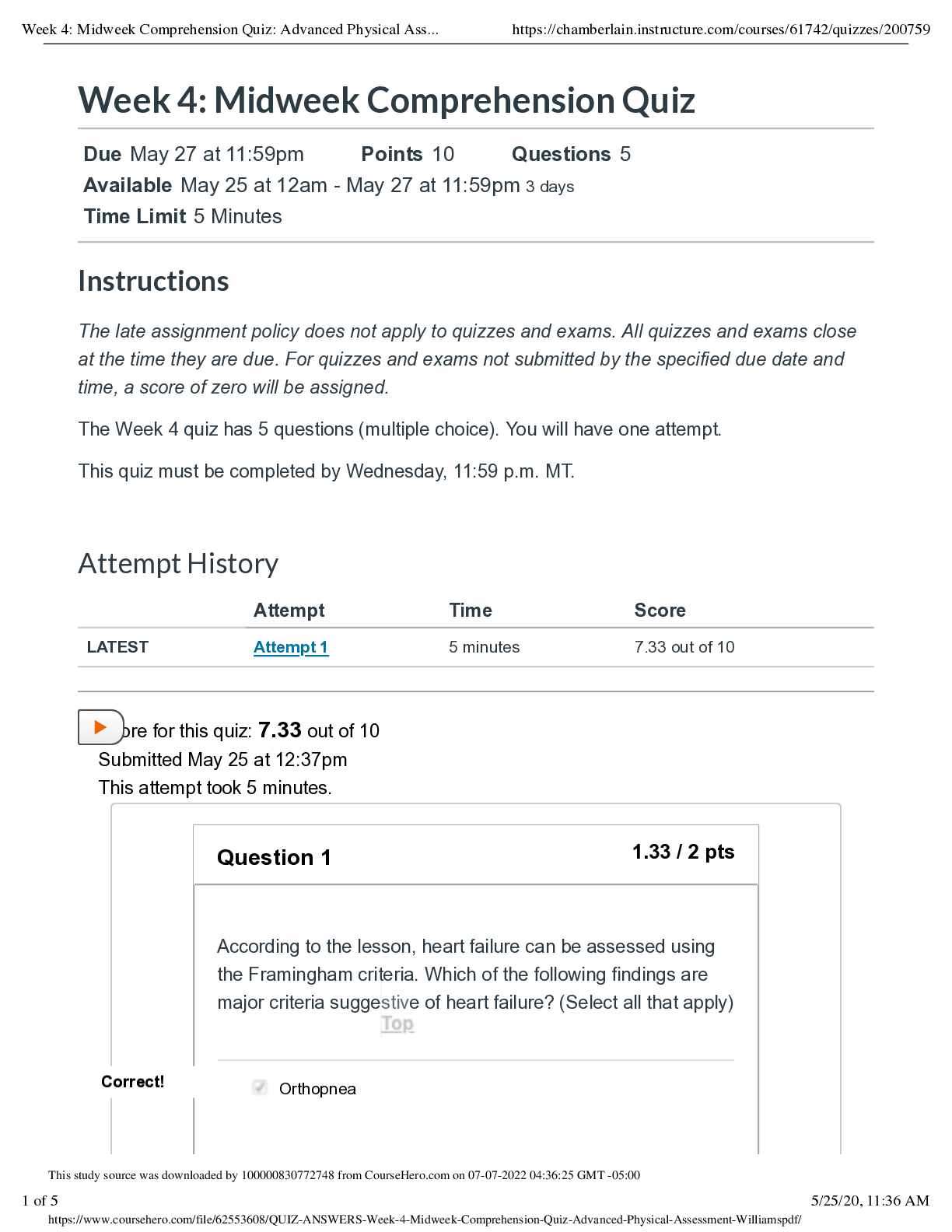
Week 4: Midweek Comprehension Quiz
Due May 27 at 11:59pm Points 10 Questions 5
Available May 25 at 12am - May 27 at 11:59pm 3 days
Time Limit 5 Minutes
Instructions
Attempt History
Attempt Time Score
LATEST Attemp
...
Week 4: Midweek Comprehension Quiz
Due May 27 at 11:59pm Points 10 Questions 5
Available May 25 at 12am - May 27 at 11:59pm 3 days
Time Limit 5 Minutes
Instructions
Attempt History
Attempt Time Score
LATEST Attempt 1 5 minutes 7.33 out of 10
Score for this quiz: 7.33 out of 10
Submitted May 25 at 12:37pm
This attempt took 5 minutes.
The late assignment policy does not apply to quizzes and exams. All quizzes and exams close
at the time they are due. For quizzes and exams not submitted by the specified due date and
time, a score of zero will be assigned.
The Week 4 quiz has 5 questions (multiple choice). You will have one attempt.
This quiz must be completed by Wednesday, 11:59 p.m. MT.
Question 1 1.33 / 2 pts
According to the lesson, heart failure can be assessed using
the Framingham criteria. Which of the following findings are
major criteria suggestive of heart failure? (Select all that apply)
Orthopnea Correct!
!
Week 4: Midweek Comprehension Quiz: Advanced Physical Ass... https://chamberlain.instructure.com/courses/61742/quizzes/200759
1 of 5 5/25/20, 11:36 AM
This study source was downloaded by 100000831988016 from CourseHero.com on 04-25-2022 09:24:12 GMT -05:00
https://www.coursehero.com/file/62553608/QUIZ-ANSWERS-Week-4-Midweek-Comprehension-Quiz-Advanced-Physical-Assessment-Williamspdf/
Ankle edema You Answered
Neck-vein distention Correct!
S3 gallop Correct!
For establishing a diagnosis of CHF using the modified
Framingham Criteria, 2 major criteria or 1 major and 2
minor criteria must be present. Major criteria
are:Paroxysmal nocturnal dyspnea or orthopnea ;
Neck-vein distention; Rales; Cardiomegaly; Acute
pulmonary edema; S3 gallop; Increased venous
pressure >16 cm of water; and Hepatojugular reflux.
Question 2 0 / 2 pts
According to the lesson, low-pitched sounds of S3 and S4 and
the murmur of mitral stenosis are best heard using what?
The diaphragm of the stethoscope You Answered
The bell of the stethoscope Correct Answer
!
Week 4: Midweek Comprehension Quiz: Advanced Physical Ass... https://chamberlain.instructure.com/courses/61742/quizzes/200759
2 of 5 5/25/20, 11:36 AM
This study source was downloaded by 100000831988016 from CourseHero.com on 04-25-2022 09:24:12 GMT -05:00
https://www.coursehero.com/file/62553608/QUIZ-ANSWERS-Week-4-Midweek-Comprehension-Quiz-Advanced-Physical-Assessment-Williamspdf/
Listen throughout the precordium with the diaphragm,
pressing it firmly against the chest. The bell is more
sensitive to the low-pitched sounds of S3 and S4 and
the murmur of mitral stenosis. Apply the bell lightly, with
just enough pressure to produce an air seal with its full
rim. Use the bell at the apex, then move medially along
the lower sternal border. Resting the heel of your hand
on the chest like a fulcrum may help you to maintain
light pressure.
Question 3 2 / 2 pts
According to the lesson, the border of the myocardium is
generally located about 3 cm lateral to the left of the sternum?
False Correct!
The border of the myocardium is generally located
about 6 cm (not 3 cm) lateral to the left of the sternum.
Question 4 2 / 2 pts
!
Week 4: Midweek Comprehension Quiz: Advanced Physical Ass... https://chamberlain.instructure.com/courses/61742/quizzes/200759
3 of 5 5/25/20, 11:36 AM
This study source was downloaded by 100000831988016 from CourseHero.com on 04-25-2022 09:24:12 GMT -05:00
https://www.coursehero.com/file/62553608/QUIZ-ANSWERS-Week-4-Midweek-Comprehension-Quiz-Advanced-Physical-Assessment-Williamspdf/
According to the Bates’ Visual Guide video 10.9 Auscultation
of Heart Sounds,
[Show More]