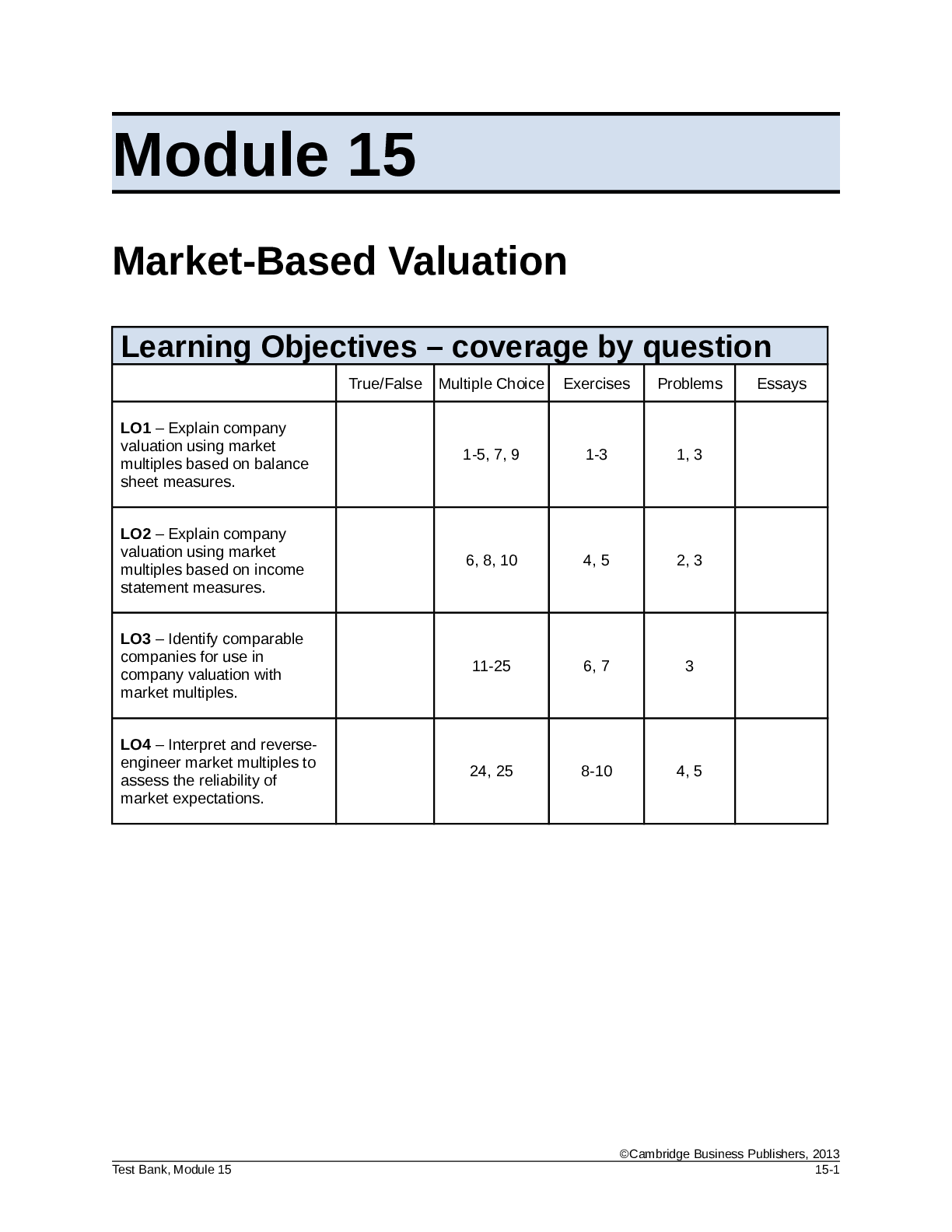
Module 15
Market-Based Valuation
Learning Objectives – coverage by question
True/False Multiple Choice Exercises Problems Essays
LO1 – Explain company
valuation using market
multiples based on balance
sheet measur
...
Module 15
Market-Based Valuation
Learning Objectives – coverage by question
True/False Multiple Choice Exercises Problems Essays
LO1 – Explain company
valuation using market
multiples based on balance
sheet measures.
LO2 – Explain company
valuation using market
multiples based on income
statement measures.
LO3 – Identify comparable
companies for use in
company valuation with
market multiples.
LO4 – Interpret and reverseengineer market multiples to
assess the reliability of
market expectations.
Module 15: Market-Based Valuation
Multiple Choice
Topic: Market Multiples
LO: 1
1. Valuation using market multiples is popular because it simply multiplies a market multiple by what
variable to determine value?
A) Stock price
B) Weighted average cost of capital
C) Summary performance measure
D) Working capital
Answer: C
Rationale: Using market multiples values the firm as the summary performance measure multiplied
by the market multiple.
Topic: Market Multiples
LO: 1
2. Which of the following would not be used as a summary performance measure when using market
multiples to determine value?
A) Stock price
B) Net operating assets
C) Net operating profit after tax
D) Book value
Answer: A
Rationale: Summary performance measures include earnings, book value, NOA, and NOPAT.
Topic: Market Multiples
LO: 1
3. Which of the following is an inconsistency of using market multiples to determine value?
A) Using a market multiple assumes that the target company is correctly priced, while comparable
companies are mispriced.
B) Using a market multiple assumes that the target company is mispriced, while comparable
companies are correctly priced.
C) Using a market multiple assumes that all companies are mispriced.
D) Using a market multiple assumes that the target company can be fully described by its summary
performance measure.
Answer: B
Rationale: Using market multiples values the firm as the summary performance measure multiplied
by the market multiple, which implicitly assumes that other firms from which the market multiple is
obtained are correctly valued.
©Cambridge Business Publishers, 2013
15-2 Financial Statement Analysis & Valuation, 3rd EditionTopic: Balance Sheet Market Multiples
LO: 1
4. When considering the residual operating income model, a company-value-to-net-operating-assets
ratio equal to 1 would suggest:
A) Future ROPI is equal to 0
B) Future ROPI is equal to 1
C) The expected present value of future ROPI is equal to 0
D) The expected present value of future ROPI is equal to 1
Answer: C
Rationale: When using market multiples and the residual operating income model if company value
equals 1 then future ROPI must be zero.
Topic: Balance Sheet Market Multiples
LO: 1
5. Zhang Foods is a manufacturer and distributor of numerous food items. The company has a book
value of $22.17 per share. Zhang Foods is part of the food processing industry which has an industry
PB ratio of 2.17.
Using industry information, estimate the intrinsic value of Zhang Foods equity per share?
A) $10.22
B) $48.11
C) $37.71
D) $46.58
Answer: B
Rationale: Intrinsic value equals book value per share multiplied by the industry PB ratio.
Topic: Income Statement Market Multiples
LO: 2
6. Zhang Foods is a manufacturer and distributor numerous food items. The company recently reported
earnings per share of $4.60. Based on its recent price of $75.42 the company has a PE ratio of 16.4.
Zhang Foods is part of the food processing industry which has an industry P/E ratio of 20.25.
Using industry information, estimate the intrinsic value of Zhang Foods equity per share?
A) $ 4.60
B) $75.42
C) $93.15
D) $37.71
Answer: C
Rationale: Intrinsic value equals earnings per share multiplied by the industry PE ratio
©Cambridge Business Publishers, 2013
Test Bank, Module 15 15-3Topic: Balance Sheet Market Multiples
LO: 1
7. Time Computers is a manufacturer of computer parts. The company has a book value of $1,054,704.
In addition the company has 212,500 common shares issued and outstanding. Time Computers is
part of the computing industry which has an industry PB ratio of 5.31.
Using industry information, estimate the intrinsic value of Time Computers equity per share?
A) $15.58
B) $ 4.96
C) $10.62
D) $26.36
Answer: D
Rationale: Intrinsic value equals book value multiplied by the industry PB ratio. Dividing the intrinsic
value by the number of shares outstanding provides an intrinsic value per share.
Topic: Income Statement Market Multiples
LO: 2
8. Time Computers is a manufacturer of computer parts. The company recently reported earnings of
$1,019,684. In addition, Time Computers has 212,500 shares issued and outstanding. The company
has a PE ratio of 21.8. Time Computers is part of the computer parts industry which has an industry
P/E ratio of 24.3.
Using industry information, estimate the intrinsic value of time Computers equity per share?
A) $ 4.80
B) $ 77.74
C) $116.60
D) $104.61
Answer: C
Rationale: Intrinsic value equals earnings multiplied by the industry PE ratio. Dividing the intrinsic
value by the number of shares outstanding provides an intrinsic value per share.
Topic: Balance Sheet Market Multiples
LO: 1
9. Fairfield Learning is a retailer focused on education supplies. The company has a book value of
$28.88 per share. Fairfield Learning has a PB ratio of 6.23 and the education supplies industry PB
ratio is 5.31. Assuming that comparable industry companies are priced correctly the intrinsic value of
Fairfield Learning’s equity per share is:
A) Undervalued $26.57 per share
B) Overvalued $26.57 per share
C) Priced correctly
D) Overvalued by $28.88 per share
Answer: B
Rationale: Intrinsic value equals book value per share multiplied by the industry PB ratio. To
determine the amount of mispricing, the intrinsic value would be compared to the current price.
©Cambridge Business Publishers, 2013
15-4 Financial Statement Analysis & Valuation, 3rd EditionTopic: Income Statement Market Multiples
LO: 2
10. Fairfield Learning is a retailer focused on education supplies. The company recently reported
earnings per share of $2.76. Based on its recent price of $32.71 the company has a PE ratio of
11.85. The educational supplies industry P/E ratio is 20.25.
Assuming that comparable industry companies are priced correctly the intrinsic value of Fairfield
Learning’s equity per share is:
A) Undervalued $23.18 per share
B) Overvalued $23.18 per share
C) Priced correctly
D) Overvalued by $2.76 per share
Answer: A
Rationale: Intrinsic value equals earnings per share multiplied by the industry PE ratio. To determine
the amount of mispricing the intrinsic value would be compared to the current price.
Topic: Selecting Comparables for Market Multiples
LO: 3
11. Which of the following factors should not be considered when choosing comparable companies and
using net operating assets as the summary performance measure?
A) Expected future profitability
B) Expected future growth
C) Capital structure
D) Expected operating risk
Answer: C
Rationale: RNOA, growth in NOA and the variance of operating income are the three factors that
need to be considered when choosing comparables when net operating assets is the summary
performance measure.
Topic: Selecting Comparables for Market Multiples
LO: 3
12. Which of the following factors should not be considered when choosing comparable companies and
using book value as the summary performance measure?
A) Expected future profitability
B) Expected future growth
C) Expected equity growth
D) Capital structure
Answer: C
Rationale: RNOA, growth in NOA and the variance of operating income and capital structure are the
four factors that need to be considered when choosing comparable companies when book value is
the summary performance measure.
[Show More]



 Correct Study Guide, Download to Score A.png)