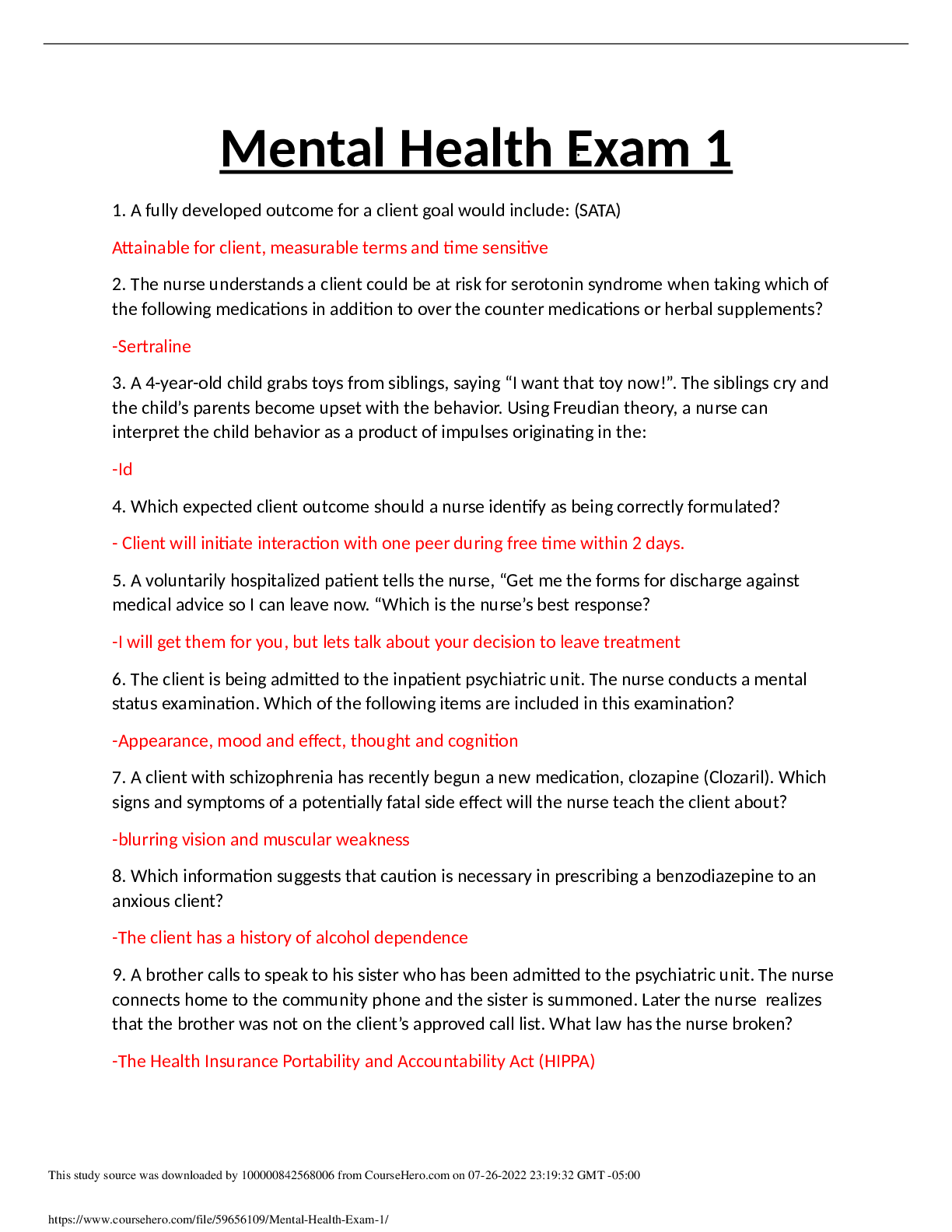
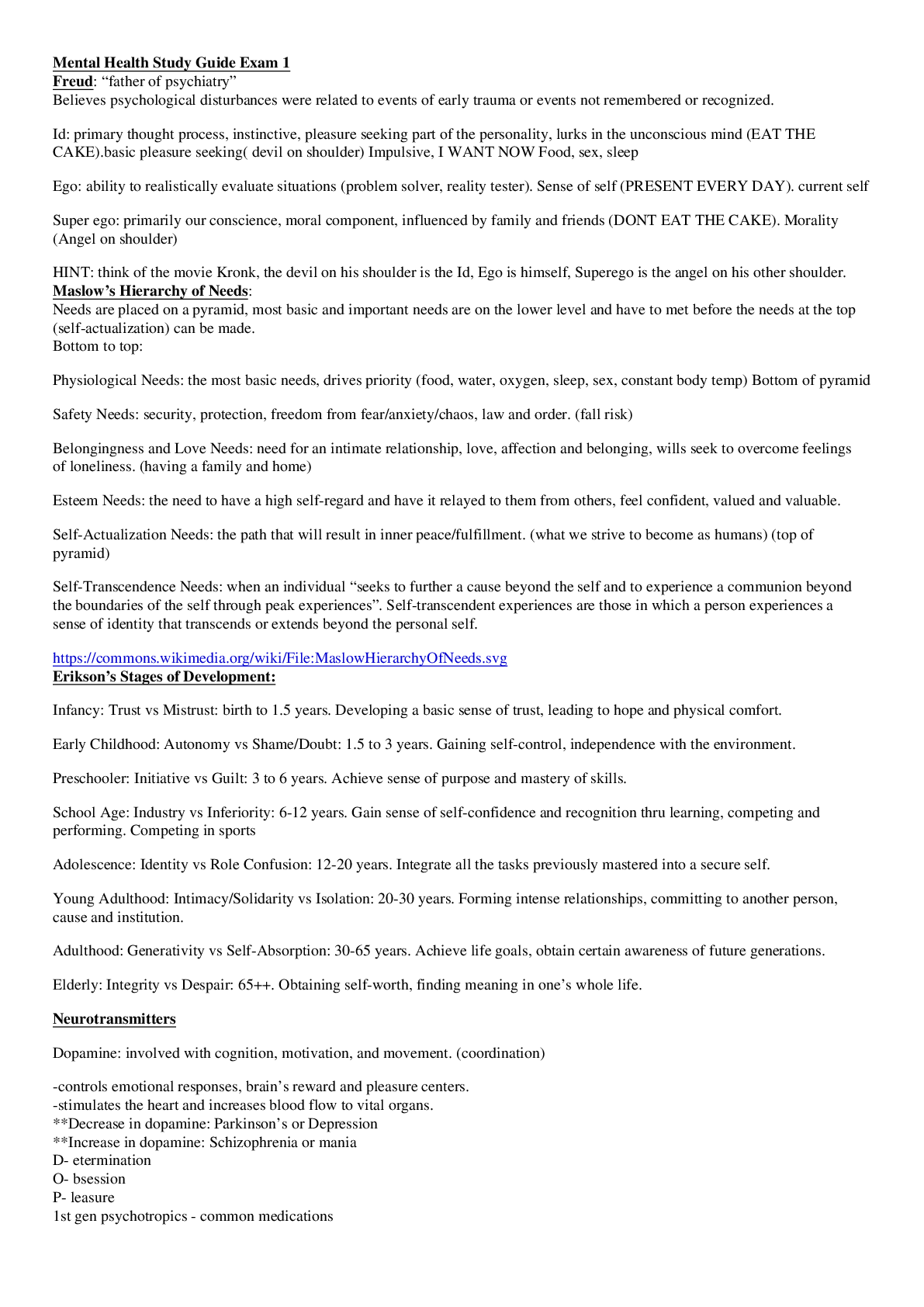
M e n t a l H e al t h E x a m 1
Theorists:
Freud
Id: The primitive, pleasure-seeking part of our personalities that lurks
in the unconscious mind.
Ego: Our sense of self. Acts as an intermediary between the I
...
M e n t a l H e al t h E x a m 1
Theorists:
Freud
Id: The primitive, pleasure-seeking part of our personalities that lurks
in the unconscious mind.
Ego: Our sense of self. Acts as an intermediary between the Id and the
world by using ego defense mechanisms, such as repression, denial,
and rationalization. Engages in secondary process thinking, which is
rational, realistic, and orientated towards problem solving.
Superego: Assigned to those processes that Freud referred to as our
conscience and is greatly influenced by our parents' or caregivers'
morals and ethical stances.
Maslow’s Hierarchy of Needs
1. Physiological- food, water, oxygen, elimination, rest, sex
2. Safety- protection, security, stability, order, structure, limits
3. Love and Belonging Needs- affiliation, affection, lover
4. Esteem- competency, achievement, esteem from others
5. Self Actualization- becoming everything one is capable of
Erikson’s Stages of Development
Infant: Birth - 1.5 yrs old
o Trust vs. Mistrust
o Task: develop a basic sense of trust and comfort and minimal
fear and uncertainty.
Early childhood (toddler) - 1.5-3 yrs old
o Autonomy vs. Shame/doubt
o Task: gain self-control and independence
Preschooler 3-6 yrs old
o Initiative vs. Guilt
o Task: achieve sense of purpose and task mastery
School age 6-12 yrs old
o Industry vs. Inferiority
o Task: self-confidence thru learning and competition
Adolescent 12-20 yrs old
o Identity vs. Role confusion
o Task: differentiation from parents leads to fidelity, integrate all
the above for sense of self
Young adult 20-30 yrs old
o Intimacy vs. isolation
o Task: form intense long term relationships
Adult 30-65 yrs old
o Generativity vs. Self-absorption
o Task: achieve life goals and obtain concern for future generation
Older adult 65+
o Integrity vs. Despair
o Task: derive meaning from life and sense of self worth
Page 2
Role of neurotransmitters as related disorders:
Dopamine
Increase:
o Schizophrenia
o Mania
Decrease:
o Parkinson's disease
o Depression
Functions:
o Fine muscle movement
o Integration of emotions and thoughts
o Decision making
o Stimulates hypothalamus to release hormones (sex, thyroid,
adrenal)
Serotonin
Increase:
o Anxiety states
Decrease:
o Depression
Functions:
o Mood
o Sleep regulation
o Hunger
o Pain perception
o Aggression and libido
o Hormonal activity
Norepinephrine
Increase:
o Mania
o Anxiety
o Schizophrenia
Decrease:
o Depression
Functions:
o Mood
o Attention and arousal
o Stimulates sympathetic branch of autonomic nervous system for
"fight or flight" in response to stress
GABA
Increase:
o Reduction of anxiety
o Schizophrenia
o Mania
Decrease:
o Mania
o Anxiety
o Schizophrenia
Page 3
o Huntington chorea (Huntington's disease)
Functions:
o Inhibitory neurotransmitter:
o Reduces anxiety, excitation, aggression
o May play a role in pain perception
o Anticonvulsant and muscle-relaxing properties
o May impair cognition and psycho motor functioning
Nurse-Client Relationship:
Orientation
Can last for a few meetings or long period of time, the first time the
nurse and patient meet.
o An atmosphere is established in which rapport can grow.
o The nurse's role is clarified, and the responsibilities of both the
patient and the nurse are defined.
o The contract containing the time, place, date, and duration of
the meetings is discussed.
o Confidentiality is discussed and assumed.
o The terms of termination are introduced.
o The nurse becomes aware of transference and
countertransference issues.
o Patient problems are articulated, and mutually agreed goals are
established.
Working
Allows for the patient to experience increased levels of anxiety and
demonstrate dysfunctional behaviors in a safe setting while
experimenting with new and more adaptive coping behaviors.
o Maintain the relationship
o Gather further data
o Promote the patient's problem-solving skills, self-esteem, and
use of language
o Facilitate behavioral change
o Overcome resistance behaviors
o Evaluate problems and goals, and redefine them as necessary
o Promote practice and expression of alternative adaptive
behaviors
Termination phase
The final, integral phase of the nurse-patient relationship. Termination
is discussed during the first interview, and again during the working
stage at appropriate times. Termination may occur when the patient is
discharged or when the student's clinical rotation ends.
o Summarizing the goals and objectives achieved in the
relationship
o Discussing ways for the patient to incorporate into daily life any
new coping strategies learned during the time spent with the
nurse
Page 4
o Reviewing situations that occurred during the time spent
together
o Exchanging memories, which can help validate the experience
for both nurse and patient and facilitate closure of that
relationship
Nurse-client vs social relationship
The therapeutic relationship between nurse and patient differs from
both a social and an intimate relationship in that the nurse maximizes
his or her communication skills, understanding of human behavior, and
personal strengths to enhance the patient's growth. Patients more
easily engage in the relationship when the clinician's interactions
address their concerns, respect the patient as a partner in decision
making, and use language that is straightforward.
Boundaries with clients
Patient needs separated from nurses needs
Warning signs: over helping, controlling, narcissism
Relationship is no longer helpful if boundaries are broken.
Role of psych RN
Nursing process:
Developing plan of care
Developing a goal/outcome
Mental health vs mental illness
[Show More]

.png)
.png)

.png)


![Preview of [eBook] [PDF] Clinical Nursing Calculations 3rd Edition By Susan Sienkiewicz, Sandra Meg](https://browseimages.nyc3.digitaloceanspaces.com/paper-images/2025/Jul/04/4jF14r9I2025-07-04-05-586867ec3011731.png)