Assess Your Knowledge
Mental Health Exam 1
Discuss prominent theories and therapeutic models
o Behavioral Therapy: attempts to correct or eliminate
maladaptive (bad) behaviors/responses by rewarding &
reinforcing ad
...
Assess Your Knowledge
Mental Health Exam 1
Discuss prominent theories and therapeutic models
o Behavioral Therapy: attempts to correct or eliminate
maladaptive (bad) behaviors/responses by rewarding &
reinforcing adaptive (good) behavior. Use of Desensitization,
Aversion Therapy (becoming not afraid of spiders), Biofeedback
and Modeling as well as the below 3 items.
Pavlov, Watson & Skinner
Pavlov: Classical Conditioning (Ex: baby cries and
mom has milk “let-down” reflex).
Watson: Personality traits & responses were learned
(conscious) behavior.
Skinner: Operant Conditioning. Behaviors are
learned through Positive/Negative Reinforcement (Ex:
studying hard results in good grades).
o Cognitive Behavioral Therapy: combines both behavioral and
cognitive theory and seeks to modify negative thoughts that lead
to dysfunctional emotions & actions. This is useful for those
patients who feel incompetent, abandoned, evil or vulnerable.
It is NOT the stimulus (situation/person/place/thing) that
causes the response; it is the person’s evaluation & selfthoughts about the situation that causes the negative
feelings/reaction. Therapy aims to remove these
negative/repetitive thoughts and replace them with
rational interpretations of situations.
Ex: “Matt had a car accident. He now refuses to drive and
says, “I shouldn’t be allowed on the road”. (This is
distorted thinking and rationalization of his car accident).
o Milieu Therapy: Creating a SAFE, structured
inpatient/outpatient setting where the mentally ill can test new
behaviors and coping mechanisms with others.
Creating a SAFE, structured inpatient/outpatient setting
where patients with mental illness can test new behaviors
and interactions.
Climate is essential to healing: paint color, relaxed
environments are conducive to the healing process.
Florence Nightingale believed that the environment helps
heal
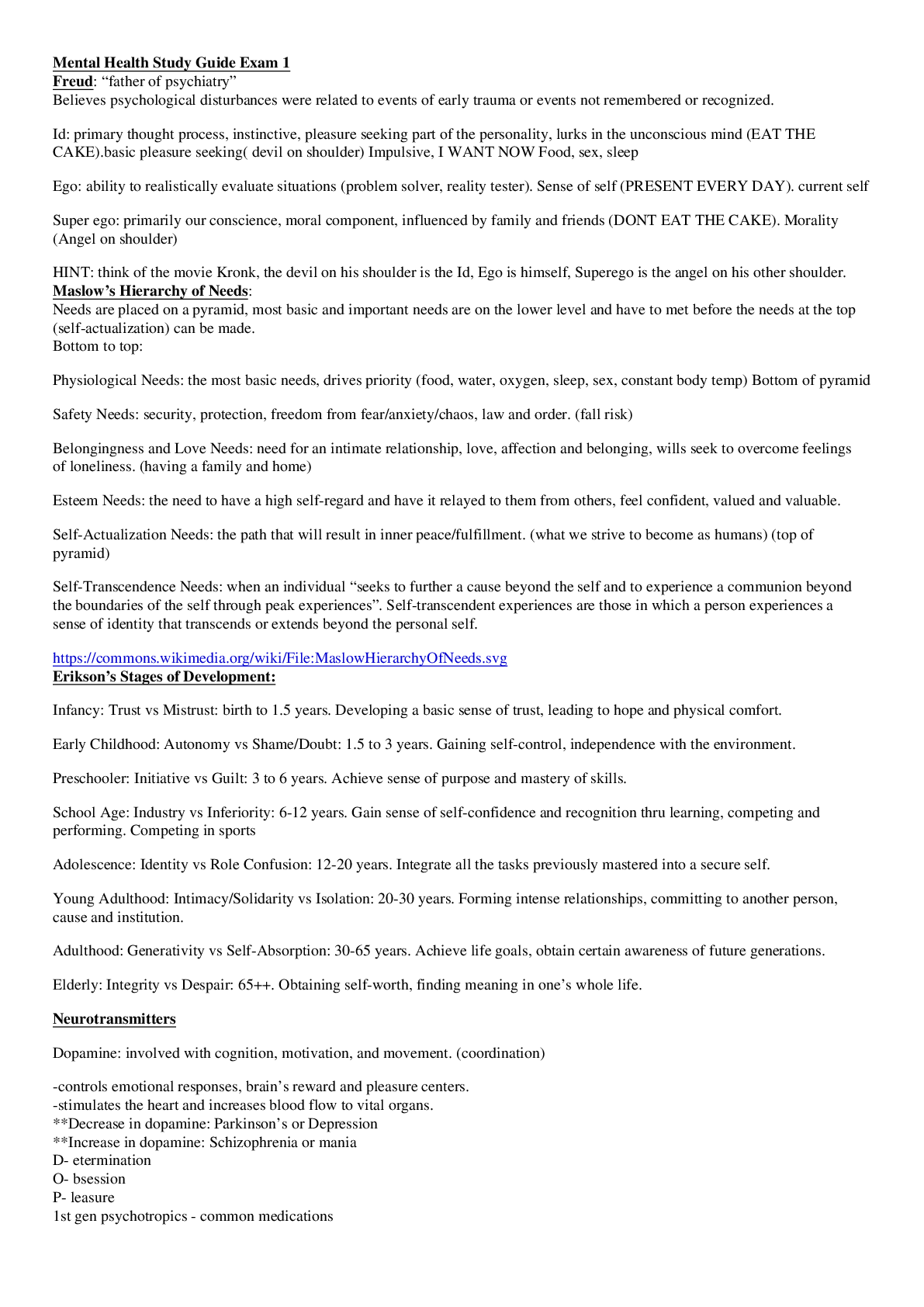
o Maslow’s Hierarchy of Needs: Basic needs on the bottom of
the pyramid have to be met before the top (self-actualization)
can be attained.
1. Physiological Needs – most basic needs that a human
needs (food, water, O2, sleep, sex, body temperature,
elimination, voiding). This level takes priority over all
others.
Assess Your Knowledge
Mental Health Exam 1
2. Safety Needs – security, protection, and freedom from
fear/anxiousness/chaos, law, order and limitations.
3. Belonging & Love Needs – The need for love, affection,
intimate relationships and belonging will see to overcome
feelings of loneliness and alienation. (Having a Family and
a Home is very important).
4. Esteem Needs – If this need is met, we feel confident,
valued and valuable. If this need is NOT met, we feel
inferior, worthless and helpless.
5. Self-Actualization – What we strive to become as humans.
Fulfillment of this need brings inner piece and contentment
with ones self.
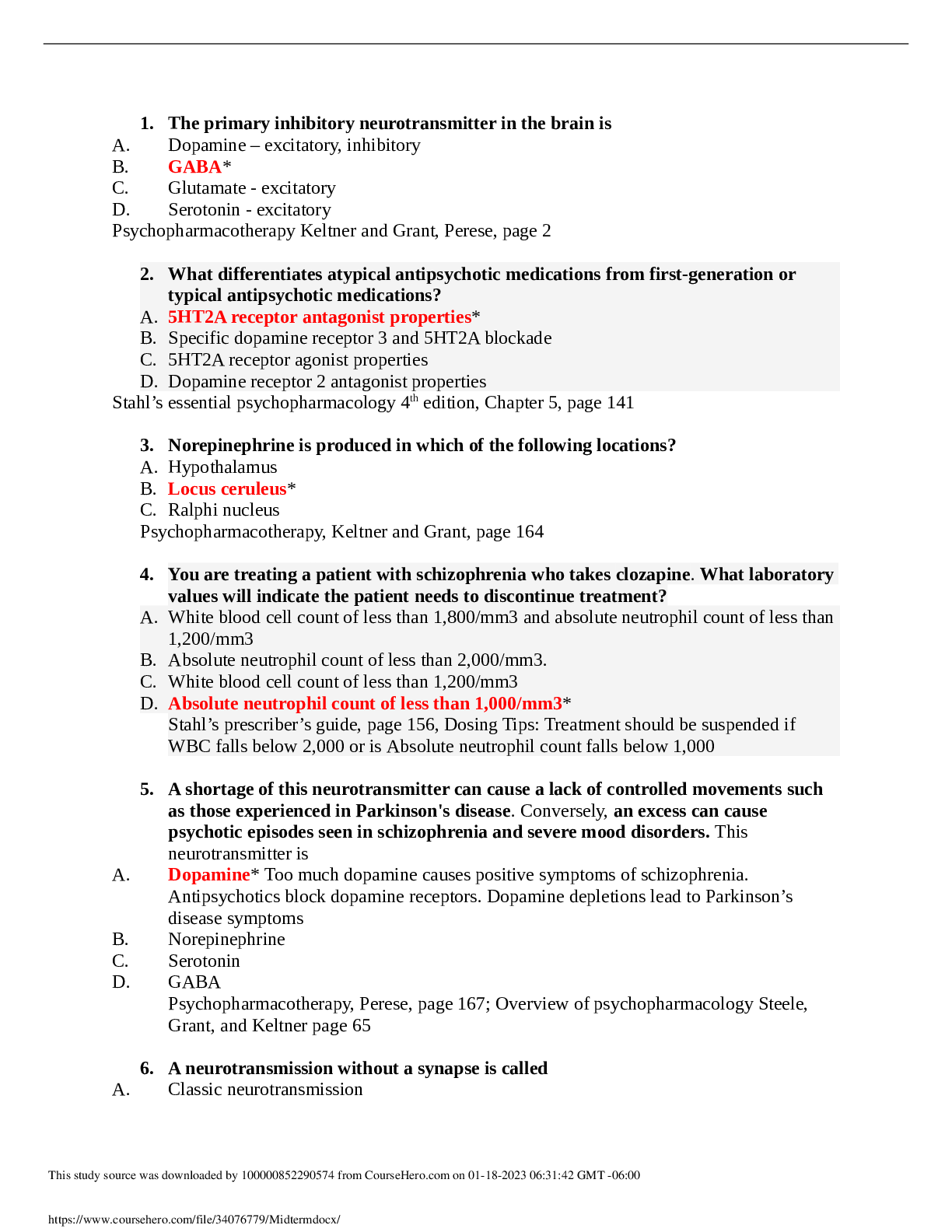
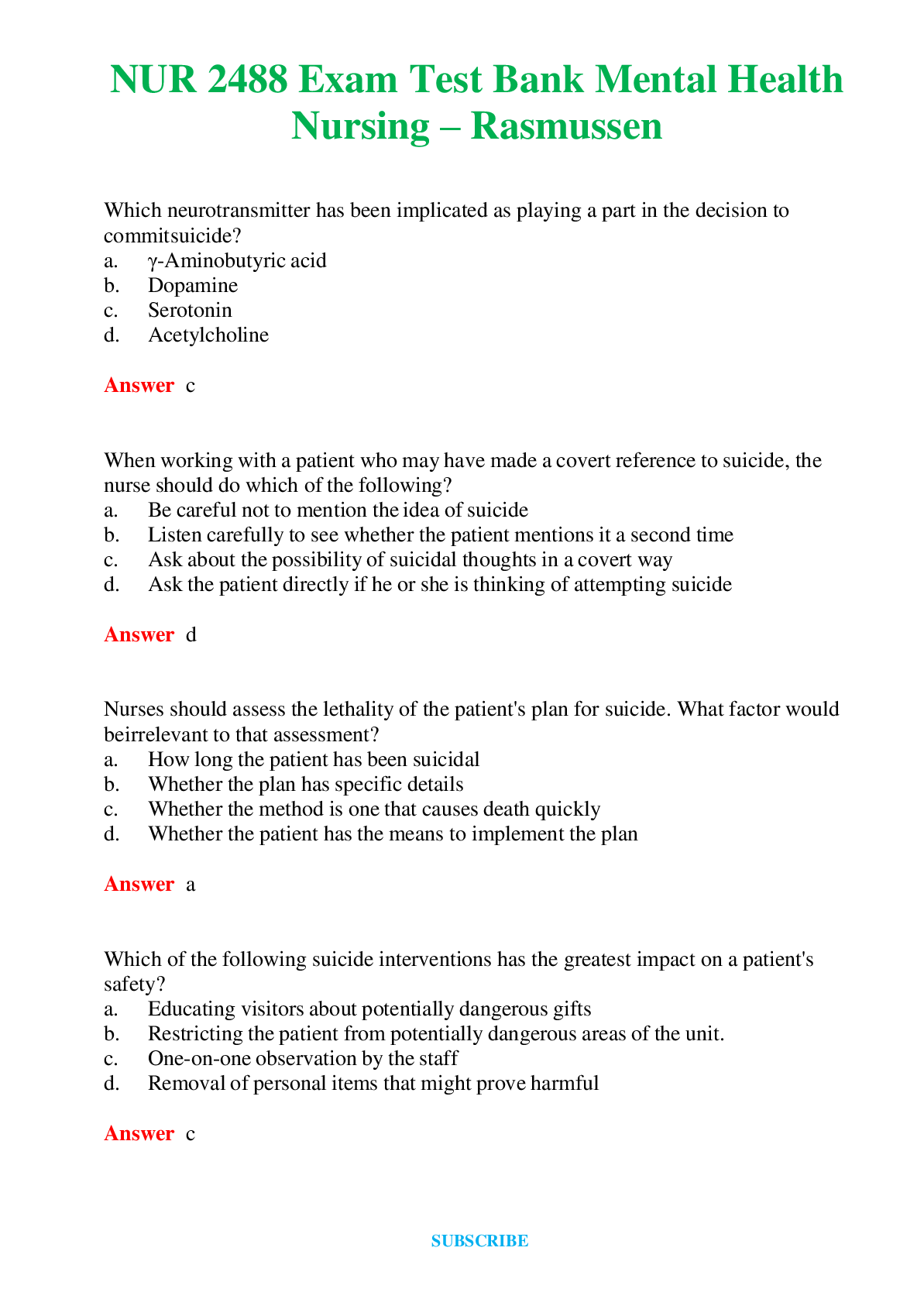
Describe the role of neurotransmitters: dopamine, serotonin, and
norepinephrine, GABA
Dopamine: controls emotional responses, the brain’s reward
and pleasure centers, stimulates heart and increases blood flow
to organs. (Haloperidol = dopamine blocker). Cocaine allows
more of dopamine to stay active for longer = increased HR, etc.
o EPS is the result of Dopamine blockers (Dopamine
needs to get through for proper brain functioning!)
o Disorders with HIGH levels: Schizophrenia, Mania
o Disorders with LOW levels: Depression, Parkinson’s Disease
Serotonin: Regulates mood, arousal, attention, behavior, and
body temperature. Most anti-depressants increase Serotonin
production. Muscle Relaxants block serotonin production.
Serotonin release by platelets play important role in
homeostasis.
o High levels of Serotonin S/Sx: causes restlessness,
shivering, diarrhea, muscle rigidity, fever and seizures.
o Disorders with HIGH levels: Anxiety
o Disorders with LOW levels: Depression
Norepinephrine: Regulate mood. A deficiency can cause
Depression and excess can cause Mania.
o Disorders with HIGH levels: Mania, Anxiety, Schizophrenia
o Disorders with LOW levels: Depression
GABA: inhibitory neurotransmitter that regulates excitability and
helps treat anxiety by helping you “chill out”. Anti-Anxiety Meds
help increase the effectiveness of GABA by making the receptors
more responsive.
o Disorders with HIGH levels: Reduction of Anxiety
o Disorders with LOW levels: Mania, Anxiety, Schizophrenia
Describe the phases of the nurse-client relationship, and what
occurs during each phase (Hildegard Peplau)
1. Orientation Phase: first time the nurse & patient meet, interact
according to their own backgrounds/standards/values/beliefs,
Assess Your Knowledge
Mental Health Exam 1
roles of the patient and nurse are clarified, confidentiality is
discussed and assumed, nurse becomes aware of transferences
& countertransference issues, goals are established, termination
terms are introduced.
2. Working Phase: exploration of feelings or situations that are
causing the problems, re-experiencing of old conflicts can
awaken high levels of anxiety, intense emotional states may
surface, defense mechanisms, denying, manipulation, evaluation
of problems and goals, promote alternative reactions/behaviors
to situations, etc. The nurse’s awareness of his or her own
personal feelings and reactions to the patient are VITAL for
effective interaction with the patient.
3. Termination Phase: summarization of goals, review of what was
achieved during communication, discussing new ways to
implement new coping strategies, evokes strong feelings in both
client & nurse.
Describe the client interview- what should be considered and
included
What should be Considered:
o The interview (content & direction) is lead by the patient.
o The nurse uses open communication, positive attending
behaviors, and active listening to better understand the
patient’s situation. This allows the patient to feel
understood, listened to, explore problems, healthy ways to
meet emotional needs and have a satisfying interpersonal
relationship experience.
What should be Included:
o Setting: has a large impact on healing (remember to use
Milieu techniques)
o Seating: stay between patient and door, avoid sitting
behind a desk, sit at an angle with the chairs (not face-to
face)
o Introductions: who you are, purpose of meeting, length of
meeting, confidentiality of meeting, asking patient how
they like to be addressed (Blake vs. Mr. Anderson), etc.
o Initiating Interview: use open ended questions like “Where
should we start”, “Tell me what has been going on when
you recently”
o Offering Leads: “Go on…”
o Making statements of Acceptance: “I follow you…”
Helpful Guidelines
o Speak briefly
o When you don’t know what to say, don’t say anything
o Focus on feelings
Assess Your Knowledge
Mental Health Exam 1
o Don’t give advice
o Avoid relying on questions
o Note patient’s non-verb
[Show More]
.png)

.png)
.png)


.png)