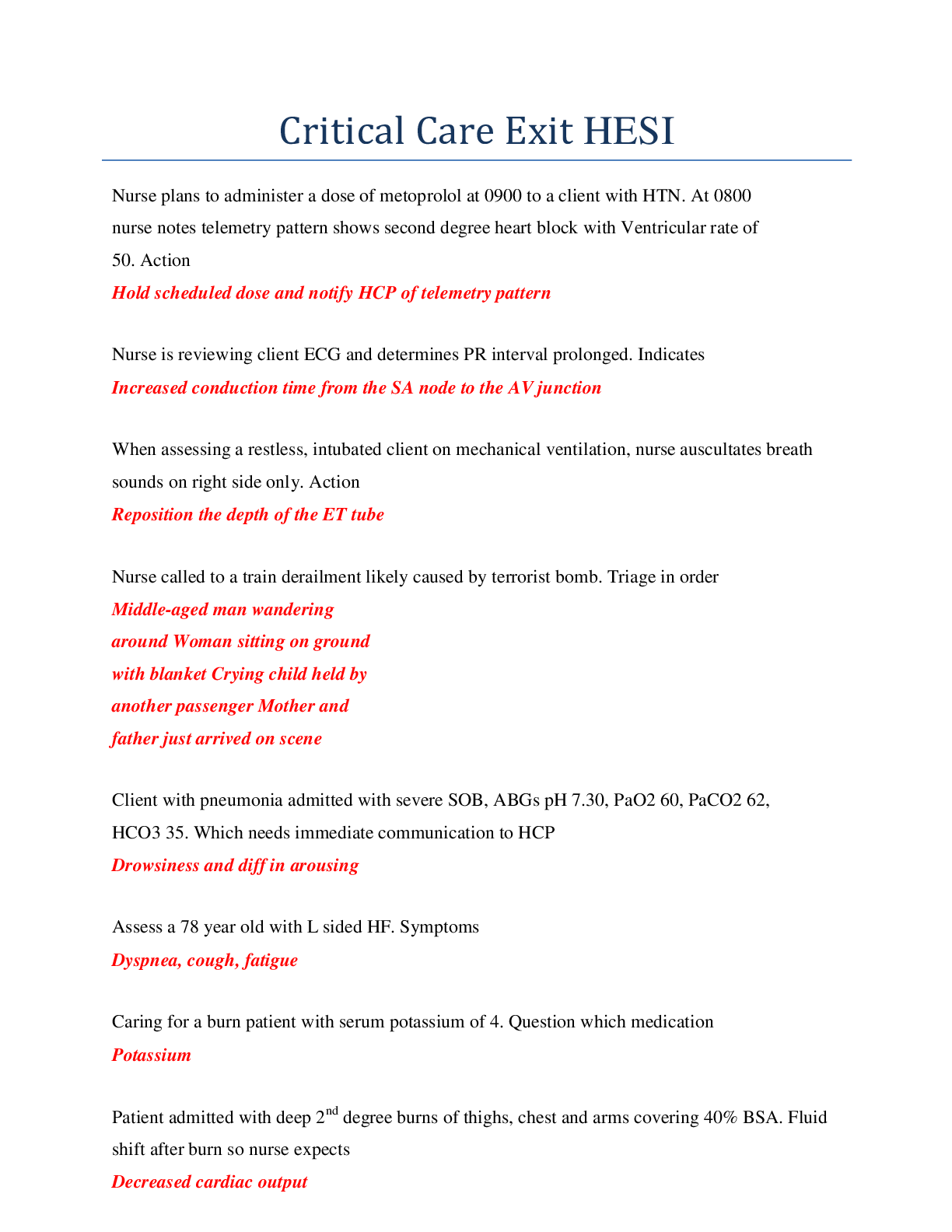
Critical care HESI – 55 questions
Cardiac
o SVT: supraventricular tachycardia
No p waves seen
Treatment:
Adenosine – give 6mg, then 12mg, then another 12mg
Cardioversion if pt not tolerating rhythm
Don
...
Critical care HESI – 55 questions
Cardiac
o SVT: supraventricular tachycardia
No p waves seen
Treatment:
Adenosine – give 6mg, then 12mg, then another 12mg
Cardioversion if pt not tolerating rhythm
Don’t defibrillate!!!
Have someone bring crash cart to room
o Atrial fibrillation:
Chaotic atrial activity
Irregularly irregular
Controlled: vent rate < 100
On digoxin at home and has controlled a fib look at digoxin
level
Uncontrolled: vent rate > 100
P waves are fibrillatory
High risk for clots give anticoagulant
Common in elderly
Holiday heart syndrome: alcohol and emotional stress
o Atrial flutter:
Ventricular rhythm stays regular
Sawtooth waves
Cardiovert!
o Asystole: flat line
Patient is essentially dead
Give CPR and epi
Pulse is gone
Patient in asystole for 20 minutes talk to family, patient is dead
o 3
rd degree heart block
Look at patient’s blood pressure, bradycardia
Give atropine, epinephrine, pacemaker
o Alcoholic EKG
Wide QRS and flat T = life threatening
Flat T means hypokalemia
o Peaked t waves are usually from hyperkalemia
o STEMI: ST elevation myocardial infarction
Give thrombolytics within 4 hours of onset
o MI vs. Indigestion
Classic symptoms of MI: dull chest pain radiating down left arm
Women, elderly, pt’s with hx of DM may not have classic symptoms,
instead:
N/V
Belching
Indigestion
Diaphoresis
This study source was downloaded by 100000831988016 from CourseHero.com on 05-06-2022 11:49:09 GMT -05:00
https://www.coursehero.com/file/52376523/critical-care-HESI-finaldocx/
Dizziness
Fatigue
o New nurse on cardiac unit:
Assign pt with sinus arrhythmia going for a stress test
Don’t assign:
Torsades
V tach
V fib
o Pulmonary artery catheter insertion, swan insertion
Priority is monitoring the pressures
When it gets into right ventricle watch for arrhythmias
Sterile field
o Hand is cold and decreased capillary refill – call physician because clot may be
forming, don’t do an Allen test
o Radial artery line and pt has decreased cap refill call the physician
o Hemorrhagic stroke
Do not give tPa!!!
o Ischemic stroke
Look at BP before giving alteplase
o Cardiac tamponade
Muffled heart sounds
Jugular venous distention
Hypertension
Tx: pericardial centesis
o Vasodilation medications
Morphine
Lidocaine
o Dopamine
Vasopressor and will increase BP
Increases renal flow at low doses
So if low dose renal dose
Increases vasodilation of artery no higher than 5 mcg/kg/min
o DIC: first sign is often gums bleeding
PT/INR
o Heart failure
BNP should be less than 100, if it’s over 100 it’s indicative of heart failure,
lung dysfunction
o Pacemaker is firing and nothing is happening
Look at sensitivity/sync mode of pacemaker, possibly increase rate
o IABP: intraaortic balloon pump
Pt condition is improving with IABP when you see a decreased wedge
pressure, and an increased cardiac output
o CVP: for monitoring
Need transducer hooked up and at phlebostatic axis
This study source was downloaded by 100000831988016 from CourseHero.com on 05-06-2022 11:49:09 GMT -05:00
https://www.coursehero.com/file/52376523/critical-care-HESI-finaldocx/
o Phlebostatic axis – 4th
intercostal space @ midaxillary line – also points to right
atrium
You’ve already calibrated transducer to right atrium – that’s correct
Endocrine
o HHNS
Extreme hyperglycemia
No ketones
Extracellular fluid deficit
Osmotic diuresis
Some insulin still produced so blood glucose rises slowly
Associated with type 2
Neuro manifestations:
Blurry vision
Lethargy
Obtundation
Coma
o DKA
Hyperglycemia
Ketones present
Acidosis
Caused by intense decreased level of insulin
Electrolytes are depleted
Kussmaul respirations
Priority: rehydration
Body tries to compensate with respiratory alkalosis
Type 1
Pt experiences dehydration bc of osmotic diuresis
When DKA resolves hypokalemia frequently occurs
o Addison’s disease – adrenocortical insufficiency
May be hypotensive initially
Increase dose of steroids during times of stress: surgery, sick
First thing is to hang IV fluids
Second thing is give corticosteroids
Decreased immune response
Hyperglycemia
Cataracts
Don’t stop abruptly
Cortisol levels: High in morning, after 8PM you’ll see a decrease
o SIADH
Causes hyponatremia
Give hypertonic solution
Fluid restriction
Monitor neuro status
Vasopressor antagonist
Put on seizure precautions
Neuro
This study source was downloaded by 100000831988016 from CourseHero.com on 05-06-2022 11:49:09 GMT -05:00
https://www.coursehero.com/file/52376523/critical-care-HESI-finaldocx/
o Cushing’s triad
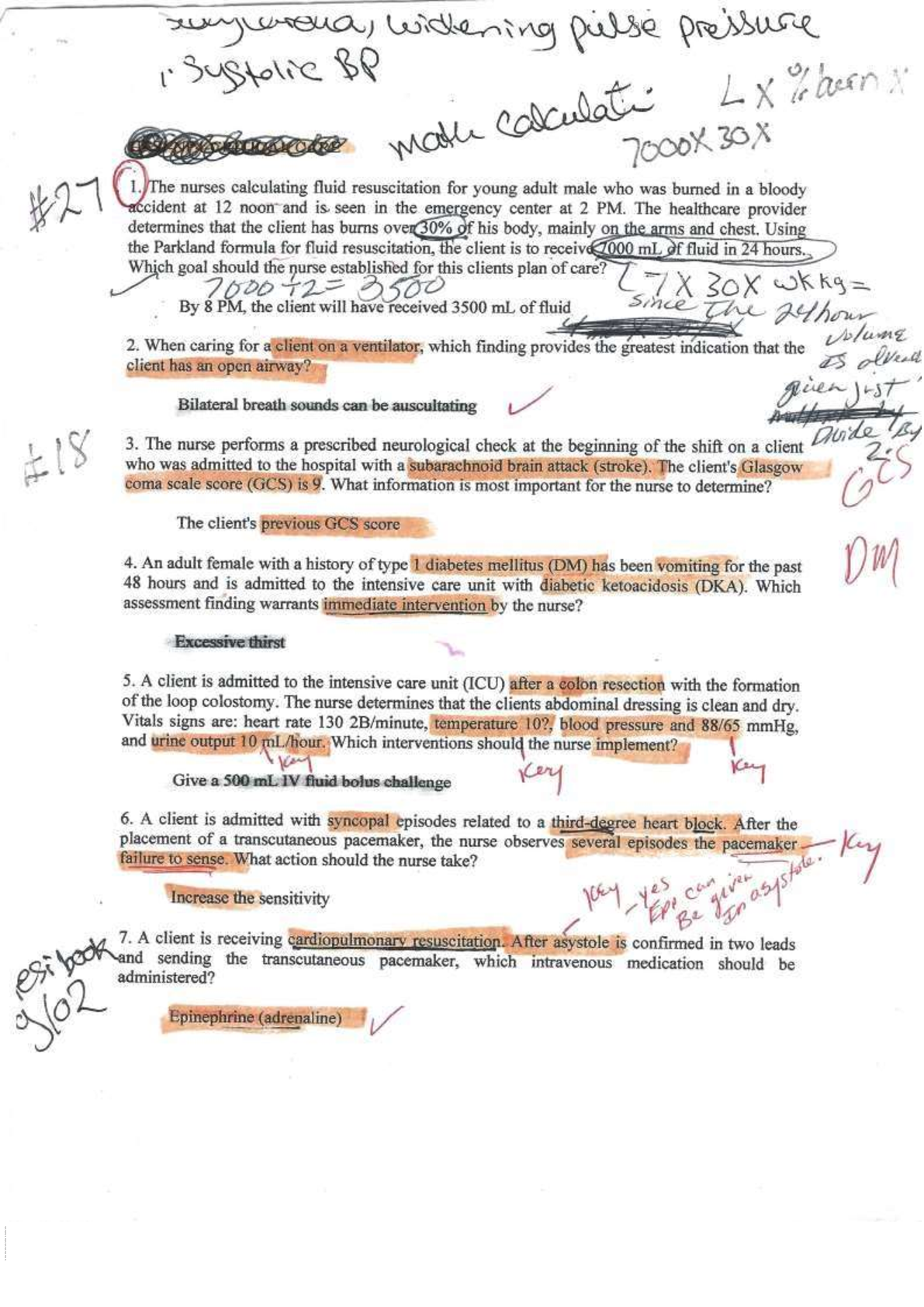
Widening pulse pressure/hypotension
Bradycardia
Irregular respirations (bradypnea/Cheyne-Stokes)
o Pt with increased ICP
Spread out interventions – give rest periods
o GCS
GCS of 9 – want to compare it to what it was last time it was checked
A decline of even 1 in 1 hour is significant
Maximum score is 15, minimum is 3
Eye opening (alertness)
o 4: spontaneously
o 3: to speech
o 2: to pain
o 1: none
Verbal response (o
[Show More]



.png)





.png)