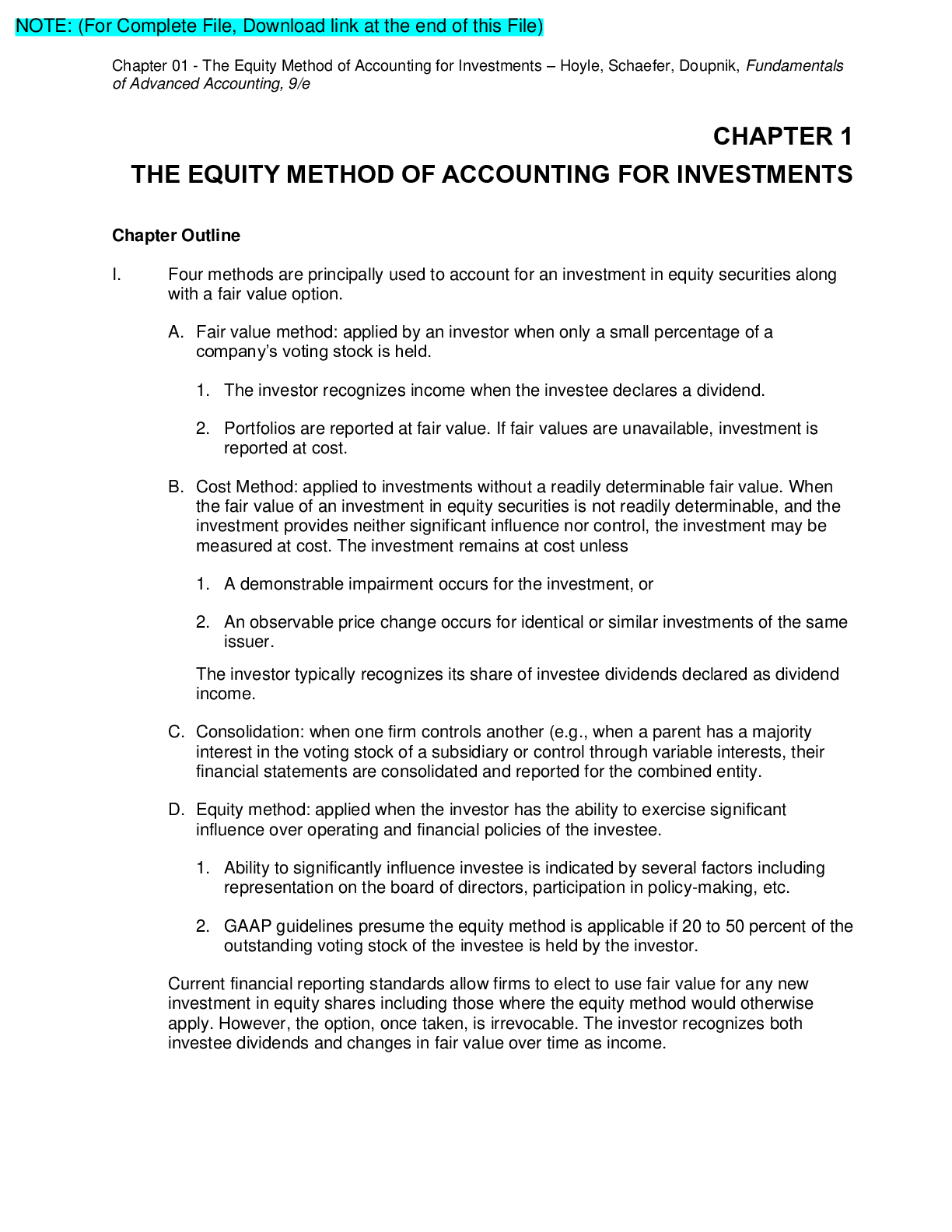
. Gaw Company owns 15% of the common stock of Trace Corporation and
used the fair-value method to account for this investment. Trace
reported net income of $110,000 for 2011 and paid dividends of
$60,000 on October 1,
...
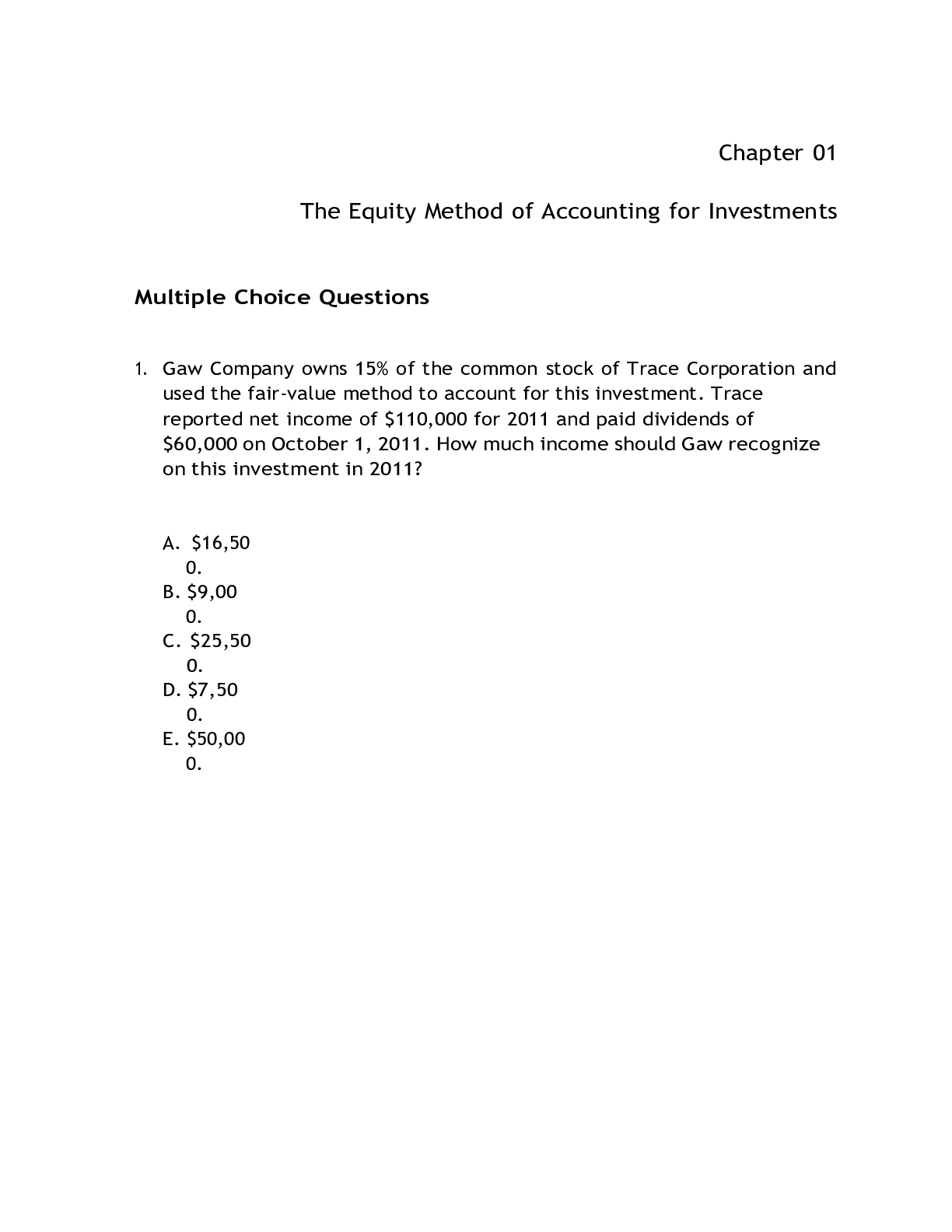
. Gaw Company owns 15% of the common stock of Trace Corporation and
used the fair-value method to account for this investment. Trace
reported net income of $110,000 for 2011 and paid dividends of
$60,000 on October 1, 2011. How much income should Gaw recognize
on this investment in 2011?
A. $16,50
0.
B. $9,00
0.
C. $25,50
0.
D. $7,50
0.
E. $50,00
0.
Full file at http://gettestbank.eu/Test-Bank-for-Advanced-Accounting,-11th-Edition-Joe-Ben-Hoyle
2. Yaro Company owns 30% of the common stock of Dew Co. and uses the
equity method to account for the investment. During 2011, Dew
reported income of $250,000 and paid dividends of $80,000. There is
no amortization associated with the investment. During 2011, how
much income should Yaro recognize related to this investment?
A. $24,00
0.
B. $75,00
0.
C. $99,00
0.
D. $51,00
0.
E. $80,00
0.
3. On January 1, 2011, Pacer Company paid $1,920,000 for 60,000 shares
of Lennon Co.'s voting common stock which represents a 45%
investment. No allocation to goodwill or other specific account was
made. Significant influence over Lennon was achieved by this
acquisition. Lennon distributed a dividend of $2.50 per share during
2011 and reported net income of $670,000. What was the balance in
the Investment in Lennon Co. account found in the financial records of
Pacer as of December 31, 2011?
A. $2,040,50
0.
B. $2,212,50
0.
C. $2,260,50
0.
D. $2,171,50
0.
E. $2,071,50
0.
Full file at http://gettestbank.eu/Test-Bank-for-Advanced-Accounting,-11th-Edition-Joe-Ben-Hoyle
4. A company should always use the equity method to account for an
investment if:
A. it has the ability to exercise significant influence over the operating
policies of the investee.
B. it owns 30% of another company's
stock.
C. it has a controlling interest (more than 50%) of another
company's stock.
D.the investment was made primarily to earn a return on
excess cash.
E. it does not have the ability to exercise significant influence over the
operating policies of the investee.
5. On January 1, 2009, Dermot Company purchased 15% of the voting
common stock of Horne Corp. On January 1, 2011, Dermot purchased
28% of Horne's voting common stock. If Dermot achieves significant
influence with this new investment, how must Dermot account for the
change to the equity method?
A. It must use the equity method for 2011 but should make no changes
in its financial statements for 2010 and 2009.
B. It should prepare consolidated financial statements
for 2011.
C. It must restate the financial statements for 2010 and 2009 as if the
equity method had been used for those two years.
D. It should record a prior period adjustment at the beginning of 2011
but should not restate the financial statements for 2010 and 2009.
E. It must restate the financial statements for 2010 as if the equity
method had been used then.
Full file at http://gettestbank.eu/Test-Bank-for-Advanced-Accounting,-11th-Edition-Joe-Ben-Hoyle
6. During January 2010, Wells, Inc. acquired 30% of the outstanding
common stock of Wilton Co. for $1,400,000. This investment gave Wells
the ability to exercise significant influence over Wilton. Wilton's assets
on that date were recorded at $6,400,000 with liabilities of $3,000,000.
Any excess of cost over book value of Wells' investment was attributed
to unrecorded patents having a remaining useful life of ten years.
In 2010, Wilton reported net income of $600,000. For 2011, Wilton
reported net income of $750,000. Dividends of $200,000 were paid in
each of these two years. What was the reported balance of Wells'
Investment in Wilson Co. at December 31, 2011?
A. $1,609,00
0.
B. $1,485,00
0.
C. $1,685,00
0.
D. $1,647,00
0.
E. $1,054,30
0.
7. On January 1, 2011, Bangle Company purchased 30% of the voting
common stock of Sleat Corp. for $1,000,000. Any excess of cost over
book value was assigned to goodwill. During 2011, Sleat paid dividends
of $24,000 and reported a net loss of $140,000. What is the balance in
the investment account on December 31, 2011?
A. $950,80
0.
B. $958,00
0.
C. $836,00
0.
D. $990,10
0.
E. $956,40
0.
Full file at http://gettestbank.eu/Test-Bank-for-Advanced-Accounting,-11th-Edition-Joe-Ben-Hoyle
8. On January 1, 2011, Jordan Inc. acquired 30% of Nico Corp. Jordan used
the equity method to account for the investment. On January 1, 2012,
Jordan sold two-thirds of its investment in Nico. It no longer had the
ability to exercise significant influence over the operations of Nico. How
should Jordan have accounted for this change?
A. Jordan should continue to use the equity method to maintain
consistency in its financial statements.
B. Jordan should restate the prior years' financial statements and
change the balance in the investment account as if the fair-value
method had been used since 2011.
C. Jordan has the option of using either the equity method or the fairvalue method for 2011 and future years.
D. Jordan should report the effect of the change from the equity to the
fair-value method as a retrospective change in accounting principle.
E. Jordan should use the fair-value method for 2012 and future years
but should not make a retrospective adjustment to the investment
account.
9. Tower Inc. owns 30% of Yale Co. and applies the equity method. During
the current year, Tower bought inventory costing $66,000 and then sold
it to Yale for $120,000. At year-end, only $24,000 of merchandise was
still being held by Yale. What amount of intra-entity inventory profit
must be deferred by Tower?
A. $6,48
0.
B. $3,24
0.
C. $10,80
0.
D. $16,20
0.
E. $6,61
0
[Show More]
.png)


.png)