Feedback Log
0:00 You arrived at the patient's side.
0:00 You introduced yourself.
0:09 You washed your hands. To maintain patient safety, it is important to wash your
hands as soon as you enter the room.
0:10 Patie
...
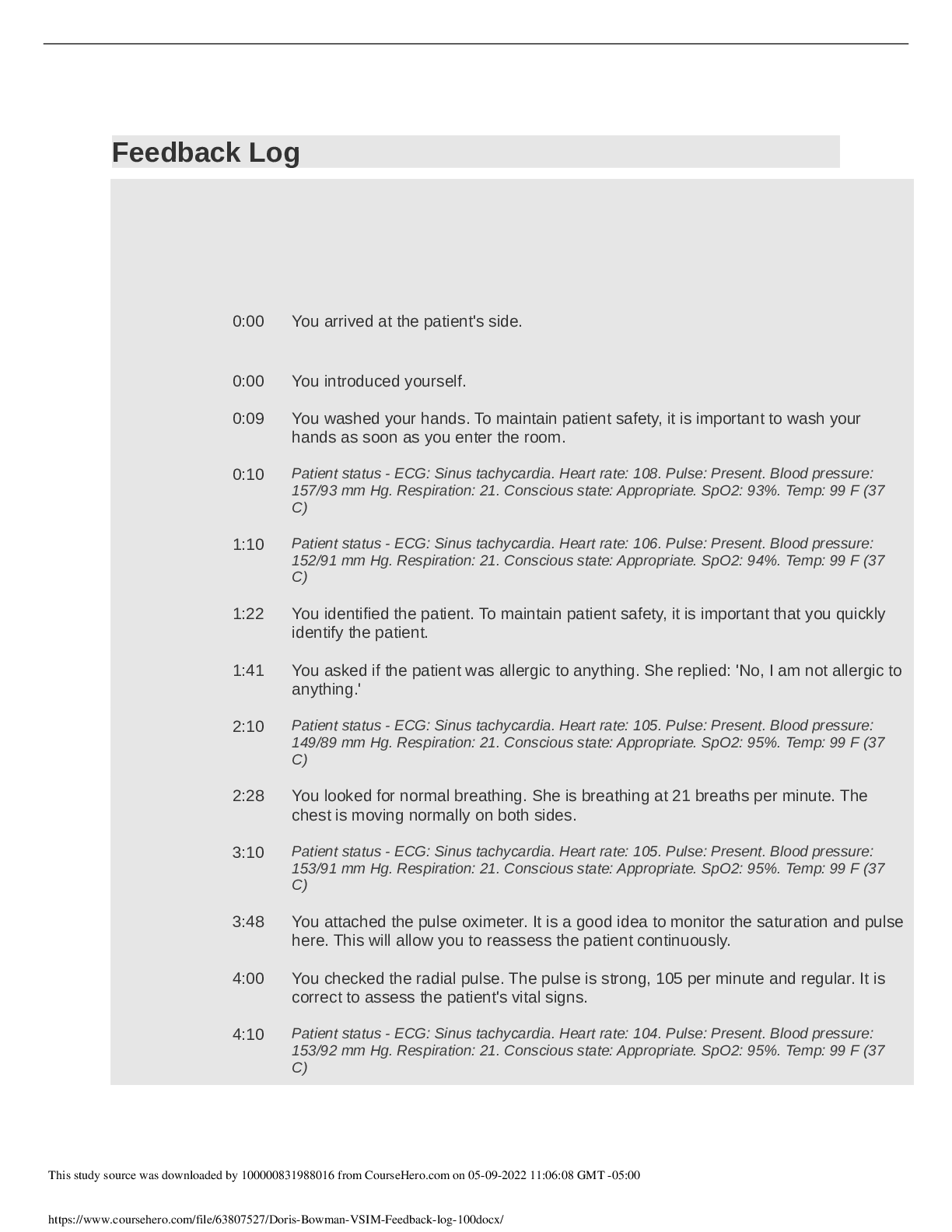
Feedback Log
0:00 You arrived at the patient's side.
0:00 You introduced yourself.
0:09 You washed your hands. To maintain patient safety, it is important to wash your
hands as soon as you enter the room.
0:10 Patient status - ECG: Sinus tachycardia. Heart rate: 108. Pulse: Present. Blood pressure:
157/93 mm Hg. Respiration: 21. Conscious state: Appropriate. SpO2: 93%. Temp: 99 F (37
C)
1:10 Patient status - ECG: Sinus tachycardia. Heart rate: 106. Pulse: Present. Blood pressure:
152/91 mm Hg. Respiration: 21. Conscious state: Appropriate. SpO2: 94%. Temp: 99 F (37
C)
1:22 You identified the patient. To maintain patient safety, it is important that you quickly
identify the patient.
1:41 You asked if the patient was allergic to anything. She replied: 'No, I am not allergic to
anything.'
2:10 Patient status - ECG: Sinus tachycardia. Heart rate: 105. Pulse: Present. Blood pressure:
149/89 mm Hg. Respiration: 21. Conscious state: Appropriate. SpO2: 95%. Temp: 99 F (37
C)
2:28 You looked for normal breathing. She is breathing at 21 breaths per minute. The
chest is moving normally on both sides.
3:10 Patient status - ECG: Sinus tachycardia. Heart rate: 105. Pulse: Present. Blood pressure:
153/91 mm Hg. Respiration: 21. Conscious state: Appropriate. SpO2: 95%. Temp: 99 F (37
C)
3:48 You attached the pulse oximeter. It is a good idea to monitor the saturation and pulse
here. This will allow you to reassess the patient continuously.
4:00 You checked the radial pulse. The pulse is strong, 105 per minute and regular. It is
correct to assess the patient's vital signs.
4:10 Patient status - ECG: Sinus tachycardia. Heart rate: 104. Pulse: Present. Blood pressure:
153/92 mm Hg. Respiration: 21. Conscious state: Appropriate. SpO2: 95%. Temp: 99 F (37
C)
This study source was downloaded by 100000831988016 from CourseHero.com on 05-09-2022 11:06:08 GMT -05:00
https://www.coursehero.com/file/63807527/Doris-Bowman-VSIM-Feedback-log-100docx/
4:28 You attached the automatic noninvasive blood pressure (NIBP) measurement cuff.
This will allow you to reassess the patient continuously.
4:37 You checked the temperature at the mouth. The temperature was 99 F (37 C).
4:47 You asked the patient if she had any pain. She replied: 'Yes! Ahh...'
4:58 You asked the patient if anything made the pain better. She replied: 'No, not really.'
5:02 You asked the patient if anything made the pain worse. She replied: 'No, not really.'
5:06 You asked the patient if she could describe her pain. She replied: 'It hurts around my
stomach, please give me something for the pain.'
5:09 You asked the patient where the pain was located. She replied: 'It's in my stomach.'
5:10 Patient status - ECG: Sinus tachycardia. Heart rate: 104. Pulse: Present. Blood pressure:
154/93 mm Hg. Respiration: 21. Conscious state: Appropriate. SpO2: 95%. Temp: 99 F (37
C)
5:19 You asked: How bad is the pain? She replied: 'It's pretty bad, I'd give it a 6.'
5:28 You asked the patient how long she had pain for. She replied: 'Since surgery'
5:38 You asked the patient if the pain was better after the medication. She replied: 'It's the
same.'
5:57 You attached a 3-lead EC
[Show More]