ATI MED SURG PRACTICE QUESTIONS WITH CORRECT ANSWERS
Chapter 12-Integumentary Disorder:
Burns
1. The client comes into the emergency room in severe pain and reports that a pot of boiling hot water accidentally spilled
...
ATI MED SURG PRACTICE QUESTIONS WITH CORRECT ANSWERS
Chapter 12-Integumentary Disorder:
Burns
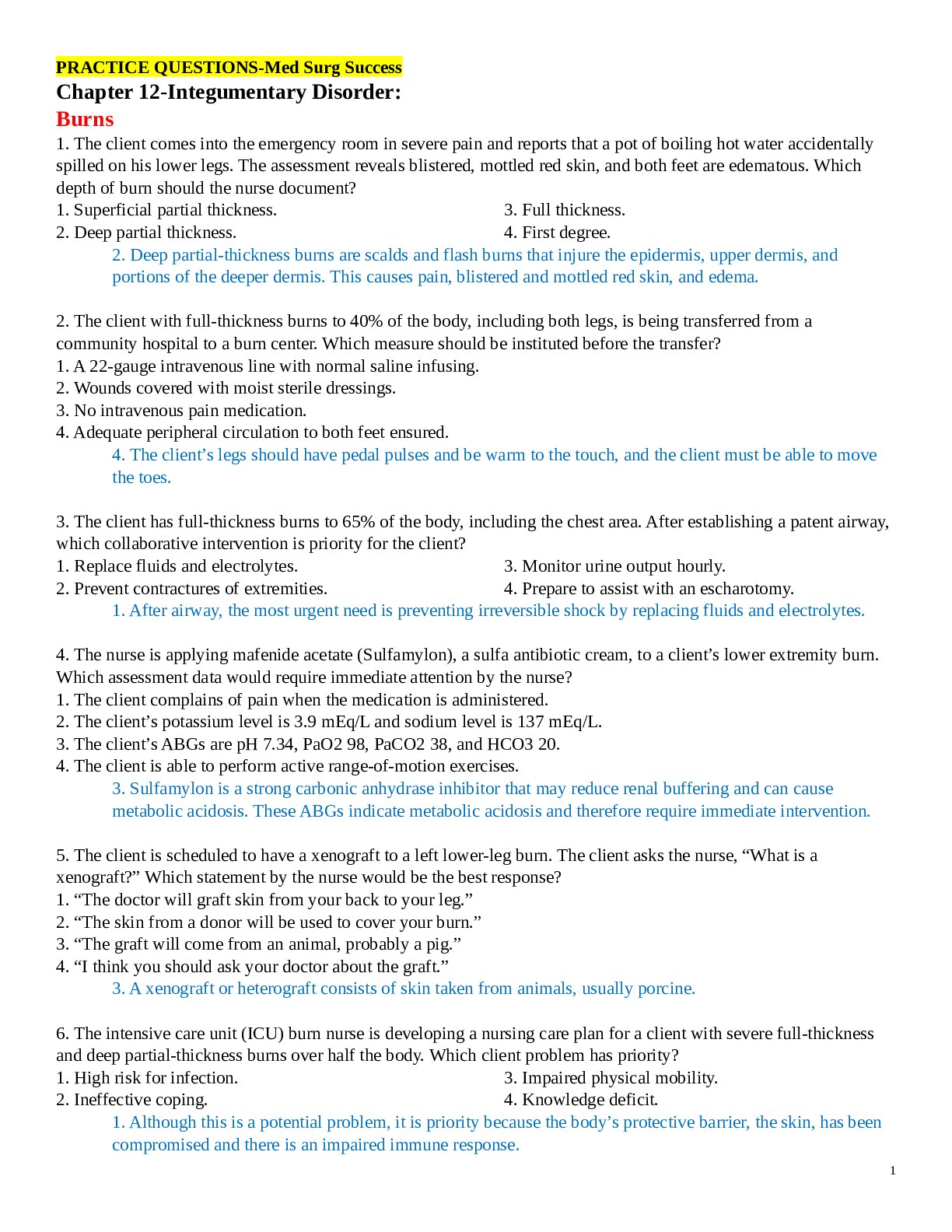
1. The client comes into the emergency room in severe pain and reports that a pot of boiling hot water accidentally spilled on his lower legs. The assessment reveals blistered, mottled red skin, and both feet are edematous. Which depth of burn should the nurse document?
1.Superficial partial thickness.
2.Deep partial thickness.
3.
Full thickness.
4.First degree.
2. Deep partial-thickness burns are scalds and flash burns that injure the epidermis, upper dermis, and portions of the deeper dermis. This causes pain, blistered and mottled red skin, and edema.
2. The client with full-thickness burns to 40% of the body, including both legs, is being transferred from a community hospital to a burn center. Which measure should be instituted before the transfer?
1.A 22-gauge intravenous line with normal saline infusing.
2.Wounds covered with moist sterile dressings.
3.No intravenous pain medication.
4.Adequate peripheral circulation to both feet ensured.
4. The client’s legs should have pedal pulses and be warm to the touch, and the client must be able to move the toes.
3. The client has full-thickness burns to 65% of the body, including the chest area. After establishing a patent airway, which collaborative intervention is priority for the client?
1.Replace fluids and electrolytes.
2.Prevent contractures of extremities.
3.
Monitor urine output hourly.
4.Prepare to assist with an escharotomy.
1.After airway, the most urgent need is preventing irreversible shock by replacing fluids and electrolytes.
4. The nurse is applying mafenide acetate (Sulfamylon), a sulfa antibiotic cream, to a client’s lower extremity burn. Which assessment data would require immediate attention by the nurse?
1.The client complains of pain when the medication is administered.
2.The client’s potassium level is 3.9 mEq/L and sodium level is 137 mEq/L.
3.The client’s ABGs are pH 7.34, PaO2 98, PaCO2 38, and HCO3 20.
4.The client is able to perform active range-of-motion exercises.
3. Sulfamylon is a strong carbonic anhydrase inhibitor that may reduce renal buffering and can cause metabolic acidosis. These ABGs indicate metabolic acidosis and therefore require immediate intervention.
[Show More]









.png)
.png)
.png)


.png)

