ISYE-6501 Week #13 Homework
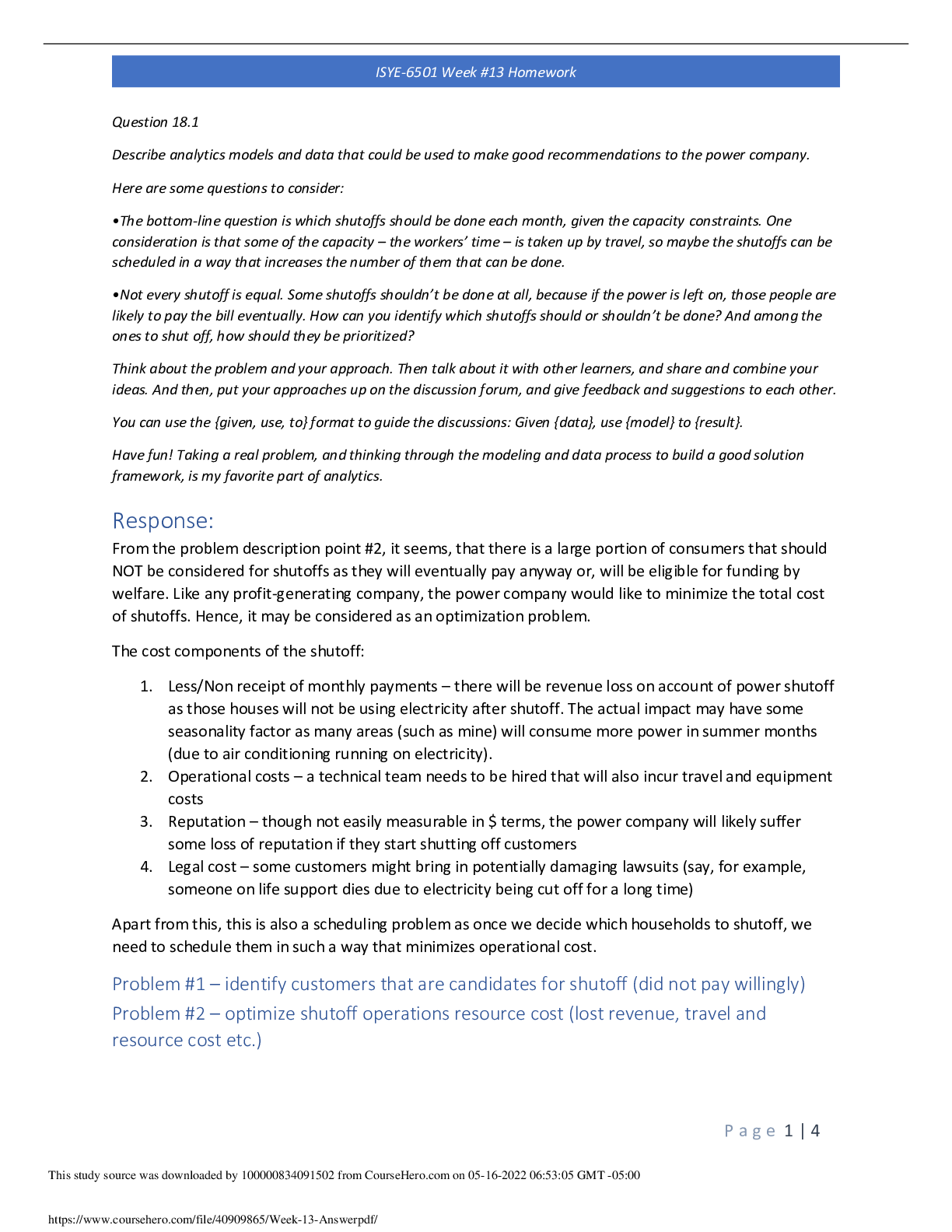
Question 18.1
Describe analytics models and data that could be used to make good recommendations to the power company.
Here are some questions to consider:
•The bottom-line question is whi
...
ISYE-6501 Week #13 Homework
Question 18.1
Describe analytics models and data that could be used to make good recommendations to the power company.
Here are some questions to consider:
•The bottom-line question is which shutoffs should be done each month, given the capacity constraints. One
consideration is that some of the capacity – the workers’ time – is taken up by travel, so maybe the shutoffs can be
scheduled in a way that increases the number of them that can be done.
•Not every shutoff is equal. Some shutoffs shouldn’t be done at all, because if the power is left on, those people are
likely to pay the bill eventually. How can you identify which shutoffs should or shouldn’t be done? And among the
ones to shut off, how should they be prioritized?
Think about the problem and your approach. Then talk about it with other learners, and share and combine your
ideas. And then, put your approaches up on the discussion forum, and give feedback and suggestions to each other.
You can use the {given, use, to} format to guide the discussions: Given {data}, use {model} to {result}.
Have fun! Taking a real problem, and thinking through the modeling and data process to build a good solution
framework, is my favorite part of analytics.
Response:
From the problem description point #2, it seems, that there is a large portion of consumers that should
NOT be considered for shutoffs as they will eventually pay anyway or, will be eligible for funding by
welfare. Like any profit-generating company, the power company would like to minimize the total cost
of shutoffs. Hence, it may be considered as an optimization problem.
The cost components of the shutoff:
1. Less/Non receipt of monthly payments – there will be revenue loss on account of power shutoff
as those houses will not be using electricity after shutoff. The actual impact may have some
seasonality factor as many areas (such as mine) will consume more power in summer months
(due to air conditioning running on electricity).
2. Operational costs – a technical team needs to be hired that will also incur travel and equipment
costs
3. Reputation – though not easily measurable in $ terms, the power company will likely suffer
some loss of reputation if they start shutting off customers
4. Legal cost – some customers might bring in potentially damaging lawsuits (say, for example,
someone on life support dies due to electricity being cut off for a long time)
Apart from this, this is also a scheduling problem as once we decide which households to shutoff, we
need to schedule them in such a way that minimizes operational cost.
Problem #1 – identify customers that are candidates for shutoff (did not pay willingly)
Problem #2 – optimize shutoff operations resource cost (lost revenue, travel and
resource cost etc.)
This study source was downloaded by 100000834091502 from CourseHero.com on 05-16-2022 06:53:05 GMT -05:00
https://www.coursehero.com/file/40909865/Week-13-Answerpdf/
P a g e 2 | 4
ISYE-6501 Week #13 Homework
Overall approach:
Step #0 – INPUT of Customer Data
The customer data might have data quality and completeness issues. For that we need to to perform
basic cleaning activities, including, outlier detection, smoothing and imputation (for missing data
points).
Step #1 - Create classification models
Given... Use... To...
Customer Data Classification Models -
K-means
Logistic Regression
Broadly classify all customers into three categories:
1. Customers who usually pay
2. Customers who are unable to pay for valid
reasons (welfare)
3. Customers who are willingly not paying
Out of various classification and regression techniques, I shortlisted these two on the basis of most
appropriate applicability to the situation at hand. Also, for creating the logistic regression, we will need
the time series data on last (maybe, 12 months) payments history that can be used to rule of seasonality
of non-payments. The logistic regression model will also take into account other factors like customer
credit scores/history, income, family status, zip code etc.
Step #3 – Create a report on the willful non-paying customers.
This study source was downloaded by 100000834091502 from CourseHero.com on 05-16-2022 06:53:05 GMT -05:00
https://www.coursehero.com/file/40909865/Week-13-Answerpdf/
P a g e 3 | 4
ISYE-6501 Week #13 Homework
The report should be in a format that can be used for additional analysis in the next steps. We might
decide to keep the report on the conservative side and ensure personally identifiable information (PII) is
restricted in circulation.
Step #4 – Optimize the cost of shutoff
Given... Use... To...
A list of all the
customers who are
willingly not paying
(candidates for
shutoff)
ARIMA Predict future revenue loss due to willful non-payment
of electric
[Show More]