HS 200 Quiz Submissions - Unit 2 Quiz
uestion 1 2 / 2 points
The immune system recognizes germs that enter the body as “foreign invaders,” or ______ and produces proteins called
__________ in response. Question option
...
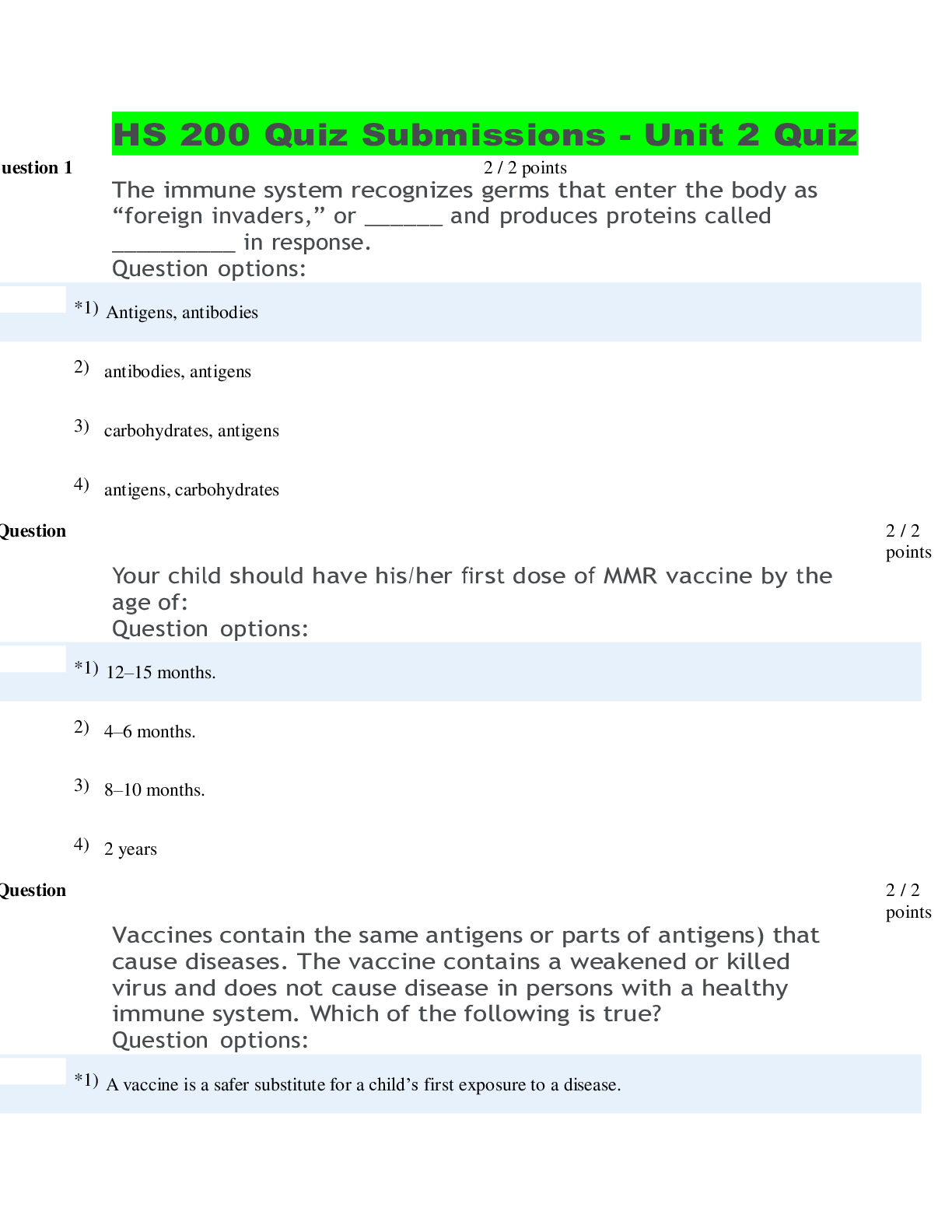
HS 200 Quiz Submissions - Unit 2 Quiz
uestion 1 2 / 2 points
The immune system recognizes germs that enter the body as “foreign invaders,” or ______ and produces proteins called
__________ in response. Question options:
*1) Antigens, antibodies
2) antibodies, antigens
3) carbohydrates, antigens
4) antigens, carbohydrates
Question 2 / 2
points
Your child should have his/her first dose of MMR vaccine by the age of:
Question options:
*1) 12–15 months.
2) 4–6 months.
3) 8–10 months.
4) 2 years
Question 2 / 2
points
Vaccines contain the same antigens or parts of antigens) that cause diseases. The vaccine contains a weakened or killed virus and does not cause disease in persons with a healthy immune system. Which of the following is true?
Question options:
*1) A vaccine is a safer substitute for a child’s first exposure to a disease.
2) At birth, babies do not have any immunity.
3) Babies do not need vaccines during the first year of life because they have antibodies they got from their mothers.
4) A child gets sick after getting vaccinated.
Question 2 / 2
points
Childhood immunizations are important because: Question options:
1) They are needed to obtain a passport
2) They help prevent colds
4) They prevent genetic conditions from appearing
Question 2 / 2
points
Hib vaccines protect against:
Question options:
*1) Haemophilus influenzae type b
2) Hepatitis B
3) HIV
4) Rotavirus
Question WRONG 0 / 2
points
Trivalent flu vaccines include:
Question options:
1) a high dose flu shot, approved for people aged 60 years or less, and contains a higher dose of antigen to help creat stronger immune response.
2) a high dose flu shot, approved for people 65 years or older and contains a higher dose of antigen to help create a stronger immune response.
3) a high dose flu shot, approved for children, contains higher dose of antigen to help create a stronger immune resp
Question 2 / 2
points
It takes about _____ weeks after vaccination for antibodies to develop in the body and provide protection against flu.
Question options:
1) 4
3) 6
4) 8
Question 2 / 2
points
PCV13 vaccine protects against:
Question options:
*1) Pneumococcus
2) Polio
3) Rotavirus
4) Measles
Question 2 / 2
points
Tetanus is an acute, potentially deadly, systemic infection characterized by:
Question options:
*1) painful involuntary contraction of muscles all over the body and can lead to “lockjaw”
2) swelling of extremities
3) acute diarrhea
4) severe cough
Question 2 / 2
0
Preteens should get one dose of Tdap between the ages of
______ years to boost their immunity. Question options:
*1) 11–12
2) 9–10
3) 8–9
4) 7–8
points
Question 2 / 2
1
Children should receive 5 doses of DTaP, one dose at each of the following ages:
Question options:
1) Birth, 2mo, 6mo, 18mo, and 4-6years
points
3) 1mo, 4mo, 6mo, 8mo, and 4-6years
4) 1mo, 2mo, 3mo, 8mo, and 4-6years
Question 2 / 2
2 points
Td is a tetanus-diptheria vaccine given to adolescents and adults as a booster shot:
Question options:
*1) Every 10 years
2) Every 5 years
3) Every 15 years
4) Every 2 years
Question 2 / 2
3
The DTaP vaccine contains:
Question options:
*1) Full strength doses of diphtheria, tetanus, and pertussis
2) Full strength dose of tetanus, and reduced doses of diphtheria and pertussis
3) Reduced doses of diphtheria, tetanus, and pertussis
4) Full strength doses of pertussis, and reduced doses of tetanus and diphtheria
points
Question 2 / 2
4
Adolescents and adults should receive booster shots of _____
every 10 years. Question options:
1) DTaP
2) dTaP
points
4) DT
Question 2 / 2
5
Women should receive the Tdap vaccine during their pregnancies, preferably in:
Question options:
1) First trimester
2) Second trimester
points
4) During labor, to ensure fastest route of transmission
Question
WRONG 0 / 2
6
Newborn babies are immune to many diseases due to the antibodies they received in utero from their mothers. This immunity disappears during:
Question options:
1) The first two months of life
2) The first six months of life
3) The first year of life
4) By two years
points
Question 2 / 2
7
Vaccines:
Question options:
*1) have greatly reduced infectious diseases such as measles.
2) completely eliminated measles from all countries.
3) are not safe substitutes for a child’s first exposure to diseases.
points
4) cannot cause any side effects.
Question 2 / 2
8
A shorter incubation time for tetanus is correlated with: Question options:
1) less contaminated wounds.
points
3) a milder version of the disease.
4) the route of transmission of the bacteria.
Question 2 / 2
9
Tetanus is caused by: Question options:
1) parasites
2) viruses
points
4) fungi
Question 2 / 2
0
The microbe that causes tetanus enters the body by: Question options:
*1) a puncture wound in the skin.
2) inhaling the microbe.
points
3) a blood transfusion.
4) eating food contaminated with the microbe.
Question 2 / 2
1
Human papilloma virus (HPV): Question options:
*1) is the most common sexually transmitted infection (STI).
2) cannot be passed when an infected person shows no signs or symptoms.
3) is not the cause of cervical cancer.
4) vaccines are not available.
points
Question 2 / 2
2
The CDC recommends children of this age be vaccinated against HPV:
Question options:
1) 5–6 years old.
2) 7–8 years old
points
4) Everyone older than age 26 years.
Question 2 / 2
3
Health problems related to HPV infection include genital warts and cervical cancer. Which of the following statements is true? Question options:
*1) About 1 in 100 sexually active adults in the U.S. has genital warts at any given time.
points
2) Genital warts cannot be treated with prescription medications.
3) If you are pregnant and have HPV, you should not get routine cervical cancer screening that can detect abnormal changes.
4) There is treatment for the virus itself.
Question 2 / 2
4
HPV vaccines should not be given to a: Question options:
1) Child who is mildly ill
points
3) Child who has mild cold
4) Child with a runny nose
Question 2 / 2
5
All of the following statements are true about CDC’s recommendation about HPV vaccination, except: Question options:
points
1) 11- to 12-year-olds should receive two doses of HPV vaccine at six months apart to protect against cancers cause human papillomavirus infections.
2) Teens and young adults who starts the series later, at ages 15 through 26 years, need three doses of HPV vaccine protect against cancer causing HPV infection.
3) Three doses are recommended for people with weakened immune systems aged 9–26 years.
Question
WRONG 0 / 2
6
Gardasil-9: Question options:
points
1) Is a vaccine indicated in females 9 through 45 years of age for the prevention of cervical, vulvular, vaginal, and
cancer caused by human papillomavirus (HPV).
2) Is a treatment for external genital lesions.
3) Eliminates the necessity of girls to continue to undergo recommended cervical cancer screening later in life.
Question 2 / 2
7
Which of the following statements is true about Gardasil 9: Question options:
*1) The safety and effectiveness of Gardasil 9 have not been established in pregnant women.
2) The safety and effectiveness of Gardasil 9 have been established in pregnant women.
3) The most common adverse reaction in females is diarrhea.
4) The duration of immunity of Gardasil 9 is about 10 years.
points
Question 2 / 2
8
In the spring of 2009, a novel influenza A (H1N1) virus emerged. This virus was designated as:
Question options:
1) Influenza B (H1N1)pdm09 virus.
points
3) Asian Flu virus.
4) Ethiopian Flu virus.
Question 2 / 2
9 points
2009 Flu pandemic caused by (H1N1)pdm09 virus primarily affected:
Question options:
1) people aged 65 years or older.
2) middle aged adult.
4) people aged 70 years age or older.
Question
WRONG 0 / 2
0
A person should not get MMR vaccine, if: Question options:
1) She is a mother of a newborn and is breastfeeding.
points
2) he/she has a weakened immune system due to disease such as cancer or HIV/AIDS, or undergoing immunothera chemotherapy.
3) he/she has a plan to travel.
Question 2 / 2
1
To prevent measles, children (and some adults) should be vaccinated with two doses of the measles, mumps, and rubella vaccine (MMR). Children should receive their first dose of MMR at the age of:
Question options:
*1) 12–15 months.
2) 24–30 months.
3) 2–4 months.
points
4) 4–6 months.
Question 2 / 2
2
Women of childbearing age:
Question options:
*1) should make sure that they get at least one dose of MMR vaccine before they get pregnant.
2) while breastfeeding, should not receive MMR vaccine.
3) do not need to get MMR vaccination.
4) should not breastfeed after receiving MMR vaccination.
points
Question 2 / 2
3
______ is a vaccine for Tuberculosis (TB). Question options:
*1) BCG
2) Tdap
3) DTaP
4) Hib
points
Question 2 / 2
4
BCG vaccination is recommended for:
Question options:
*1) Children with negative tuberculin test and who cannot be separated from adults with TB disease.
2) Pregnant women.
3) Persons who are immunosuppressed.
points
4) Persons who are candidates for organ transplant.
Question 2 / 2
5
Tuberculosis (TB) is caused by Mycobacterium tuberculosis, which is a:
Question options:
1) virus.
2) fungus.
3) protozoa.
points
Question 2 / 2
6
Shingles is caused by: Question options:
1) human papillomavirus (HPV)
2) human immunodeficiency virus (HIV)
points
4) West Nile virus
Question
WRONG 0 / 2
7
For prevention of shingles, Zostavax vaccine is used when: Question options:
1) A person is allergic to Shingrix vaccine
points
3) A person still has shingle rash
4) A person is a young adult
Question
WRONG 0 / 2
8
The vaccine for shingles (Zostavax) is recommended for use: Question options:
1) in people 60 years of age and older.
points
3) in people 40–49 years of age.
4) in children 14–22 years of age.
Question
WRONG 0 / 2
9
People who should not get the shingles vaccine include: Question options:
1) people who had chickenpox.
2) people aged 65 years or older.
points
4) people with weakened immune systems from HIV/AIDS.
Question 2 / 2
0
If you were vaccinated with ______, you may have a _______
reaction to a TB skin test. Question options:
*1) BCG, positive
points
2) Tdap, positive
3) MMR, positive
4) Chicken pox, positive
Question 2 / 2
1
Annual flu shots are important because: Question options:
1) They cause antibodies to develop in the body immediately after vaccination
points
3) They prevent the common cold
4) The flu virus is the same every year but boosters are needed to maintain immunity
Question 2 / 2
2
Vaccines help develop immunity: Question options:
*1) by imitating an infection without causing illness (“imitation infection”)
2) by producing red blood cells that provide protection against the illness
3) by ensuring complete protection within hours after vaccination
4) by causing the illness so that the body remembers it for future exposure
points
Question
WRONG 0 / 2
3
Tetanus: Question options:
1) is a mild, but chronic illness
points
2) is caused by a virus
3) is caused by bacteria
4) leads to locking of the finger joints
Question 2 / 2
4
A shorter incubation time for tetanus is correlated with: Question options:
1) less contaminated wounds
points
3) a milder version of the disease
4) the route of transmission of the bacteria
Question 2 / 2
5
Which vaccine does the CDC recommend for healthy adults aged 60 years or older?
Question options:
1) Rotavirus
2) Hepatitis C
points
4) BCG
Question 2 / 2
6
What happens the first time a child is infected with an antigen?
Question options:
points
1) The child is protected against the antigen immediately after vaccination
2) The child does not become ill due to passive immunity
3) Their immune system “forgets” the antigen
Question
WRONG 0 / 2
7
A person who was infected with a disease just before or right after vaccination:
Question options:
1) can develop symptoms but does not actually have the disease
2) can develop symptoms and get the disease
3) cannot develop the disease due to latency period
4) cannot develop the disease because the vaccine interrupts it
points
Question 2 / 2
8
What does the CDC recommend as the best protection against H1N1?
Question options:
1) vaccination
2) hand washing
3) avoid touching your nose and mouth
4) stay away from crowds
points
Question 2 / 2
9 points
The shingles vaccine is recommended: Question options:
1) to prevent shingles from occurring
2) to treat active shingles
3) to treat genital herpes
4) to treat post-herpetic neuralgia
Question 2 / 2
0
If you have HIV you are: Question options:
1) no more likely to get TB than the general population
points
3) protected against TB from the HIV antibodies
4) protected against TB from HIV
Atte
82 / 100 - 82 %
Overall Grade (highe
82 / 100 - 82 %
[Show More]