NURS 111-AHA PALS Practice exam-graded 100% -2022
Document Content and Description Below
1. A 5-year-old child presents with lethargy, increased work of breathing, and pale color. The primary assessment reveals that the airway is open and the respiratory rate is 30/min, with crackles heard on auscultation. T
...
[Show More]
Last updated: 3 years ago
Preview 1 out of 10 pages
Instant download
Buy this Document to get the Full Access Instantly
Provided by Students Who Aced it
We Verify Document Content to Gurantee Accuracy
Reviews( 0 )
Document information
Connected school, study & course
About the document
Uploaded On
May 26, 2022
Number of pages
10
Written in
All

Additional information
This document has been written for:
Uploaded
May 26, 2022
Downloads
0
Views
82
Document Keyword Tags
Recommended For You
Get more on EXAM »
$10.5
24 Pages
WGU D220 Nursing Informatics Questions and Answers Graded 100...

$15
14 Pages
NRP 2022 exam/ NRP 7TH EDITION Parts 1 and 2 answered and grad...

$20
20 Pages
HESI A2: Exam2(Study Mode) Questions and Answers latest 2024/2...
$14.5
36 Pages
NURS 6630 psychopharmacology Midterm Exam - Walden University....

$17
35 Pages
NURS 111, Psychotic Disorders Test Bank Questions and Rational...
$15
20 Pages
Testbank-Fundamentals of Nursing 10th Edition Potter Perry-NUR...

$16
252 Pages
NURSE 395-Pathophysiology Unit 2 6 test bank-graded 100%
$9.5
23 Pages
Relias Dysrhythmia Basic Test Answers 2023 Dysrhythmia – Basic...
$10
20 Pages
Relias Dysrhythmia Basic A_Test Answers ( A+ GRADED 100% VER...
$15
6 Pages
Scenario 2 – Alcohol Withdrawal/Aggression Robert Jackson Pre-...
$10
7 Pages
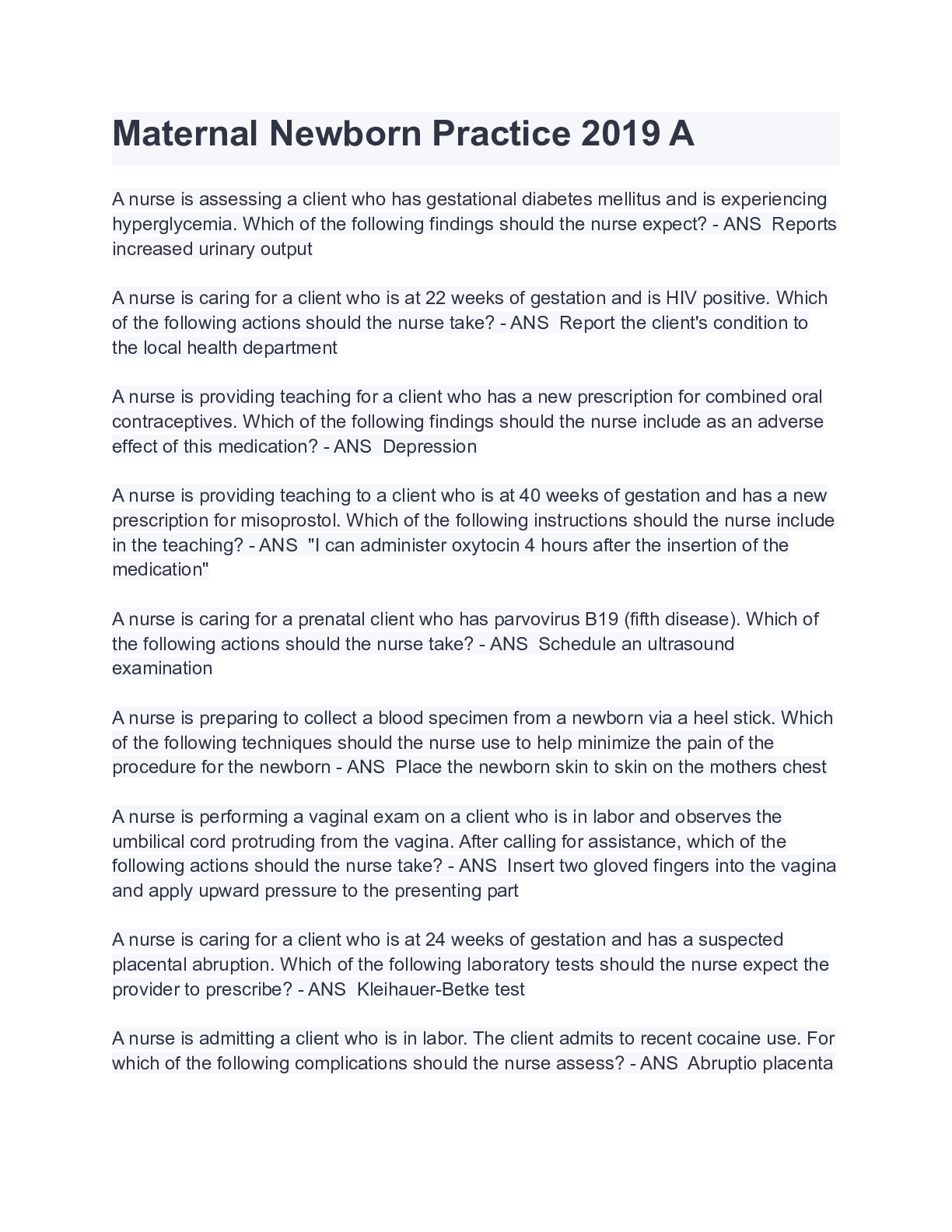
Maternal Newborn Practice 2019 A ( A+ GRADED 100% VERIFIED)
More related documents below