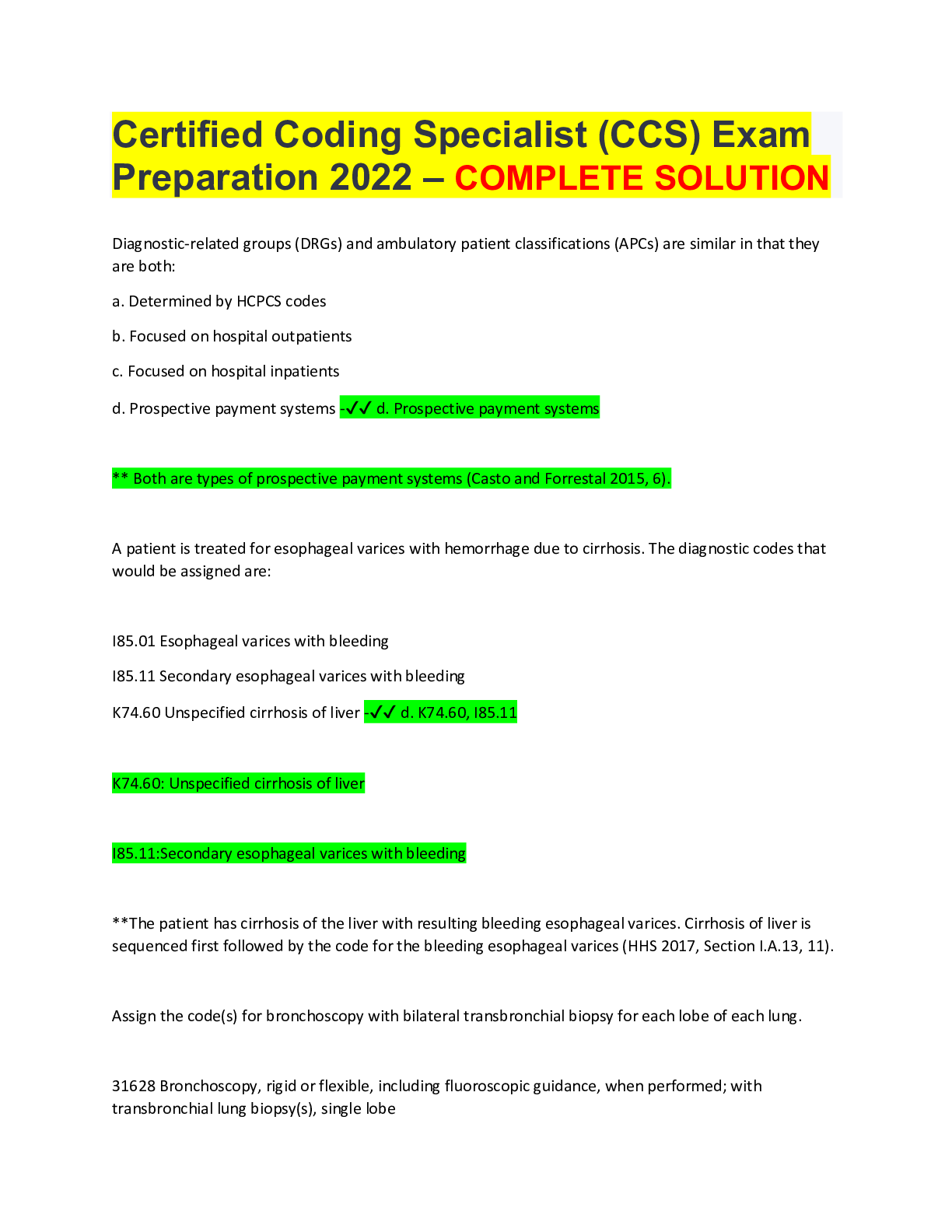
Certified Coding Specialist (CCS) Exam
Prep Questions -AHIMA 6th Edition
Carcinoma in situ - ✔✔Tumor cells that are undergoing malignant changes but are still confined to the
point of origin without invasion of the su
...
Certified Coding Specialist (CCS) Exam
Prep Questions -AHIMA 6th Edition
Carcinoma in situ - ✔✔Tumor cells that are undergoing malignant changes but are still confined to the
point of origin without invasion of the surrounding normal tissue
Examples of carcinoma in situ - ✔✔Intraepithelial infiltrating
The patient was admitted from the emergency department because of chest pain. Following blood work,
it was determined that the patient had elevated CPKs and MB enzymes. The EKG shows nonspecific ST
changes.
What type of diagnosis might this indicate?
a. Unstable angina
b. Myocardial infarction
c. Congestive heart failure
d. Mitral valve stenosis - ✔✔b
The CPK elevation with MB enzymes elevated and the EKG ST changes denote a possible Ml (LeonChisen 2013, 386-387).
A patient is admitted and diagnosed with fever and urinary burning. The discharge diagnosis· is
Escherichia coli, urinary tract infection.
Which of the following represents the correct diagnoses and appropriate sequence of those conditions?
a. Fever, urinary burning, urosepsis
b. Fever, urinary burning, sepsis
c. Escherichia coli, urinary tract infection
d. Urinary tract infection, Escherichia coli - ✔✔d
Symptoms are not coded when a definitive diagnosis is present on discharge. The patient discharge
diagnosis of urinary tract infection. The organism (E. coli) is coded with a seco diagnosis code (B96.20)
which is to be added as an additional code to identify the bacterial agent (HHS 2014, Section II.A., 98).
A patient was admitted with heart failure within one week of a heart transplant. Due to the timing, the
coder thought that it may represent a postoperative transplant rejection following heart transplant.
What action(s) should the coding staff take?
a. Query the physician.
b. Assign the codes for the postoperative transplant rejection.
c. Assign only the code for the transplant rejection.
d. Assign only the code for heart failure. - ✔✔a
When the documentation is not clear regarding a potential complication, it is appropriate query the
physician (HHS 2014, Section I.B.16, 16; Leon-Chisen 2013, 43-44).
A patient is admitted to a psychiatric unit of an acute-care facility. The patient experienced the following
symptoms almost every day for the last month: loss of interest or pleasure in most or all activities, which
is a change from her prior level of functioning. She has also gained 15 lbs, has difficulty falling asleep,
feels fatigued, and has difficulty making decisions.
What potential diagnosis most closely fits the patient's overall symptoms?
a. Insomnia
b. Major depression
c. Reye's syndrome
d. Bipolar disorder - ✔✔b
The symptoms provided are indicative of a depressive disorder (Leon-Chisen 2013, 175).
Inpatient:
Admission for inguinal hernia repair. This 30-year-old patient has acquired immunodeficiency syndrome
(AIDS) but is not symptomatic at this time due to medication regimen. The procedure performed was a
right indirect inguinal herniorrhaphy via open approach. - ✔✔ICD-10-CM: K40.90, B20,
ICD-10-PCS: OYQ50ZZ (Schraffenberger 2013, 82-84,252)
Inpatient:
A 75-year-old male patient was admitted from a nursing home with dehydration and dysphagia due to a
previous stroke. During hospitalization the patient was rehydrated and transferred back to the nursing
home. - ✔✔ICD-10-CM: E86.0, I69.391
(Schraffenberger 2013, 131, 209-210).
Stroke= cerebral infarction
Inpatient:
A patient is admitted to an acute care facility for detoxification from alcohol and barbiturate intoxication
with chronic alcoholism and barbiturate abuse. The patient also has cirrhosis of the liver due to
alcoholism. - ✔✔ICD-10-CM: F10.229, F13.129, K70.30,
(Schraffenberger 2013, 140-143.)
ICD-10-PCS HZ2ZZZZ
(Leon-Chisen 2014, 186).
Inpatient:
A 30-year-old patient was seen in the emergency department for recurrent epileptic seizures. The
patient also had tic douloureux. - ✔✔ICD-10-CM: G40.909, G50.0
(Schraffenberger 2013,158-159).
Inpatient:
A patient was admitted to an acute care facility with a temperature of 102 and atrial fibrillation. The
chest x-ray reveals pneumonia with subsequent documentation by the physician of pneumonia in the
progress notes and discharge summary. The patient was treated with oral antiarrhythmia medications
and IV antibiotics. - ✔✔ICD-10-CM: J18.9, 148.91-
In accordance with the UHDDS, both conditions are not equally treated. The pneumonia was treated
with IV antibiotics. This diagnosis had greater utilization of resources of medications and staff time
compared with the atrial fibrillation, which was treated with oral medication. Because of this, the
pneumonia is sequenced first (HHS 2014, Section II, C).
Inpatient:
A patient with chronic cholecystitis and gallbladder stones underwent a laparoscopic cholecystectomy in
an acute care facility. However, due to extensive gallbladder adhesions the procedure was converted to
an open cholecystectomy. - ✔✔ICD-10-CM: K80.10, K82.8 (Schraffenberger 2013, 249-250, 454); HHS
2011, Section I, 18. d, 14), ICD-10-PCS: OFT40ZZ, OFJ44ZZ (Leon-Chisen 2014, 250).
Inpatient:
A patient is admitted to the inpatient setting with hydronephrosis and a staghorn calculus of the right
kidney. The patient underwent an uretetoscopy with placement of bilateral ureteral stents for dilation
purposes and removal of calculus of right kidney. - ✔✔ICD-10-CM: N13.2,
ICD-10-PCS: OT788DZ, OTC08ZZ
(Leon-Chisen 2013, 269).
Inpatient:
A 77-year-old nursing home patient was admitted to the acute care setting for excisional debridement
of decubitus stage 3 ulcer of the right heel via surgical excision in the OR. The patient also has
degenerative joint disease of both knees. - ✔✔ICD-10-CM: L89.613, M17.0,
ICD-10-PCS: OJBQOZZ
(Schraffenberger 2013, 265-266, 278, 282-284).
Inpatient:
45-year-old woman was admitted to the inpatient setting for a displacement of a lumbar intervertebral
disk. This was treated with a laminectomy and diskectomy. - ✔✔ICD-10-CM: M51.26,
ICD-10-PCS: OSB20ZZ, OQBOOZZ
(Schraffenberger 2013,279, 282-284).
Inpatient:
A 34-year-old woman delivered a live born, te
[Show More]