DATABASE C170_Performance_Assessment 2020 - Western Governors University
SALES ORDER: Date, Donut Order ID, Customer ID, Customer, First Name, Last Name, Street
Address, Apt #, City, St, Zip Code, Home Phone, Mobile Ph
...
DATABASE C170_Performance_Assessment 2020 - Western Governors University
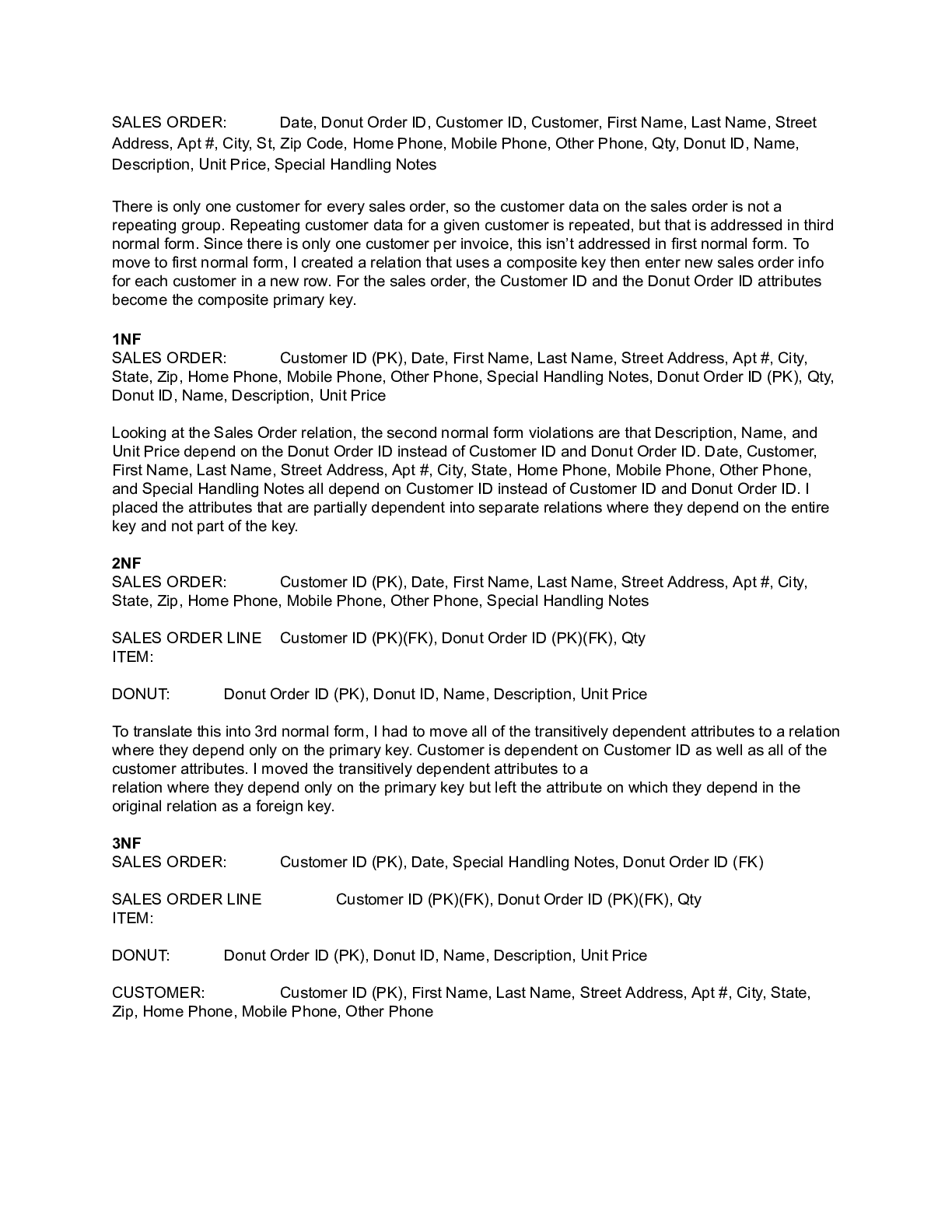
SALES ORDER: Date, Donut Order ID, Customer ID, Customer, First Name, Last Name, Street
Address, Apt #, City, St, Zip Code, Home Phone, Mobile Phone, Other Phone, Qty, Donut ID, Name,
Description, Unit Price, Special Handling Notes
There is only one customer for every sales order, so the customer data on the sales order is not a
repeating group. Repeating customer data for a given customer is repeated, but that is addressed in third
normal form. Since there is only one customer per invoice, this isn’t addressed in first normal form. To
move to first normal form, I created a relation that uses a composite key then enter new sales order info
for each customer in a new row. For the sales order, the Customer ID and the Donut Order ID attributes
become the composite primary key.
1NF
SALES ORDER: Customer ID (PK), Date, First Name, Last Name, Street Address, Apt #, City,
State, Zip, Home Phone, Mobile Phone, Other Phone, Special Handling Notes, Donut Order ID (PK), Qty,
Donut ID, Name, Description, Unit Price
Looking at the Sales Order relation, the second normal form violations are that Description, Name, and
Unit Price depend on the Donut Order ID instead of Customer ID and Donut Order ID. Date, Customer,
First Name, Last Name, Street Address, Apt #, City, State, Home Phone, Mobile Phone, Other Phone,
and Special Handling Notes all depend on Customer ID instead of Customer ID and Donut Order ID. I
placed the attributes that are partially dependent into separate relations where they depend on the entire
key and not part of the key.
2NF
SALES ORDER: Customer ID (PK), Date, First Name, Last Name, Street Address, Apt #, City,
State, Zip, Home Phone, Mobile Phone, Other Phone, Special Handling Notes
SALES ORDER LINE Customer ID (PK)(FK), Donut Order ID (PK)(FK), Qty
ITEM:
DONUT: Donut Order ID (PK), Donut ID, Name, Description, Unit Price
To translate this into 3rd normal form, I had to move all of the transitively dependent attributes to a relation
where they depend only on the primary key. Customer is dependent on Customer ID as well as all of the
customer attributes. I moved the transitively dependent attributes to a
relation where they depend only on the primary key but left the attribute on which they depend in the
original relation as a foreign key.
3NF
SALES ORDER: Customer ID (PK), Date, Special Handling Notes, Donut Order ID (FK)
SALES ORDER LINE Customer ID (PK)(FK), Donut Order ID (PK)(FK), Qty
ITEM:
DONUT: Donut Order ID (PK), Donut ID, Name, Description, Unit Price
CUSTOMER: Customer ID (PK), First Name, Last Name, Street Address, Apt #, City, State,
Zip, Home Phone, Mobile Phone, Other Phone1NF
SALES ORDER
Customer ID (PK)
Donut Order ID (PK)
Date
First Name
Last Name
Street Address
Apt
City
State
Zip
Home Phone
Mobile Phone
Other Phone
Special Handling Notes
Qty
Donut ID
Name
Description
Unit Price2NF
-
-
-
-
-
-
-
-
-
-
-
-
-
-
-
-
-
-
-
-
-
-
-
-
-
-
-
-
-
NSERT INTO DONUT
(DONUT_ORDER_ID,DONUT_ID,DONUT_NAME,DONUT_DESCRIPTION,UNIT_PRI
CE)
VALUES(1,3,'Cinammon','Cinammon Donut','1.75');
INSERT INTO SALES_ORDER
(CUSTOMER_ID,DATE,SPECIAL_HANDLING_NOTES,DONUT_ORDER_ID)
VALUES(1,'20180218','Plates and Napkins please',1);
INSERT INTO SALES_ORDER_LINE_ITEM
(CUSTOMER_ID,DONUT_ORDER_ID,QTY)
VALUES(1,1,10);
SELECT * FROM CUSTOMER_INFO;
SELECT * FROM DONUT;
SELECT * FROM SALES_ORDER;
SELECT * FROM SALES_ORDER_LINE_ITEM;SELECT * FROM DONUT, CUSTOMER, SALES_ORDER,
SALES_ORDER_LINE_ITEM
WHERE CUSTOMER.CUSTOMER_ID = SALES_ORDER.CUSTOMER_ID
AND SALES_ORDER.DONUT_ORDER_ID =
SALES_ORDER_LINE_ITEM.DONUT_ORDER_ID
AND SALES_ORDER_LINE_ITEM.DONUT_ORDER_ID =
DONUT.DONUT_ORDER_ID;
[Show More]


















 – Chamberlain College of Nursing.png)
 – Chamberlain College of Nursing.png)