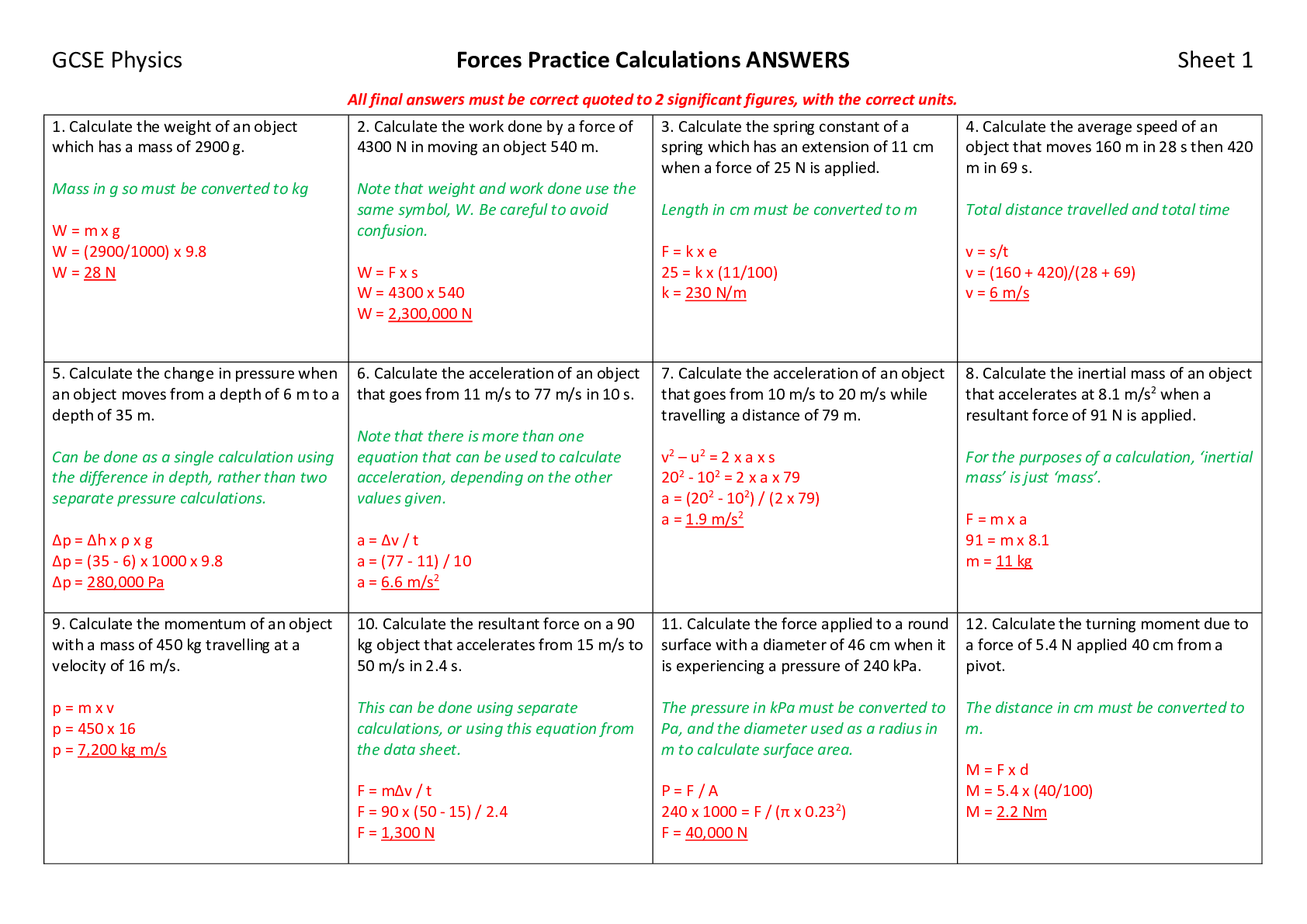
1. Calculate the weight of an object
which has a mass of 2900 g.
Mass in g so must be converted to kg
W = m x g
W = (2900/1000) x 9.8
W = 28 N
2. Calculate the work done by a force of
4300 N in moving an object 54
...
1. Calculate the weight of an object
which has a mass of 2900 g.
Mass in g so must be converted to kg
W = m x g
W = (2900/1000) x 9.8
W = 28 N
2. Calculate the work done by a force of
4300 N in moving an object 540 m.
Note that weight and work done use the
same symbol, W. Be careful to avoid
confusion.
W = F x s
W = 4300 x 540
W = 2,300,000 N
3. Calculate the spring constant of a
spring which has an extension of 11 cm
when a force of 25 N is applied.
Length in cm must be converted to m
F = k x e
25 = k x (11/100)
k = 230 N/m
4. Calculate the average speed of an
object that moves 160 m in 28 s then 420
m in 69 s.
Total distance travelled and total time
v = s/t
v = (160 + 420)/(28 + 69)
v = 6 m/s
5. Calculate the change in pressure when
an object moves from a depth of 6 m to a
depth of 35 m.
Can be done as a single calculation using
the difference in depth, rather than two
separate pressure calculations.
Δp = Δh x ρ x g
Δp = (35 - 6) x 1000 x 9.8
Δp = 280,000 Pa
6. Calculate the acceleration of an object
that goes from 11 m/s to 77 m/s in 10 s.
Note that there is more than one
equation that can be used to calculate
acceleration, depending on the other
values given.
a = Δv / t
a = (77 - 11) / 10
a = 6.6 m/s2
7. Calculate the acceleration of an object
that goes from 10 m/s to 20 m/s while
travelling a distance of 79 m.
v2 – u2 = 2 x a x s
202 - 102 = 2 x a x 79
a = (202 - 102) / (2 x 79)
a = 1.9 m/s2
8. Calculate the inertial mass of an object
that accelerates at 8.1 m/s2 when a
resultant force of 91 N is applied.
For the purposes of a calculation, ‘inertial
mass’ is just ‘mass’.
F = m x a
91 = m x 8.1
m = 11 kg
9. Calculate the momentum of an object
with a mass of 450 kg travelling at a
velocity of 16 m/s.
p = m x v
p = 450 x 16
p = 7,200 kg m/s
10. Calculate the resultant force on a 90
kg object that accelerates from 15 m/s to
50 m/s in 2.4 s.
This can be done using separate
calculations, or using this equation from
the data sheet.
F = mΔv / t
F = 90 x (50 - 15) / 2.4
F = 1,300 N
11. Calculate the force applied to a round
surface with a diameter of 46 cm when it
is experiencing a pressure of 240 kPa.
The pressure in kPa must be converted to
Pa, and the diameter used as a radius in
m to calculate surface area.
P = F / A
240 x 1000 = F / (π x 0.232)
F = 40,000 N
12. Calculate the turning moment due to
a force of 5.4 N applied 40 cm from a
pivot.
The distance in cm must be converted to
m.
M = F x d
M = 5.4 x (40/100)
M = 2.2 Nm13. Calculate the force, F, acting on the balanced
system below.
The distances can be left in cm, because the units are
the same on both sides of the equation.
anticlockwise moment = clockwise moment
F x d = F x d
18 x 34 = F x 14
F = 44 N
14. Calculate the distance, d, required to balance the
system below.
The distances can be left in cm, because the units are
the same on both sides of the equation.
anticlockwise moment = clockwise moment
F x d = F x d
11 x 39 = 26 x d
d = 17 cm
15. The objects below collide and move off as a single
object. Calculate the velocity after the collision.
Total momentum before = total momentum after
total momentum before = m1 x v1 + m2 x v2
= 1000 x 15 + 1700 x 8
= 28600 kg m/s
total momentum after = (m1 + m2) x v
28600 = (1000 + 1700) x v
v = 11 m/s
16. Use the graph to determine (a) the speed in each of the two sections and (b) the
average speed for the whole journey.
(a) calculate gradient = Δy / Δx
speed 1 = (31-0) / (40-0)
= 0.78 m/s
speed 2 = (14-34) / (80-40)
= 0.35 m/s
(b) average speed = total distance / total time
v = s / t
v = 45 / 80 = 0.56 m/s
17. Use the graph to determine the (a) initial acceleration and (b) the distance
travelled.
(a) calculate gradient = Δy / Δx
a = (15-0) / (15-0)
= 1.0 m/s2
(b) distance = area under graph
total area = area of triangle + area of rectangle
distance = ½ x 15 x 15 + 15 x (20-15)
= 190 m
distance (m)
time (s)
velocity (m/s)
time (s)
18 N F
34 cm 14 cm
11 N
39 cm d
26 N
15 m/s 8 m/s
1000 kg 1700 kg
45
31
40 80
15
15 20GCSE Physics Forces Practice Calculations ANSWERS Sheet 2
All final answers must be correct quoted to 2 significant figures, with the correct units.
1. Calculate the weight of an object
which has a mass of 4600 g.
Mass in g so must be converted to kg
W = m x g
W = (4600/1000) x 9.8
W = 45 N
2. Calculate the work done by a force of
3800 N in moving an object 120 m.
Note that weight and work done use the
same symbol, W. Be careful to avoid
confusion.
W = F x s
W = 3800 x 120
W = 460,000 N
3. Calculate the spring constant of a
spring which has an extension of 8 cm
when a force of 10 N is applied.
Length in cm must be converted to m
F = k x e
10 = k x (8/100)
k = 130 N/m
4. Calculate the average speed of an
object that moves 190 m in 11 s then 470
m in 54 s.
Total distance travelled and total time
v = s/t
v = (190 + 470)/(11 + 54)
v = 10 m/s
5. Calculate the change in pressure when
an object moves from a depth of 7 m to a
depth of 29 m.
Can be done as a single calculation using
the difference in depth, rather than two
separate pressure calculations.
Δp = Δh x ρ x g
Δp = (29 - 7) x 1000 x 9.8
Δp = 220,000 Pa
6. Calculate the acceleration of an object
that goes from 7 m/s to 56 m/s in 6 s.
Note that there is more than one
equation that can be used to calculate
acceleration, depending on the other
values given.
a = Δv / t
a = (56 - 7) / 6
a = 8.2 m/s2
7. Calculate the acceleration of an object
that goes from 19 m/s to 55 m/s while
travelling a distance of 83 m.
v2 – u2 = 2 x a x s
552 - 192 = 2 x a x 83
a = (552 - 192) / (2 x 83)
a = 16 m/s2
8. Calculate the inertial mass of an object
that accelerates at 5.7 m/s2 when a
resultant force of 96 N is applied.
For the purposes of a calculation, ‘inertial
mass’ is just ‘mass’.
F = m x a
96 = m x 5.7
m = 17 kg
9. Calculate the momentum of an object
with a mass of 560 kg travelling at a
velocity of 12 m/s.
p = m x v
p = 560 x 12
p = 6,700 kg m/s
10. Calculate the resultant force on a 180
kg object that accelerates from 7 m/s to
58 m/s in 3.7 s.
This can be done using separate
calculations, or using this equation from
the data sheet.
F = mΔv / t
F = 180 x (58 - 7) / 3.7
F = 2,500 N
11. Calculate the force applied to a round
surface with a diameter of 60 cm when it
is experiencing a pressure of 180 kPa.
The pressure in kPa must be converted to
Pa, and the diameter used as a radius in
m to calculate surface area.
P = F / A
180 x 1000 = F / (π x 0.302)
F = 51,000 N
12. Calculate the turning moment due to
a force of 6.7 N applied 31 cm from a
pivot.
The distance in cm must be converted to
m.
M = F x d
M = 6.7 x (31/100)
M = 2.1 Nm13. Calculate the force, F, acting on the balanced
system below.
The distances can be left in cm, because the units are
the same on both sides of the equation.
anticlockwise moment = clockwise moment
F x d = F x d
46 x 31 = F x 16
F = 89 N
14. Calculate the distance, d, required to balance the
system below.
The distances can be left in cm, because the units are
the same on both sides of the equation.
anticlockwise moment = clockwise moment
F x d = F x d
18 x 31 = 34 x d
d = 16 cm
15. The objects below collide and move off as a single
object. Calculate the velocity after the collision.
Total momentum before = total momentum after
total momentum before = m1 x v1 + m2 x v2
= 1200 x 23 + 1300 x 16
= 48400 kg m/s
total momentum after = (m1 + m2) x v
48400 = (1200 + 1300) x v
v = 19 m/s
16. Use the graph to determine (a) the speed in each of the two sections and (b) the
average speed for the whole journey.
(a) calculate gradient = Δy / Δx
speed 1 = (34-0) / (5-0)
= 6.8 m/s
speed 2 = (16-31) / (40-5)
= 0.40 m/s
(b) average speed = total distance / total time
v = s / t
v = 48 / 40 = 1.2 m/s
17. Use the graph to determine the (a) initial acceleration and (b) the distance
travelled.
(a) calculate gradient = Δy / Δx
a = (45-0) / (10-0)
= 4.5 m/s2
(b) distance = area under graph
total area = area of triangle + area of rectangle
distance = ½ x 45 x 10 + 45 x (15-10)
= 450 m
distance (m)
time (s)
velocity (m/s)
time (s)
46 N F
31 cm 16 cm
18 N
31 cm d
34 N
23 m/s 16 m/s
1200 kg 1300 kg
48
34
5 40
45
10
[Show More]



.png)
.png)
.png)