. Draw the symbol for
proportionality.
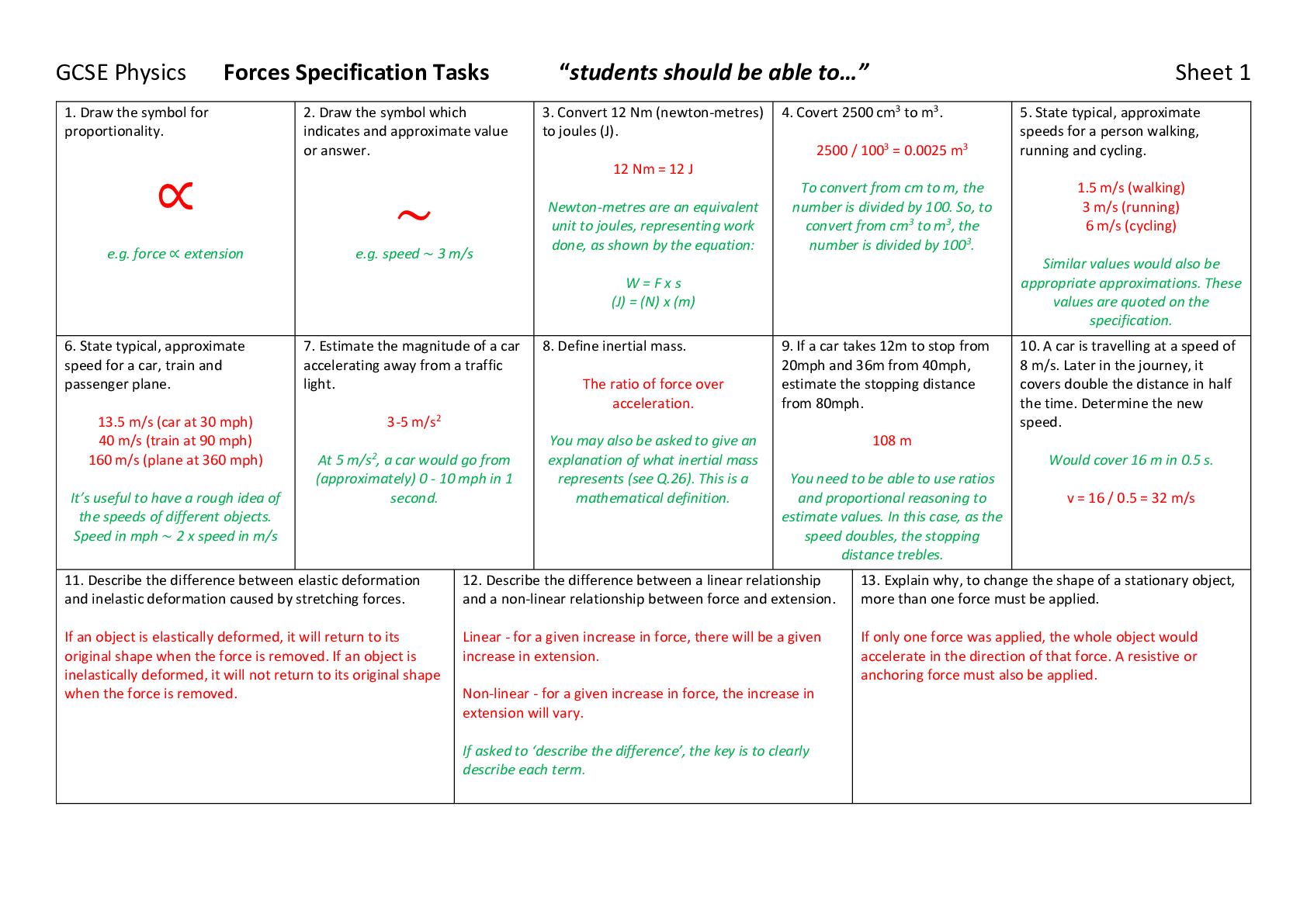
∝
e.g. force ∝ extension
2. Draw the symbol which
indicates and approximate value
or answer.
~
e.g. speed ~ 3 m/s
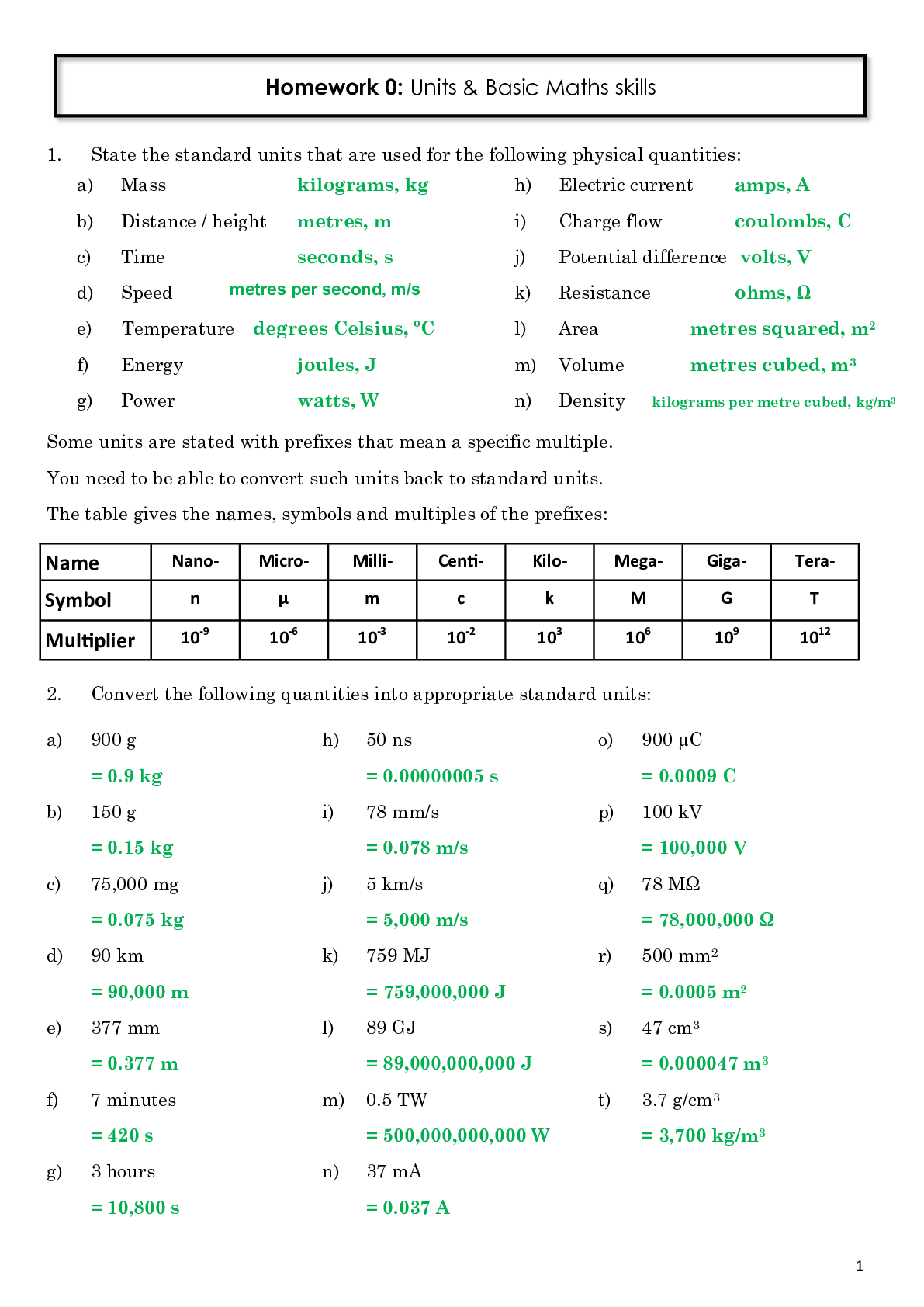
3. Convert 12 Nm (newton-metres)
to joules (J).
12 Nm =
...
. Draw the symbol for
proportionality.
∝
e.g. force ∝ extension
2. Draw the symbol which
indicates and approximate value
or answer.
~
e.g. speed ~ 3 m/s
3. Convert 12 Nm (newton-metres)
to joules (J).
12 Nm = 12 J
Newton-metres are an equivalent
unit to joules, representing work
done, as shown by the equation:
W = F x s
(J) = (N) x (m)
4. Covert 2500 cm3 to m3.
2500 / 1003 = 0.0025 m3
To convert from cm to m, the
number is divided by 100. So, to
convert from cm3 to m3, the
number is divided by 1003.
5. State typical, approximate
speeds for a person walking,
running and cycling.
1.5 m/s (walking)
3 m/s (running)
6 m/s (cycling)
Similar values would also be
appropriate approximations. These
values are quoted on the
specification.
6. State typical, approximate
speed for a car, train and
passenger plane.
13.5 m/s (car at 30 mph)
40 m/s (train at 90 mph)
160 m/s (plane at 360 mph)
It’s useful to have a rough idea of
the speeds of different objects.
Speed in mph ~ 2 x speed in m/s
7. Estimate the magnitude of a car
accelerating away from a traffic
light.
3-5 m/s2
At 5 m/s2, a car would go from
(approximately) 0 - 10 mph in 1
second.
8. Define inertial mass.
The ratio of force over
acceleration.
You may also be asked to give an
explanation of what inertial mass
represents (see Q.26). This is a
mathematical definition.
9. If a car takes 12m to stop from
20mph and 36m from 40mph,
estimate the stopping distance
from 80mph.
108 m
You need to be able to use ratios
and proportional reasoning to
estimate values. In this case, as the
speed doubles, the stopping
distance trebles.
10. A car is travelling at a speed of
8 m/s. Later in the journey, it
covers double the distance in half
the time. Determine the new
speed.
Would cover 16 m in 0.5 s.
v = 16 / 0.5 = 32 m/s
11. Describe the difference between elastic deformation
and inelastic deformation caused by stretching forces.
If an object is elastically deformed, it will return to its
original shape when the force is removed. If an object is
inelastically deformed, it will not return to its original shape
when the force is removed.
12. Describe the difference between a linear relationship
and a non-linear relationship between force and extension.
Linear - for a given increase in force, there will be a given
increase in extension.
Non-linear - for a given increase in force, the increase in
extension will vary.
If asked to ‘describe the difference’, the key is to clearly
describe each term.
13. Explain why, to change the shape of a stationary object,
more than one force must be applied.
If only one force was applied, the whole object would
accelerate in the direction of that force. A resistive or
anchoring force must also be applied.
[Show More]