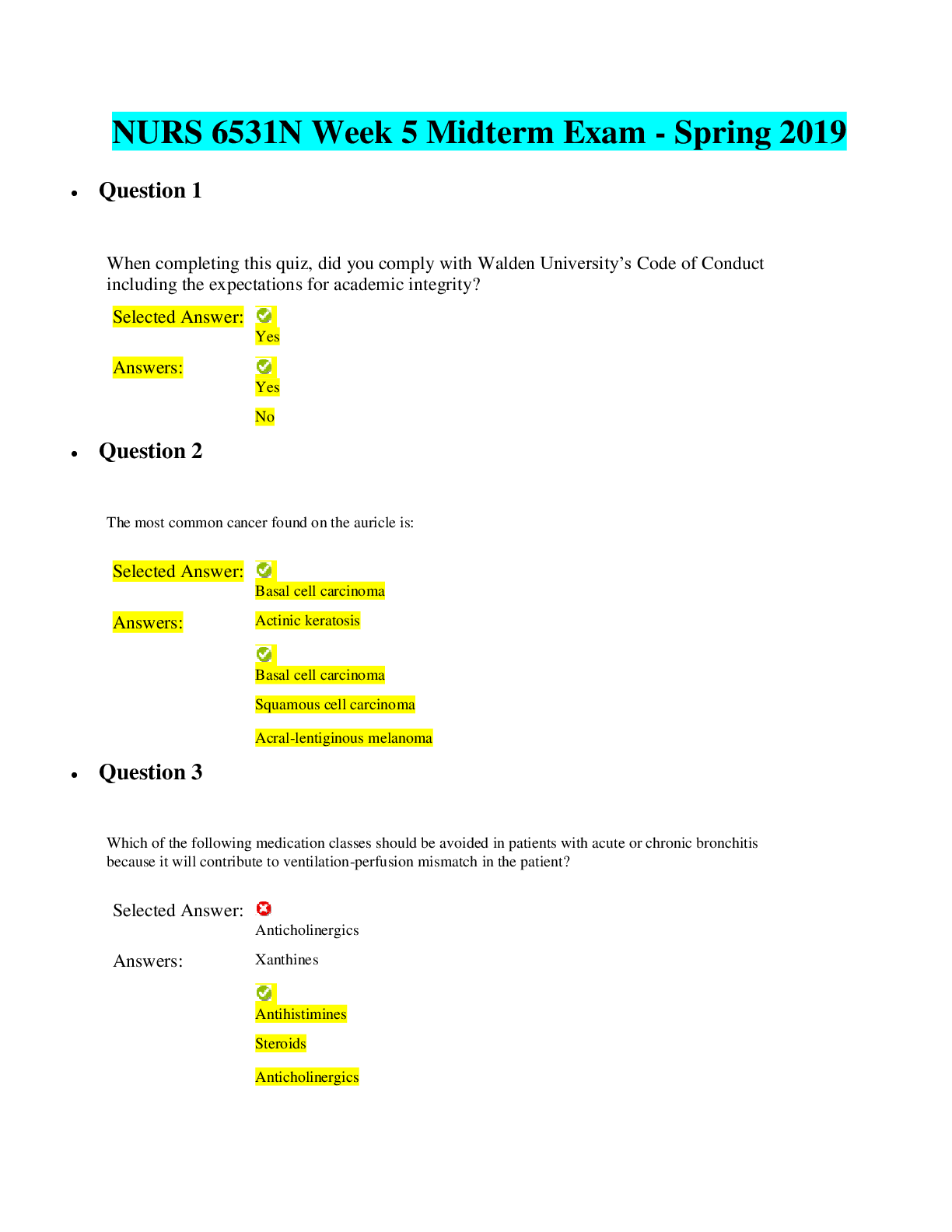
hen completing this quiz, did you comply with Walden University’s Code of Conduct
including the expectations for academic integrity?
Selected Answer:
Yes
Answers:
Yes
No
Question 2
The most common cancer found
...
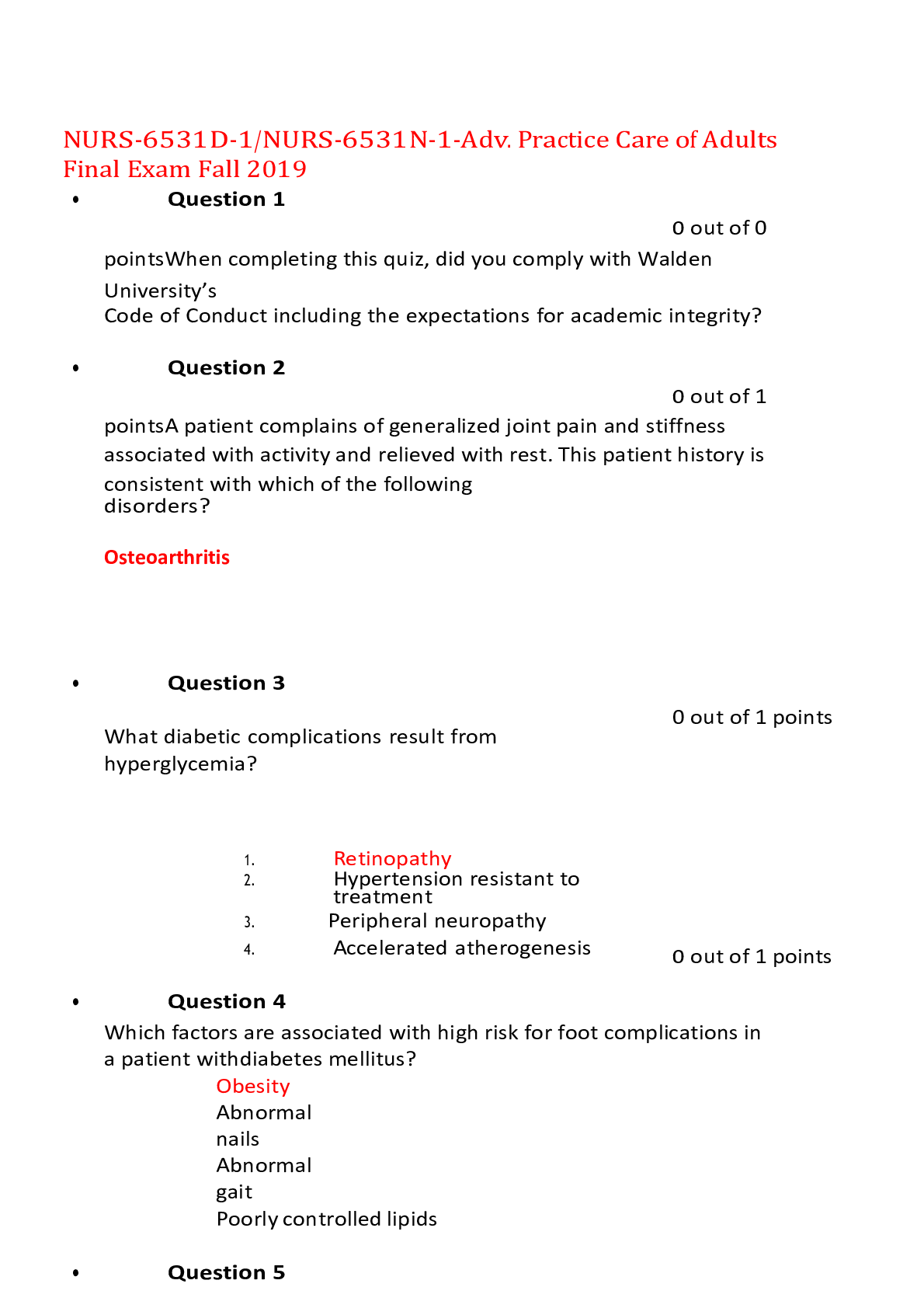
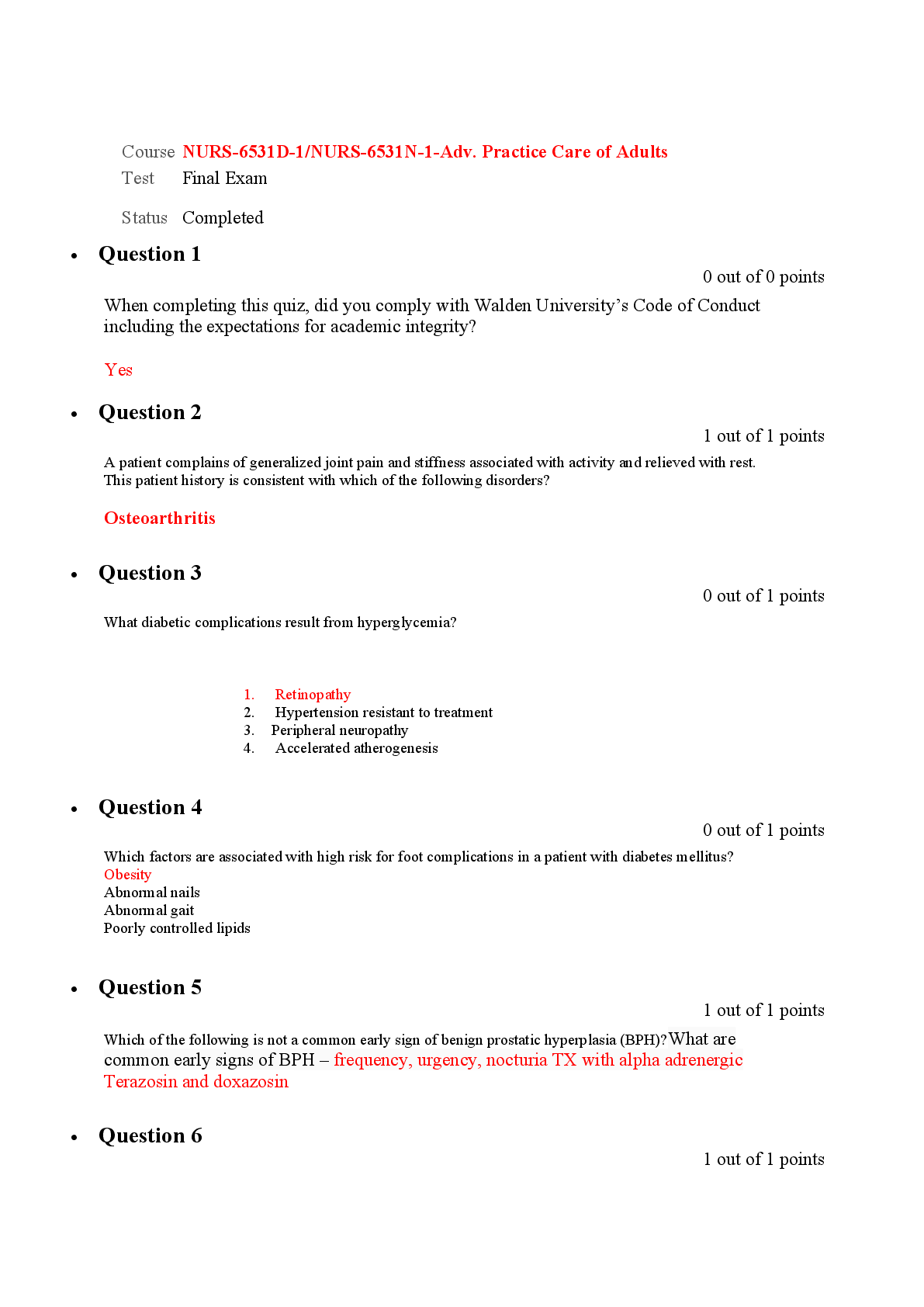
hen completing this quiz, did you comply with Walden University’s Code of Conduct
including the expectations for academic integrity?
Selected Answer:
Yes
Answers:
Yes
No
Question 2
The most common cancer found on the auricle is:
Selected Answer:
Basal cell carcinoma
Answers: Actinic keratosis
Basal cell carcinoma
Squamous cell carcinoma
Acral-lentiginous melanoma
Question 3
Which of the following medication classes should be avoided in patients with acute or chronic bronchitis
because it will contribute to ventilation-perfusion mismatch in the patient?
Selected Answer:
Anticholinergics
Answers: Xanthines
Antihistimines
Steroids
Anticholinergics Question 4
A 47 year old male patient presents to the clinic with a single episode of a moderate amount of bright red rectal
bleeding. On examination, external hemorrhoids are noted. How should the nurse practitioner proceed?
Selected Answer:
Instruct the patient on measures to prevent hemorrhoids such as bowel habits and diet.
Answers: Instruct the patient on measures to prevent hemorrhoids such as bowel habits and diet.
Order a topical hemorrhoid cream along with a stool softener.
Refer the patient for a barium enema and sigmoidoscopy.
Refer the patient for a surgical hemorrhoidectomy.
Question 5
Which of the following patient characteristics are associated with chronic bronchitis?
Selected Answer:
Underweight, pink skin, and increased respiratory rate
Answers:
Overweight, cyanosis, and normal or slightly increased respiratory rate
Underweight, pink skin, and increased respiratory rate
Overweight, pink skin, and normal or slightly increased respiratory rate
Normal weight, cyanosis, and greatly increased respiratory rate
Question 6
A 65-year-old female with a past medical history of hypertension, hyperlipidemia, and polymyalgia rheumatica
presents to urgent care with new onset left lower quadrant pain. Her current medications include omeprazole 20
milligrams po daily, lisinopril 20 milligrams po daily, simvastatin 20 milligrams po daily, and prednisone 12
milligrams po daily. The nurse practitioner suspects acute diverticulitis and possibly an abscess. The most
appropriate diagnostic test for this patient at this time is:
Selected Answer:CT scan
Answers: CBC/diff
Erythrocyte sedimentation rate
Abdominal ultrasound
CT scan
Question 7
A patient reports “something flew in my eye” about an hour ago while he was splitting logs. If there were a
foreign body in his eye, the nurse practitioner would expect to find all except:
Selected Answer:
Purulent drainage
Answers:
Purulent drainage
Tearing
Photophobia
A positive fluorescein stain
Question 8
A 21 year old college student presents to the student health center with copious, markedly purulent discharge
from her left eye. The nurse practitioner student should suspect:
Selected Answer:
Gonococcal conjunctivitis
Answers: Viral conjunctivitis
Common pink eye
Gonococcal conjunctivitisAllergic conjunctivitis
Question 9
A 35 year old man presents with radicular pain followed by the appearance of grouped vesicles consisting of
about 15 lesions across 3 different thoracic dermatomes. He complains of pain, burning, and itching. The nurse
practitioner should suspect:
Selected
Answer: A complicated case of shingles and prescribe acyclovir, an analgesic, and a topical
cortisone cream
Answers: A common case of shingles and prescribe an analgesic and an antiviral agent
A complicated case of shingles and prescribe acyclovir, an analgesic, and a topical
cortisone cream
Herpes zoster and consider that this patient may be immunocompromised
A recurrence of chickenpox and treat the patient’s symptoms
Question 10
Which type of lung cancer has the poorest prognosis?
Selected Answer:
Adenocarcinoma
Answers: Adenocarcinoma
Epidermoid carcinoma
Small cell carcinoma
Large cell carcinoma
Question 11An 83-year-old female presents to the office complaining of diarrhea for several days. She explains she has
even had fecal incontinence one time. She describes loose stools 3–4 times a day for several weeks and denies
fever, chills, pain, recent antibiotic use. The history suggests that the patient has:
Selected Answer:
Chronic diarrhea
Answers: Acute diarrhea
Chronic diarrhea
Irritable bowel
Functional bowel disease
Question 12
Margaret, age 32, comes into the office with painful joints and a distinctive rash in a butterfly distribution on her
face. The rash has red papules and plaques with a fine scale. What do you suspect?
Selected Answer:
Systemic lupus erythematosus
Answers: An allergic reaction
Relapsing polychondritis
Lymphocytoma cutis
Systemic lupus erythematosus
Question 13
Antibiotic administration has been demonstrated to be of little benefit to the treatment of which of the following
disease processes?
Selected Answer:
Acute bronchitis
Answers: Chronic sinusitisAcute bronchitis
Bacterial pneumonia
Acute exacerbation of chronic bronchitis
Question 14
Lisa, age 49, has daily symptoms of asthma. She uses her inhaled short-acting beta-2 agonist daily. Her
exacerbations affect her activities and they occur at least twice weekly and may last for days. She is affected
more than once weekly during the night with an exacerbation. Which category of asthma severity is Lisa in?
Selected Answer:
Mild persistent
Answers: Mild intermittent
Mild persistent
Moderate persistent
Question 15
Which of the following is the most appropriate therapeutic regimen for an adult patient with no known allergies
diagnosed with group A B-hemolytic strep?
Selected Answer:
None of the above
Answers:
Penicillin V 500 milligrams PO every 8 hours for 10 days
Ampicillin 250 milligrams PO twice a day for 10 days
Clarithromycin 500 milligrams po daily for 7 days
None of the above
Question 16
[Show More]