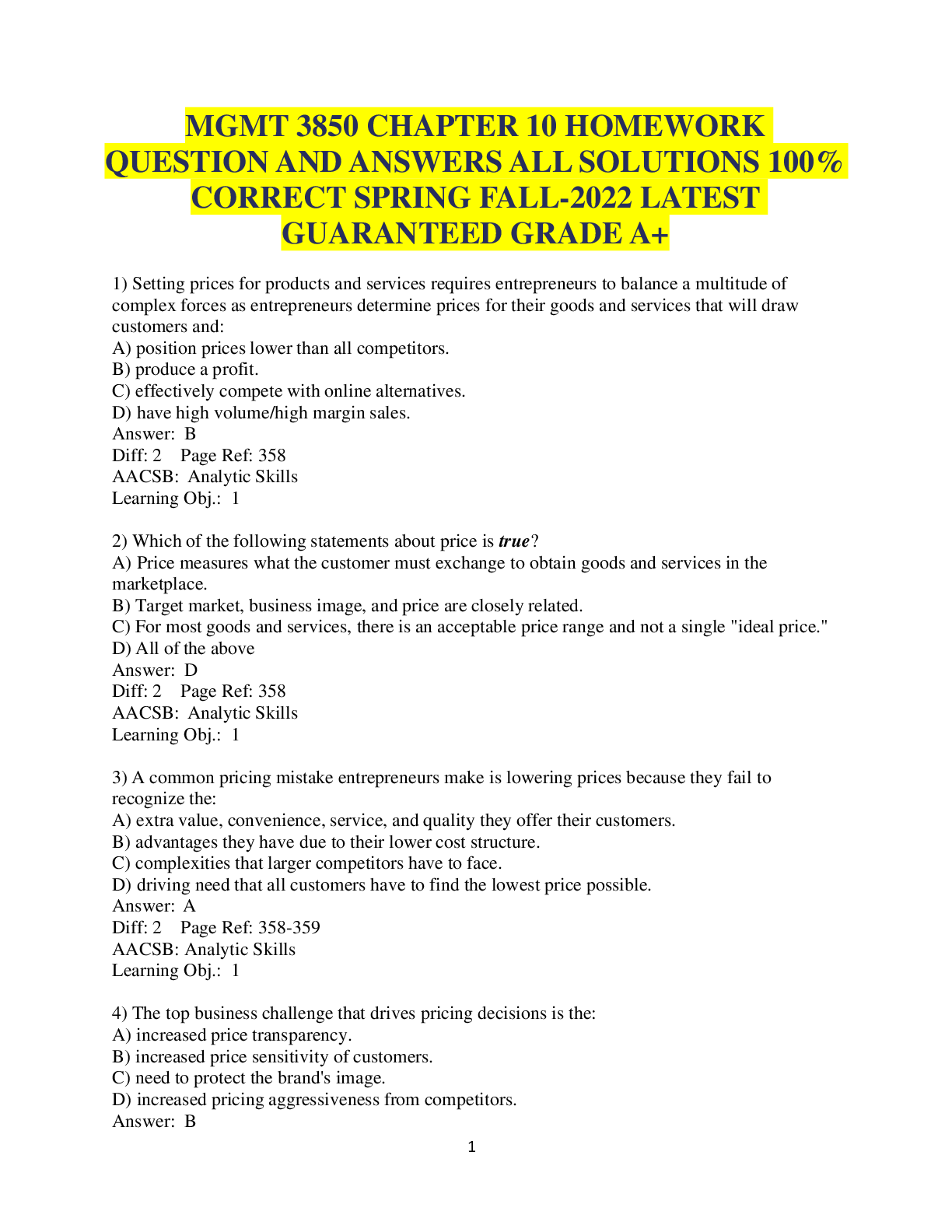
1) Setting prices for products and services requires entrepreneurs to balance a multitude of complex forces as entrepreneurs determine prices for their goods and services that will draw customers and:
A) position prices
...
1) Setting prices for products and services requires entrepreneurs to balance a multitude of complex forces as entrepreneurs determine prices for their goods and services that will draw customers and:
A) position prices lower than all competitors.
B) produce a profit.
C) effectively compete with online alternatives.
D) have high volume/high margin sales. Answer: B
Diff: 2 Page Ref: 358 AACSB: Analytic Skills Learning Obj.: 1
2) Which of the following statements about price is true?
A) Price measures what the customer must exchange to obtain goods and services in the marketplace.
B) Target market, business image, and price are closely related.
C) For most goods and services, there is an acceptable price range and not a single "ideal price."
D) All of the above Answer: D
Diff: 2 Page Ref: 358 AACSB: Analytic Skills Learning Obj.: 1
3) A common pricing mistake entrepreneurs make is lowering prices because they fail to recognize the:
A) extra value, convenience, service, and quality they offer their customers.
B) advantages they have due to their lower cost structure.
C) complexities that larger competitors have to face.
D) driving need that all customers have to find the lowest price possible. Answer: A
Diff: 2 Page Ref: 358-359 AACSB: Analytic Skills Learning Obj.: 1
4) The top business challenge that drives pricing decisions is the:
A) increased price transparency.
B) increased price sensitivity of customers.
C) need to protect the brand's image.
D) increased pricing aggressiveness from competitors. Answer: B
Diff: 2 Page Ref: 358, Figure 10.1 AACSB: Analytic Skills
Learning Obj.: 1
5) frequently convey the idea of quality, prestige, and uniqueness to customers.
A) Effective packaging
B) Low prices
C) High prices
D) High profile promotions Answer: C
Diff: 2 Page Ref: 360-361 AACSB: Communication Learning Obj.: 1
6) A key ingredient to setting prices properly is to understand a company's:
A) cost structure.
B) most aggressive price competitor.
C) target market.
D) profit expectations. Answer: C
Diff: 3 Page Ref: 359-360 AACSB: Analytic Skills Learning Obj.: 1
7) An entrepreneurial company can differentiate itself by creating a distinctive image in customers' minds or by offering:
A) superior service and quality.
B) exceptional design and convenience.
C) speed and performance.
D) All the above provide the opportunity for differentiation. Answer: D
Diff: 3 Page Ref: 360-361 AACSB: Analytic Skills Learning Obj.: 1
8) In general, entrepreneurs should head-to-head price competition with firms that can more easily achieve lower prices through lower cost structures.
A) avoid
B) take on
C) meet
D) exit the market when faced with Answer: A
Diff: 2 Page Ref: 361-362 AACSB: Analytic Skills Learning Obj.: 1
9) Generally, entrepreneurs should avoid head-to-head price competition with other firms that can more easily achieve lower prices through:
A) offering lower value products and services.
B) a better designed Web site.
C) geographic advantages.
D) lower cost structures. Answer: D
Diff: 2 Page Ref: 362 AACSB: Analytic Skills Learning Obj.: 1
10) A business with a 25 percent gross profit margin that reduces its price by 10 percent would have to its sales volume just to break even.
A) double
B) triple
C) quadruple
D) match Answer: B
Diff: 2 Page Ref: 362 AACSB: Analytic Skills Learning Obj.: 1
11) Which of the following statements concerning the impact of competition on a small company's prices is true?
A) When setting prices, a business owner must either match or beat competitors' prices on similar products or services.
B) Because federal laws prohibit the practice as an unfair trade practice, business owners should not monitor their rivals' prices on identical items.
C) When going up against larger, more powerful rivals, small firms should consider using nonprice competition as a way to differentiate their products or services rather than head-to-head price competition.
D) All of the above Answer: C
Diff: 2 Page Ref: 361-363 AACSB: Reflective Thinking Learning Obj.: 1
12) One key to setting prices properly is based on understanding a company's:
A) buying power.
B) competitive position.
C) target market.
D) cost structure. Answer: C
Diff: 3 Page Ref: 364 AACSB: Analytic Skills Learning Obj.: 1
13) value is the price customers would be willing to pay if they perfectly understood the benefits offered, while value is what determines the price they are willing to pay.
A) Objective; perceived
B) Perceived, objective
C) Objective; quantitative
D) Perceived; real Answer: A
Diff: 2 Page Ref: 363 AACSB: Use of IT Learning Obj.: 1
14) Ultimately, the "right" price for a product or service depends on one factor:
A) the lowest price possible.
B) premium prices.
C) the value that it provides for a customer.
D) the most effective advertising campaign. Answer: C
Diff: 1 Page Ref: 363 AACSB: Use of IT Learning Obj.: 1
15) One of the most important determinants of customers' response to a price is whether they perceive the price to be a fair exchange:
A) compared to what they have paid in the past.
B) regardless of their actual experience with the product.
C) based on their expectation, not reality.
D) for the value they receive from the product or service. Answer: D
Diff: 2 Page Ref: 363 AACSB: Analytic Skills Learning Obj.: 1
16) The final price a business owner sets within the acceptable price range depends on:
A) the cost of the product or service.
B) the desired "image" he wants to create in the customer's mind.
C) the maximum price customers are willing to pay.
D) All of the above Answer: D
Diff: 1 Page Ref: 364-365 AACSB: Analytic Skills Learning Obj.: 1
17) Businesses facing rapidly rising costs should consider:
A) offer products in smaller sizes or quantities.
B) communicate with customers about the cost increases.
C) anticipate rising material costs and try to lock in prices early.
D) All the above Answer: D
Diff: 1 Page Ref: 365-366 AACSB: Analytic Skills Learning Obj.: 1
18) The acceptable price range of a product or service is the area between the defined by customers in the market and the established by the company's cost structure.
A) price floor; price ceiling
B) image; quality
C) price ceiling; price floor
D) price floor; value Answer: C
Diff: 2 Page Ref: 367, Figure 10.2 AACSB: Analytic Skills
Learning Obj.: 2
19) The "ideal price" for a product:
A) is high enough to cover costs and to generate a profit.
B) is low enough to produce adequate sales volume.
C) today may be different from the "ideal price" tomorrow.
D) All of the above Answer: D
Diff: 2 Page Ref: 367 AACSB: Analytic Skills Learning Obj.: 2
20) Management consulting firm McKinsey and Company states that more than percent of the pricing problems on new products are the result of companies setting prices that are too low.
A) 20
B) 40
C) 60
D) 80 Answer: D
Diff: 2 Page Ref: 367 AACSB: Analytic Skills Learning Obj.: 2
21) When pricing a new product, a small business owner should strive to always satisfy which three objectives?
A) Product acceptance, maintaining market share, and earning a profit
B) Quick acceptance, extensive distribution, and quickly recovering costs
C) Recovering initial development costs, recovering initial promotional costs, and discouraging competition
D) Discouraging competition, recovering development costs, and developing a prestige image Answer: A
Diff: 2 Page Ref: 367, 369 AACSB: Analytic Skills Learning Obj.: 2
[Show More]




.png)





.png)