Day 4 1
NCLEX Test Taking Strategy Questions
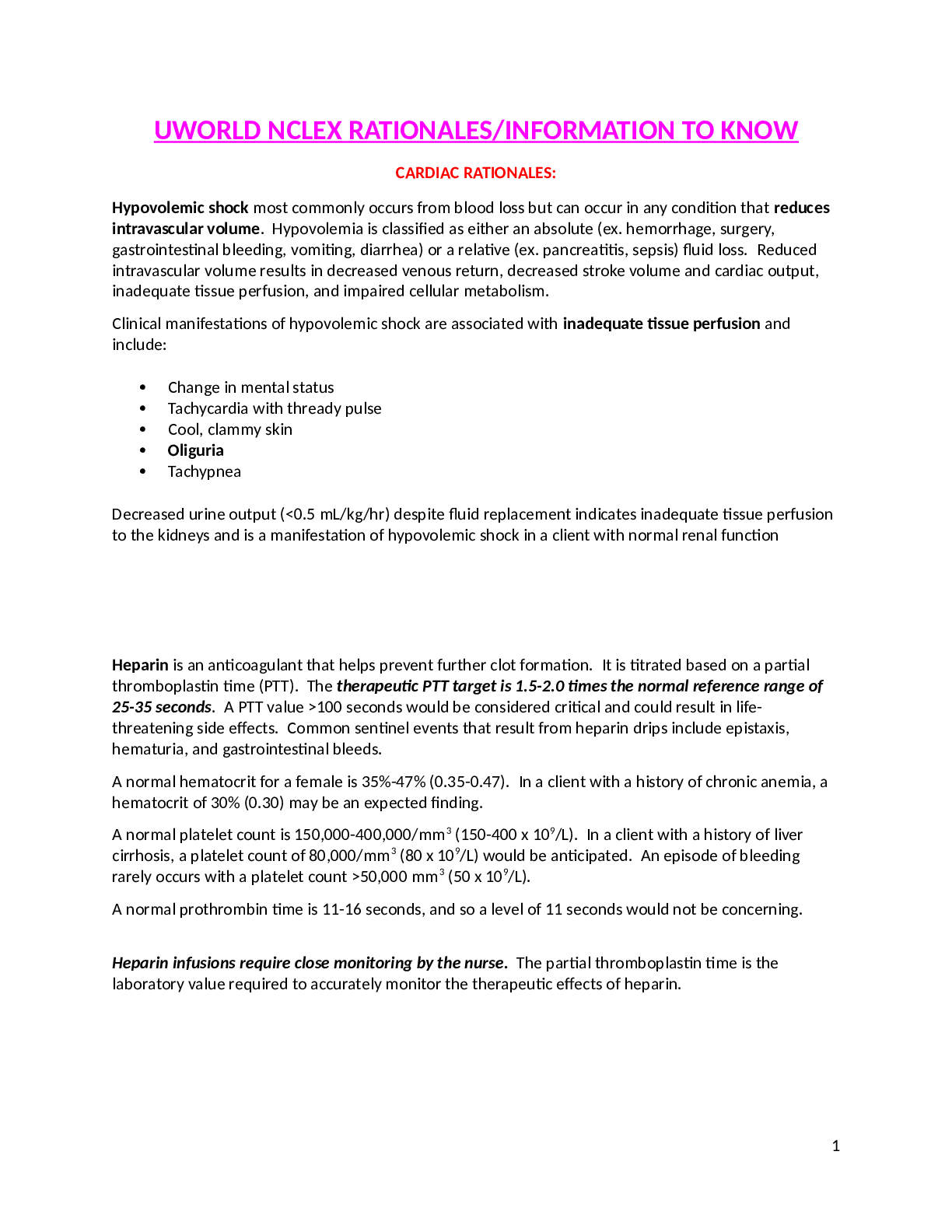
1. The nurse is providing post-operative care to a craniotomy client. Diabetes insipidus is
suspected when the client’s urine output suddenly increases significantly. Which
...
Day 4 1
NCLEX Test Taking Strategy Questions
1. The nurse is providing post-operative care to a craniotomy client. Diabetes insipidus is
suspected when the client’s urine output suddenly increases significantly. Which action takes
highest priority?
o 1. Monitoring urine output
o 2. Checking pulse
o 3. Checking blood pressure
o 4. Assessing level of consciousness
2. Incorrect: Checking the pulse is a good thing, but, not as important as checking the BP.
4. Incorrect: If my client is going into shock the highest priority is to assess the BP.
2. The client is being treated for fluid volume deficit. Which is an expected outcome of
successful treatment?
o 1. Resolution of orthostatic hypotension
o 2. Maintenance of weight loss
o 3. Compliance with sodium restricted diet
o 4. Maintenance of serum Na above 148 mEq
3. The nurse in the intensive care unit is caring for a client receiving hemodynamic monitoring.
When planning for a client’s care, which nursing diagnoses associated with hemodynamic
monitoring may be utilized by the nurse? Select all that apply.
1. Decreased cardiac output
2. Fluid volume deficit
3. Fluid volume excess
4. Ineffective tissue perfusion
5. Ineffective airway.
4. The nurse is caring for a client that has two IV access sites. One is a 20 gauge antecubital
peripheral IV that was started yesterday for blood and has normal saline (NS) at keep vein open
rate. The other is a double lumen central line catheter with one port for Total Parental Nutrition
and the other is used for blood samples. Where is the best site for the nurse to administer 20 mEq
of potassium chloride (KCL) in 100 mL of normal saline(NS) over 4 hours?
o 1. Central line port that is being used for lab draws
o 2. Same line with the Total Parental Nutrition
o 3. Large bore antecubital
o 4. Start another peripheral IV
5. The nurse is caring for a client that has metabolic acidosis secondary to acute renal failure.
What is the initial client response to this problem?
o 1. Respiratory rate increases to blow off acid.
o 2. Respiratory rate decreases to conserve acid and buffer the kidneys response.
o 3. Kidneys will excrete hydrogen and retain bicarb.
o 4. Sodium will shift to cells and buffer the hydrogens.
6. The client presents to the emergency department with nausea, vomiting and anorexia for the
last few days. An EKG on admission reveals an arrhythmia. Which electrolytes imbalance is
suspected?
o 1. Hypercalcemia
o 2. Hypokalemia
o 3. Hypermagnesemia
o 4. Hyponatremia
7. The nurse is caring for a client that is drowsy and has an elevated CO2. What are some
common drugs that cause retained CO2? Select all that apply
1. Narcotics
2. Diuretics
3. Steroids
4. Antiemetics
5. Hypnotics
8. A client was admitted 24 hours ago with sepsis. Treatment included IV therapy of lactated
Ringers (LR) at 150 ml/hr, broad spectrum antibiotics, and steroid therapy. How will the nurse
know that treatment has been successful? Select all that apply.
1. Blood pressure 96/68; HR- 98; RR- 20
2. Serum Glucose- 110
3. Hgb- 12; Hct- 38
4. pH- 7.30; pCO2- 48; HCO3- 24
5. Urinary output at 25 ml/hr
6. Awake, alert to person, place and time
9. The daytime charge nurse identifies that a client was treated for what condition during the
night after reading the following chart entries?
o 1. Respiratory Alkalosis
o 2. Respiratory Acidosis
o 3. Metabolic Alkalosis
o 4. Metabolic Acidosis
Progress Notes:
11/22/10- 0125 Restless, picking at sheets and pulling at IV tubing. Disoriented to place
and time. Dyspnea on exertion noted. Dr. Timmons notified. Stat ABGs ordered.-------
Mary Minee, RN
11/22/10- 0145 Oxygen started at 2 liters per nasal cannula. Incentive Spirometry and
deep breathing exercises initiated. Head of bed elevated to 30 degrees.------------Mary
Minee, RN
Lab reports:
pH- 7.30
pO2- 91mmHg
pCO2- 50 mmHg
HCO3- 24 mEq/L
6 Day 4
10. The nurse is caring for a client, who is 8 hours post- op receiving 40% humidified oxygen.
ABG results are: pO2= 91, pCO2= 50, pH= 7.30, HCO3= 24. Based on this information, which
nursing action would be best?
o 1. Turn client and encourage coughing and deep breathing.
o 2. Request respiratory therapy to perform postural drainage and percussion.
o 3. Report ABGs to physician and increase oxygen percentage.
o 4. Administer anti-anxiety agent.
11. After completing a round of chemotherapy, the client’s lab results revealed.
Based on this data, what problem should the nurse anticipate? Select all that apply.
1. Anemia
2. Leukopenia
3. Thrombocytopenia
4. Hypernatremia
5. Hypokalemia
12. A client weighing 154 pounds is admitted to the burn unit with second and third degree burns
covering 40% total body surface area. Normal Saline IV fluid resuscitation is ordered at 4 ml/kg
per percentage of total body surface area burned over the first 24 hours. How much fluid does the
nurse calculate the client will receive in 24 hours?
Provide your answer in whole numbers
ml
13. A client five days post electrical burn states, “I am feeling fine and would like to go home.”
What is the rationale for this length of stay?
o 1. Bone damage always occurs resulting in pathologic fractures.
o 2. Vascular and nerve damage may cause organ failure.
o 3. Continuous EKG monitoring is always required.
o 4. Infection is sometimes a delayed response.
14. A client is hospitalized hundreds of miles from home for a bone marrow transplant. The
client is in reverse isolation while undergoing total body irradiation and intense chemotherapy.
The client’s sibling, who has driven a great distance, comes to visit and has obvious
manifestations of an upper respiratory infection. Which nursing action would be most
appropriate at this time?
o 1. Do not allow the sibling to visit, and do not upset the client by mentioning the sibling’s
visit.
o 2. Allow the sibling to wave at the client through the window or door, then offer the use
of the unit phone so they can talk.
o 3. Allow the sibling to visit donning a sterile gown, mask, and gloves, but prohibit
physical contact.
o 4. Allow the sibling to visit after donning a sterile gown, mask, and gloves and have the
client wear a mask.
15. A client is admitted to the Emergency Department with burns to the chest and legs. Which
assessment is the highest priority?
o 1. Calculating the “Rule of Nines”
o 2. Determining the time of the burn
o 3. Ascertaining if the burn occurred in an enclosed area
o 4. Calculating the Parkland formula
16. The client has returned to your unit after an escharotomy of the forearm.
What is the priority nursing assessment?
o 1. Infection
o 2. Incision
o 3. Pain
o 4. Tissue perfusion
17. A client had surgery for cancer of the colon and a colostomy was performed. Prior to
discharge, the client states that he will no longer be able to swim. The nurse’s response would be
based on which understanding?
o 1. Swimming is not recommend, the client should begin looking for other areas of
interest.
o 2. Swimming is not restricted if the client wears a dressing over the stoma at all times.
o 3. The client cannot go into water that is over the stoma area, he can only go into water
up to the stoma area.
o 4. There are no restrictions on the activity of a client with a colostomy; all previous
activities may be resumed.
18. The nurse is evaluating whether a client understands the procedure for collecting a 24 hour
urine sample. The nurse recognizes that teaching was successful when the client makes which
statements? Select all that apply.
1. “I should start the 24 hour urine collection at the time of my first saved urine
specimen.”
2. “If I forget to collect any urine, I will need to start over.”
3. “It is important to ensure that no feces or toilet tissue mixes with the urine.”
4. “When the 24 hours is up, I need to void and collect that specimen.”
5. “The urine specimen should be stored in my refrigerator during collection.”
19. After gathering supplies, explaining the procedure, putting the client in a high fowlers
position, and washing hands, the nurse begins to clean a client’s tracheostomy. Place the steps in
the proper order. All options must be used.
1. Soak inner cannula in peroxide.
2. Reinsert cannula with non-dominant hand and lock into place.
3. Prepare sterile supplies, hydrogen peroxide and normal saline.
4. Don sterile gloves.
5. Rinse and dry inner cannula with pipe cleaner.
6. Put on clean gloves to remove soiled dressing.
7. Secure tracheostomy with clean twill tape.
8. Cleanse the wound and plate of the tracheostomy tube with sterile cotton tipped applicator.
9. Remove old twill tape.
20. The client with Addison’s disease demonstrates an understanding of steroid therapy by which
statement?
o 1. “I’ll take my medicine at night to help me sleep.”
o 2. “My medication dosage will be adjusted frequently.”
o 3. “I will limit my sodium intake to 200 mg per day.”
o 4. “I will weigh myself weekly to monitor medication effectiveness.”
21. The nurse is admitting a client with new onset Diabetes mellitus. Which findings does the
nurse expect while completing the medical history and physical examination of this client?
Select all that apply.
1. History of recurrent vaginal yeast infections
2. Complaints of intolerance to the cold
3. Slow, slurred speech noted
4. Prescription change for glasses needed twice in past year
5. Complaints of wanting to eat all the time
6. Amenorrhea
22. A nurse caring for a cancer client is teaching the client about precautions concerning the
client’s risk for bleeding problems. The nurse identifies that teaching has been successful
regarding bleeding precautions when the client makes which statement? Select all that apply.
1. “I cannot shave while I am at risk for bleeding.”
2. “It is important to gargle with a commercial mouthwash three times a day.”
3. “Stool softeners will help prevent rectal bleeding.”
4. “Prior to sexual intercourse, I will use a water-based lubricant.”
5. “I will use a soft toothbrush.”.
23. The nurse is caring for a client that is paranoid in the locked psychiatric unit. It is time for the
client’s individual session, but the client is very agitated with outburst of shouting. What would
be the nurse’s best action at this time?
o 1. Have the client sit with you and say a prayer.
o 2. Explain that shouting is not allowed and send them to group session.
o 3. Redirect the client to another activity.
o 4. Call for assistance and put the client in seclusion.
24. Which dietary consideration is the most important for the nurse to teach to a client with
hypothyroidism?
o 1. Increase carbohydrate intake.
o 2. Increase fluid intake.
o 3. Avoid shellfish.
o 4. Increase fiber.
25. Following a thyroidectomy a client is complaining of shortness of breath and neck pressure.
What should the nurse do?
o 1. Stay with the client, remove the dressing, and elevate the head of bed.
o 2. Call a code, open the trach set and position the client flat supine.
o 3. Have the client say “EEE” to check for laryngeal integrity and assess Chvostek’s sign.
o 4. Call the doctor and assess vital signs.
26. A client is admitted for evaluation of cardiac arrhythmias. What would be the most important
information to obtain when assessing this client?
1. Ability to perform isometric exercises as ordered.
2. Changes in level of consciousness or behavior.
3. Recent blood sugar changes.
4. Compliance with dietary fat restrictions.
27. The nurse is caring for a client with deep vein thrombosis of the left leg. Which nursing goal
would be most appropriate for this client?
1. To decrease inflammatory response in the affected extremity.
2. To increase peripheral circulation.
3. To prepare client and family for anticipated vascular surgery.
4. To prevent hypoxia associated with the development of pulmonary emboli.
28. A six-year-old client has been receiving chemotherapy for two weeks. The laboratory results
show a platelet count of 20,000. What is the priority nursing action?
o 1. Encourage quiet play.
o 2. Avoid persons with infections.
o 3. Administer p.r.n. oxygen.
o 4. Provide foods high in iron.
29. A nurse is caring for a client diagnosed with heart failure (HF). The client currently takes
furosemide (Lasix) 40mg every morning. Potassium 20mEq daily, digoxin (Lanoxin) 0.25mg
every day. Which client comment should the nurse assess first in caring for this client?
o 1. “My fingers and feet are swollen.”
o 2. “My weight is up 1 pound.”
o 3. “There is blood in my urine.”
o 4. “I am having trouble with my vision.”
30. After a left heart catheterization, a client complains of severe foot pain on the side of the
femoral stick. The nurse notes pulselessness, pallor, and cold extremity. What should be the
nurse’s next action?
o 1. Administer an anticoagulant .
o 2. Warm the room and re-assess.
o 3. Increase IV fluids.
o 4. Notify the physician stat.
31. A client is admitted to the medical unit with a diagnosis of Addison’s disease. What nursing
interventions should the nurse implement for this client? Select all that apply.
1. Administer potassium supplements as ordered.
2. Assist the client to select food high in sodium.
3. Administer Fludrocortisone (Florinef) as ordered.
4. Monitor intake and output.
5. Record daily weight.
32. In planning a menu for a client suffering from an acute manic episode, which meal would the
nurse determine to be most appropriate?
o 1. Spaghetti and meat balls, salad, banana
o 2. Beef and vegetable stew, bread, vanilla pudding
o 3. Fried chicken leg, ear of corn, apple
o 4. Fish fillets, stewed tomatoes, cake
33. The manic client has just interrupted the counselor’s group session for the 4th time and states
“I already know this information dealing with others when you are down.” What should the
nurse do at this time?
o 1. Engage the client to walk with you to make another pot of coffee.
o 2. Ask the client to reflect on the client’s behavior to determine if it is appropriate.
o 3. Ask the group to tell the client how they feel when she interrupts.
o 4. Instruct the client to perform jumping jacks and counting aloud to get rid of some
energy.
34. After examining the eyes of the following client, the nurse would expect which
correlating lab work?
o 1. Elevated cortisol level
o 2. Elevated thyroxine levels
o 3. Decreased parathormone levels
o 4. Increased calcitonin level
35. A client with schizophrenic disorder begins to talk about fantasy material. What would be
the most appropriate nursing action?
o 1. Encourage the client to focus on reality-based issues.
o 2. Allow the client to continue to talk so as not to interrupt the delusion.
o 3. Ask the client to explain the meaning behind what he is saying.
o 4. Persuade the client that his thoughts are not true.
36. A client has been admitted to the medical unit with hepatitis B. Identify what quadrant the
nurse would assess for hepatomegaly. Place an “x” in the correct location.
Rationale:
Correct: The liver is located under the right lower rib cage. The liver may be palpable in the right
upper quadrant.
37. Which client is at highest risk for suicide?
o 1. Seventy-six year old widower with chronic renal failure
o 2. Nineteen year old taking antidepressants
o 3. Twenty-eight year old post-partum crying weekly
o 4. Fifty year old with obsessive-compulsive disorder (OCD)
38. A client with a T4 lesion is being cared for on the neuro rehabilitation unit. The client
suddenly complains of a severe, pounding headache. Profuse diaphoresis is noted on the
forehead. The blood pressure is 180/112 and the heart rate is 56. What interventions should the
nurse initiate? Select all that apply.
1. Place the client supine with legs elevated.
2. Assess bladder and bowel for distention.
3. Examine skin for pressure areas.
4. Eliminate drafts.
5. Remove triggering stimulus.
6. Administer hydralazine (Apresoline) if BP does not return to normal.
39. A client who is fourth day post-op cholecystectomy complains of severe abdominal pain.
During the initial assessment he states, “I have had two almost black stools today.” Which
nursing action is most important?
o 1. Start an IV with D5W at 125 ml/hr.
o 2. Insert a nasogastric tube.
o 3. Notify the physician.
o 4. Obtain a stool specimen.
40. A construction worker comes into the occupational health nurse’s clinic complaining of chest
heaviness. What other signs and symptoms does the nurse expect to find if myocardial infarction
is suspected? Select all that apply.
1. Headache
2. Indigestion
3. Lightheadedness
4. Dyspnea
5. Irregular pulse
41. The nurse is caring for a client complaining of intense headaches with increasing pain for the
past month. A Magnetic Resonance Imaging (MRI) is ordered. In reviewing the client’s
information, which piece of information is of concern?
o 1. Allergic to shellfish
o 2. Cardiac pacemaker
o 3. Diabetic
o 4. No IV access
42. A newly diagnosed diabetic client is demonstrating to the nurse how to draw up regular
insulin 15 units and NPH insulin 10 units into the same syringe. The nurse knows that the client
successfully demonstrates this procedure if done in what order? Place in the correct order. All
options must be used.
1. Inject 15 units of air into regular insulin bottle.
2. Inject 10 units of air into NPH insulin bottle.
3. Prepare skin site and inject insulin.
4. Roll insulin bottles between hands.
5. Draw up 10 units of NPH insulin into the insulin syringe.
6. Draw up 15 units of regular insulin into insulin syringe.
7. Wipe the top of insulin bottles.
43. What must the nurse do while caring for a client with an eating disorder?
o 1. Encourage client to cook for others.
o 2. Weight the client daily and keep a journal.
o 3. Restrict access to mirrors.
o 4. Monitor food intake and behavior for one hour after meals.
44. Which condition would warrant the nurse discontinuing the intravenous infusion of oxytocin
(Pitocin)?
45. In preparing care for a client with Parkinson’s disease, which nursing diagnoses should the
nurse include? Select all that apply.
1. Impaired physical mobility related to muscle rigidity
2. Imbalanced nutrition, greater than body requirements related to limited exercise
3. Self-care deficits related to motor disturbance
4. Impaired verbal communication related to inability to move facial muscles
5. Unilateral neglect related to muscle paralysis.
46. The client is transferred to the Neuro Unit after developing right sided paralysis and aphasia.
Which nursing action should be included in the nursing care plan in order to promote
communication with the client?
o 1. Encourage client to shake head in response to questions.
o 2. Speak in a loud voice during interactions.
o 3. Speak using phrases and short sentences.
o 4. Encourage the use of radio to stimulate the client.
47. The client delivered a 9-pound 12-ounce baby 1 hour ago. You note during her 15-minute
assessment that she saturated 2 pads and that she is lying in a small puddle of blood. Which
nursing action should take priority?
o 1. Call for assistance.
o 2. Massage the fundus if boggy.
o 3. Assess vital signs.
o 4. Assess the perineum for tears.
48. The nurse is caring for a client with pneumonia. Which nursing observation would indicate a
therapeutic response to the treatment for the infection?
o 1. Oral temperature of 101 degrees F., increased chest pain with non-productive cough
o 2. Productive cough with thick green sputum, states feels tired
o 3. Respirations 20, with no complaints of dyspnea, moderate amount of thick white
sputum
o 4. White cell count of 10,000 mm3, urine output at 40 cc/hr, no sputum
49. Which nursing action would be included in planning care for a client with signs of increased
intracranial pressure?
o 1. Encourage coughing and deep-breathing to prevent pneumonia.
o 2. Suction airway every 2 hours to remove secretions.
o 3. Position the client in the prone position to promote venous return.
o 4. Determine cough reflex and ability to swallow prior to administering PO fluids.
Rationale:
4. Correct: If I have increased ICP my reflexes could be suppressed.
1. Incorrect: Makes ICP go up.
2. Incorrect: Makes ICP go up.
3. Incorrect: Makes ICP go up.
Day 4 27
50. Which postpartum client requires the last private room in the Women’s Health Center?
o 1. A client who had an abruption during her delivery 22 hours ago
o 2. A client who had a boggy fundus five hours post-delivery
o 3. A client who was pre-eclamptic prior to delivery 30 hours ago, with vital signs now
normal.
o 4. A client who delivered by c-section whose WBC count is 24,000
51. The nurse will be admitting a client from the operating room following a left
pneumonectomy for adenocarcinoma. Which type of chest drainage system should the nurse
anticipate the client will have?
o 1. Bilateral chest tubes.
o 2. One chest tube on the operative side.
o 3. Two chest tubes on the operative side.
o 4. No chest drainage will be necessary.
Rationale:
4. Correct: Pneumonectomy means the ENTIRE lung has been removed.
1. Incorrect: No, the entire lung has been removed.
2. Incorrect: No, the entire lung has been removed.
3. Incorrect: Again, the entire lung has been removed.
28 Day 4
52. After administration of epidural anesthesia, the laboring client’s blood pressure drops to
92/42. What would be the priority nursing intervention?
o 1. Elevate the head of the bed.
o 2. Begin oxygen by face mask at 40%.
o 3. Change her position to side-lying.
o 4. Begin dopamine as ordered.
53. The client is admitted to the hospital following a motor vehicle accident and has sustained a
closed chest wound. Which assessment finding is consistent with flail chest?
o 1. Biot’s breathing
o 2. Sucking sounds with respirations
o 3. Paradoxical chest wall movement
o 4. Hypotension and bradycardia
54. The nurse is caring for a client 28 weeks pregnant that complains of swollen hands and feet.
Which symptom below would cause the most concern?
o 1. Nasal congestion
o 2. Hiccoughs
o 3. Capillary blood glucose of 150
o 4. Muscle spasms
55. The nurse is writing a care plan for a client admitted following chest tube placement for a
spontaneous pneumothorax. Which intervention would be appropriate for the nurse to include?
o 1. Keep the water seal chamber at the level of the right atrium.
o 2. Tape all connections between the chest tube and drainage system.
o 3. Notify the physician if there is continuous bubbling in the suction control chamber.
o 4. Empty the collection chamber and record the amount of drainage every shift.
56. A child with a radial fracture complains of itching to the casted area. What is the appropriate
nursing action to relieve itching?
o 1. Allow the child to use a Q-tip to scratch the area.
o 2. Visualize the toes and area above the cast to identify areas of irritation.
o 3. Apply an ice pack for 10-15 minutes.
o 4. Explain to the child that itching is an indication the fracture is healing.
57. Following a hip replacement surgery, an elderly client is ordered to begin ambulation with a
walker. In planning nursing care, which statement by the nurse will best help this client?
o 1. Sit in a low chair for ease in getting up in a walker
o 2. Make sure rubber caps are present on all 4 legs of the walker
o 3. Begin weight-bearing on the affected hip immediately.
o 4. Practice tying your shoes before using the walker
58. The nurse is caring for a client in the 8th week of pregnancy. The client is spotting, has a
rigid abdomen and is on bed rest. What is the most important assessment at this time?
o 1. Protein in the urine
o 2. Fetal heart tones
o 3. Cervical dilation
o 4. Hemoglobin and hematocrit levels
59. A client is preparing to be discharged after a total hip replacement. Which statements, if
made by the client, would indicate to the nurse that teaching has been successful regarding
prevention of hip prosthesis dislocation? Select all that apply.
1. “I should not cross my affected leg over my other leg.”
2. “I should not bend at the waist more than 90 degrees.”
3. “While lying in bed, I should not turn my affected leg inward.”
4. “It is necessary to keep my knees together at all times.”
5. “When I sleep, I should keep a pillow between my legs.”
60. The client presents to the emergency department with no known injury and back pain so
severe they cannot walk. The client describes the pain as coming in waves. What should the
nurse do first?
o 1. Medicate for pain
o 2. Obtain urine specimen
o 3. Check the patellar reflex
o 4. Provide gentle stretching maneuvers
61. The nursing supervisor is observing a nurse caring for a client with a chest drainage system
receiving 20 cm of suction. The nursing supervisor recognizes proper procedure by the nurse
when the nurse performs which action? Select all that apply.
1. Maintain chest drainage system below the client’s chest during transport.
2. Apply tape to the connection tubes.
3. Add sterile saline to suction control chamber to achieve 20 cm.
4. Clamp the tubing to assess respiratory effort.
5. Ensure that tubing is not kinked or looped.
62. What is the diet of choice for a client on hemodialysis?
o 1. Extra protein, low sodium, fluid restriction
o 2. Fluid restriction, low sodium, low protein
o 3. Low sodium, low potassium, low carbohydrates
o 4. Extra carbohydrates, low fat, low sodium
63. In order to maintain asepsis, what should the client on home peritoneal dialysis be taught?
o 1. Drink only distilled water
o 2. Cap Tenckhoff catheter when not in use
o 3. Boil the dialysate one hour.
o 4. Clean the arteriovenous fistula with hydrogen peroxide daily
64. A client returns to the nursing unit post-thoracotomy with two chest tubes in place connected
to a drainage device. The client’s spouse asks the nurse about the reason for having two chest
tubes. The nurse’s response is based on the knowledge that the lower chest tube is placed to:
o 1. Remove air form the pleural space.
o 2. Create access for irrigating the chest cavity.
o 3. Evacuate secretions from the bronchioles and alveoli.
o 4. Drain blood and fluid from the pleural space.
65. The nurse is caring for a female that is preparing to undergo a total hysterectomy for
advanced cervical cancer. The client is crying and says that she wants to have more children and
is unsure if she should have the procedure. What should the nurse do?
o 1. Allow the client to discuss her fears and encourage her to talk with her physician.
o 2. Tell her the good things that she will able to do without more children.
o 3. Explain to the client that her ovaries can be frozen for egg harvesting at a later time.
o 4. Advise the client to put off having the surgery until she is sure.
66. You are assisting a burn client at the scene of the fire. Which intervention will prevent
infection?
o 1. Do nothing until the client arrives in Emergency Department.
o 2. Cleanse the burn with betadine.
o 3. Apply antibiotic ointment and wrap with a kerlix.
o 4. Remove non adherent clothing and wrap in a clean sheet or clothing.
[Show More]







![Preview of The Well-Managed Healthcare Organization 9th Edition by Griffith [eBook] [PDF]](https://scholarfriends.com/storage/The_Well_Managed_Healthcare_Organization_9th_Edition_by_Griffith.png)






.png)