FA Davis. Questions and answers.
Research has shown that medication errors are a result of
A. Poor packaging
B.Systems issues
C. Incompetence
D. Look-alike/sound-alike drug names - Ans-System issues
Which of the fo
...
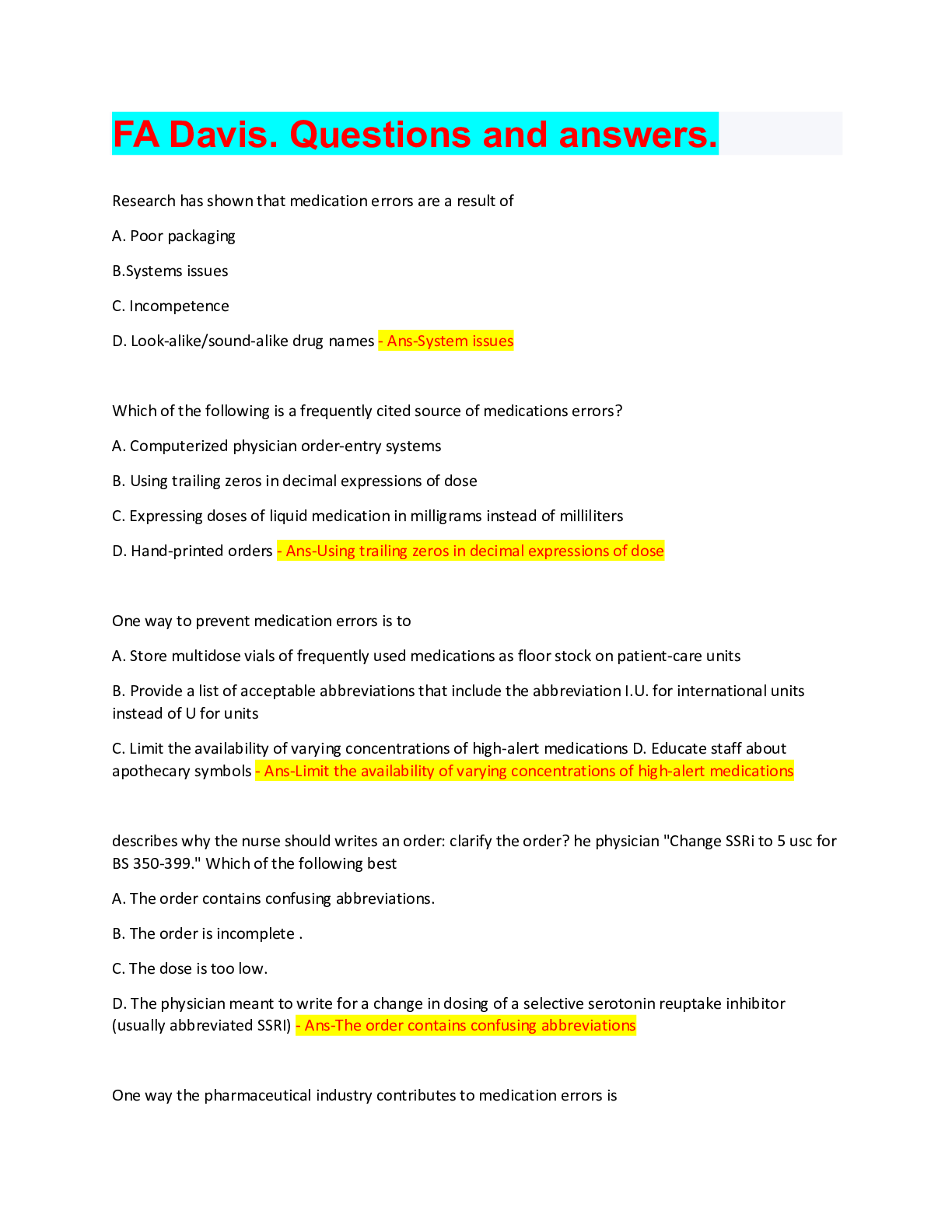
FA Davis. Questions and answers.
Research has shown that medication errors are a result of
A. Poor packaging
B.Systems issues
C. Incompetence
D. Look-alike/sound-alike drug names - Ans-System issues
Which of the following is a frequently cited source of medications errors?
A. Computerized physician order-entry systems
B. Using trailing zeros in decimal expressions of dose
C. Expressing doses of liquid medication in milligrams instead of milliliters
D. Hand-printed orders - Ans-Using trailing zeros in decimal expressions of dose
One way to prevent medication errors is to
A. Store multidose vials of frequently used medications as floor stock on patient-care units
B. Provide a list of acceptable abbreviations that include the abbreviation I.U. for international units
instead of U for units
C. Limit the availability of varying concentrations of high-alert medications D. Educate staff about
apothecary symbols - Ans-Limit the availability of varying concentrations of high-alert medications
describes why the nurse should writes an order: clarify the order? he physician "Change SSRi to 5 usc for
BS 350-399." Which of the following best
A. The order contains confusing abbreviations.
B. The order is incomplete .
C. The dose is too low.
D. The physician meant to write for a change in dosing of a selective serotonin reuptake inhibitor
(usually abbreviated SSRI) - Ans-The order contains confusing abbreviations
One way the pharmaceutical industry contributes to medication errors isA.Spending too little time on product development
B. Packaging different products similarty C. Not alerting physicians and nurses to potential name
confusion
D. Offering similar products with similar actions - Ans-Packaging different products similarly
The physician orders MSO4 4 mg IV. The nurse should
A. Call the prescriber to clarify the dose B. Prepare to administer morphine sulfate 4 mg
C. Call the prescriber to clarify the medication
D. Prepare to administer 4 mg of magnesium sulfate INv - Ans-Call the prescriber to clarify the
medication
The physician orders morphine 6 mg IM. The nurse administers hydromorphone 6 mg lM. The nurse's
action is
A. Not an error; hydromorphone is the generic form of morphine
B. An error, and the patient will require more medication to obtain pain relief
C. An error but will result in adequate pain relief with little potential for harm D. An error with high risk
of harm - Ans-An error with high risk of harm
A medication in a vial is labeled with the 50 mg IV over 5 minutes. The nurse draws up mg/mL. In the
upper right-hand corner of the label is the expression 5 mL. The order is to administer drug name. Under
the drug name is the expression 100
A. 1 mL of medication
B. 5 mL of medication
C. 0.5 mL of medication
D. There is not enough information to answer the question. - Ans-0.5 mL of medication
Dosage calculation errors are a common cause of medication error. To minimize the risk of a dosage
calculation error, the nurse should
A. Double-check the calculation
B. Show the calculation to the physician or pharmacist to check
C. Have another nurse check the original order and then review the calculationD. Have another nurse check the original order and calculate the dose without looking the first nurse's
calculation - Ans-Have another nurse check the original order and calculate the dose without looking at
the firsr nurses calculations
Mr. B., 67 years old, sees his family doctor for leg pain when walking. The doctor explains the
pathophysiology of intermittent claudication and orders him cilostazol (Pletal) 100 mg twice daily. Mr. B.
has a history of type 2 diabetes, GERD (gastro-esophageal reflux disease), and heart failure (HF). He
takes metformin 500 mg bid, omeprazole 20 mg once daily, and digoxin 0.125 mg once daily. Use your
Drug Guide to review the medications Mr. B. takes and determine which of the following statements is
accurate.
A. Mr. B.'s medications are all ordered appropriately
B. Mr. B. may experience an adverse reaction to the cilostazol due to his history of HF and GERD
C. Mr. B. may experience an adverse reaction due to a drug interaction between metformin and
cilostazol
D. Mr. B. may experience an adverse reaction related to digoxin and metformin. - Ans-Mr. B may
experience an adverse reaction to cilostazol due to his history of HF and GERD
[Show More]