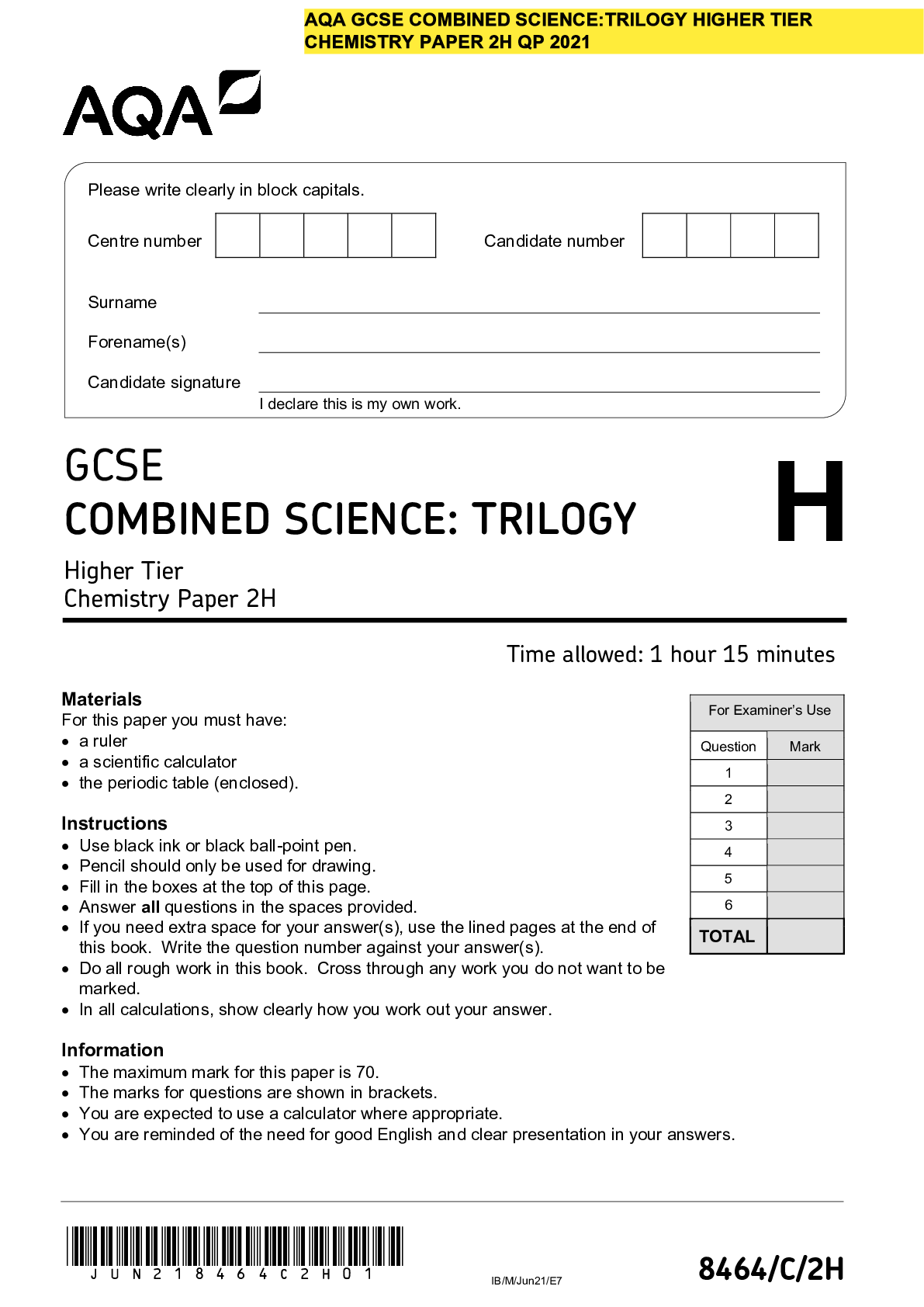
Materials
For this paper you must have:
• a ruler
• a scientific calculator
• the periodic table (enclosed)
Instructions
• Use black ink or black ball-point pen.
• Pencil should only be used for drawing.
• Fill i
...
Materials
For this paper you must have:
• a ruler
• a scientific calculator
• the periodic table (enclosed)
Instructions
• Use black ink or black ball-point pen.
• Pencil should only be used for drawing.
• Fill in the boxes at the top of this page.
• Answer all questions in the spaces provided. Do not write outside
the box around each page or on blank pages.
• If you need extra space for your answer(s), use the lined pages at the end of
this book. Write the question number against your answer(s).
• Do all rough work in this book. Cross through any work you do not want
to be marked.
• In all calculations, show clearly how you work out your answer.
Information
• The maximum mark for this paper is 100.
• The marks for questions are shown in brackets.
• You are expected to use a calculator where appropriate.
• You are reminded of the need for good English and clear presentation
in your answers.
Please write clearly in block capitals.
Centre number Candidate number
Surname
Forename(s)
Candidate signature
I declare this is my own work.
GCSE
CHEMISTRY
Foundation Tier Paper 2
F2
*02* IB/M/Jun21/8462/2F
Do not write
outside the
0 1 This question is about the Earth’s atmosphere. box
0 1 . 1 How long ago was the Earth formed?
[1 mark]
Tick () one box.
4.6 billion years ago
4.6 million years ago
4.6 thousand years ago
Table 1 shows the percentages of gases in the atmospheres of Mars and
Earth today.
Table 1
Gas
Percentage of gas in atmosphere (%)
Mars Earth
Carbon dioxide 95.97 0.04
Nitrogen 1.89 78.09
Oxygen 0.15 20.95
Other gases 1.99 X
0 1 . 2 Calculate the percentage X of other gases in the Earth’s atmosphere.
Use Table 1.
[1 mark]
X = %3
*03*
Turn over ►
IB/M/Jun21/8462/2F
Do not write
outside the
The atmosphere of the early Earth is thought to have been similar to the atmosphere box
of Mars today.
The percentages of nitrogen and of oxygen in the Earth’s atmosphere today have
changed from the percentages in the Earth’s early atmosphere.
0 1 . 3 Draw one line from each gas to the change in the percentage of that gas.
Use Table 1.
[2 marks]
0 1 . 4 The percentage of carbon dioxide in the Earth’s early atmosphere decreased.
Which two processes caused this decrease?
[2 marks]
Tick () two boxes.
Carbon dioxide dissolving in sea water
Combustion of fossil fuels
Farming of animals
Formation of sedimentary rocks
Volcanoes releasing carbon dioxide
Gas Change in percentage of gas
Nitrogen
Oxygen
Increased by about 4 times
Increased by about 21%
Increased by about 40 times
Increased by about 96%4
*04* IB/M/Jun21/8462/2F
Do not write
outside the
0 1 . 5 Photosynthesis also decreased the percentage of carbon dioxide in the Earth’s box
early atmosphere.
Photosynthesis increased the percentage of another gas.
Complete the word equation for photosynthesis.
[2 marks]
+ water → glucose +
0 1 . 6 Complete the sentence.
[1 mark]
Scientists are not certain about the percentages of gases in the Earth’s early
atmosphere because there is a lack of . 95
*05*
Turn over ►
IB/M/Jun21/8462/2F
Do not write
outside the
Turn over for the next question box
DO NOT WRITE ON THIS PAGE
ANSWER IN THE SPACES PROVIDED6
*06* IB/M/Jun21/8462/2F
Do not write
outside the
0 2 This question is about water. box
A student investigated the concentration of salt in sea water.
This is the method used.
1. Filter the sea water to remove sand.
2. Measure the mass of an empty evaporating dish.
3. Measure 50 cm3 of sea water into the evaporating dish.
4. Heat the evaporating dish and sea water.
5. Evaporate the sea water to dryness.
6. Measure the mass of the evaporating dish and salt
[Show More]




.png)

.png)