NBCOT Exam Study Guide. 100%
comprehension. Graded A+
NBCOT Exam Study Guide - Ans-NBCOT Exam Study Guide
Practice Test (170 Questions) - Ans-Practice Test (170 Questions)
A patient in the early stages of amyotrophic
...
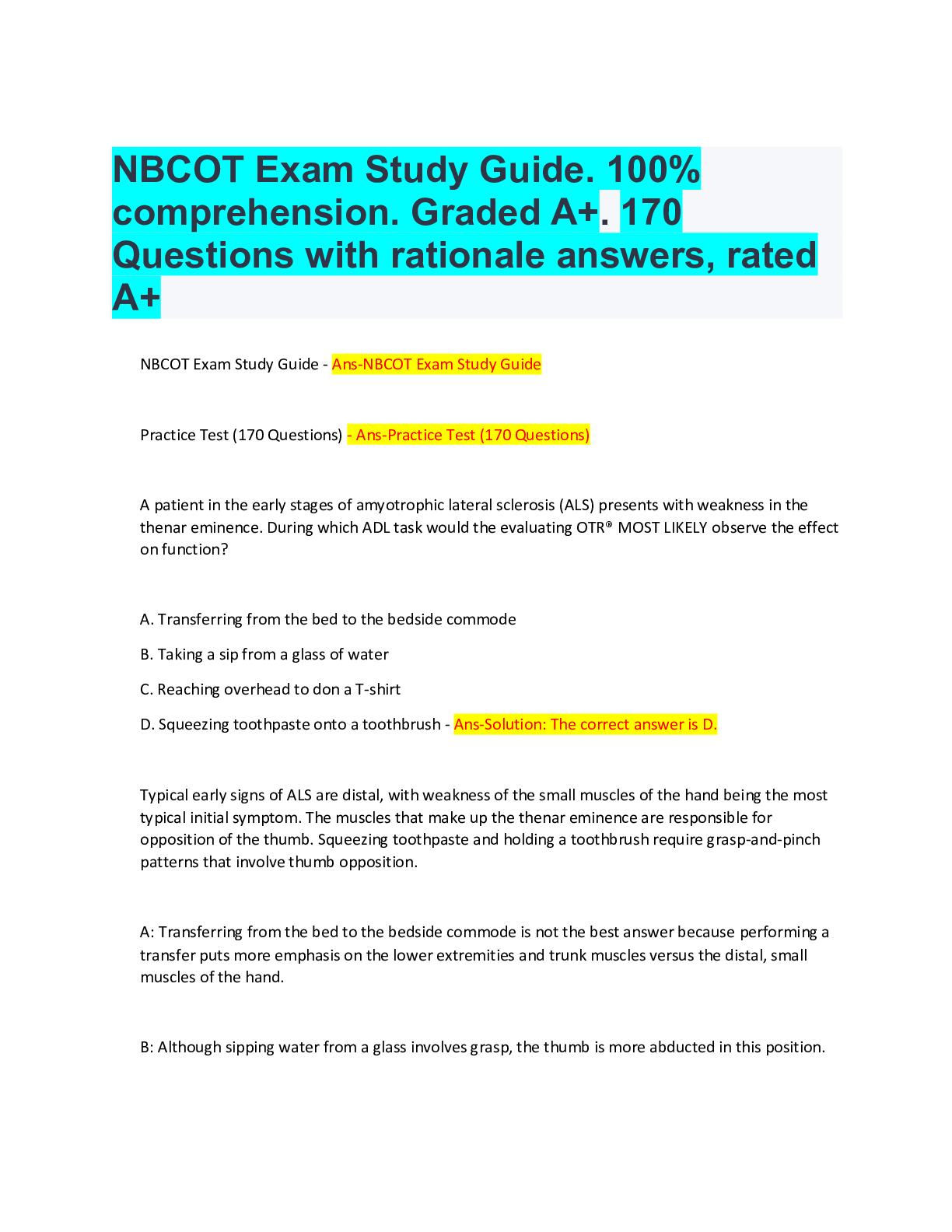
NBCOT Exam Study Guide. 100%
comprehension. Graded A+
NBCOT Exam Study Guide - Ans-NBCOT Exam Study Guide
Practice Test (170 Questions) - Ans-Practice Test (170 Questions)
A patient in the early stages of amyotrophic lateral sclerosis (ALS) presents with weakness in the
thenar eminence. During which ADL task would the evaluating OTR® MOST LIKELY observe the effect
on function?
A. Transferring from the bed to the bedside commode
B. Taking a sip from a glass of water
C. Reaching overhead to don a T-shirt
D. Squeezing toothpaste onto a toothbrush - Ans-Solution: The correct answer is D.
Typical early signs of ALS are distal, with weakness of the small muscles of the hand being the most
typical initial symptom. The muscles that make up the thenar eminence are responsible for
opposition of the thumb. Squeezing toothpaste and holding a toothbrush require grasp-and-pinch
patterns that involve thumb opposition.
A: Transferring from the bed to the bedside commode is not the best answer because performing a
transfer puts more emphasis on the lower extremities and trunk muscles versus the distal, small
muscles of the hand.
B: Although sipping water from a glass involves grasp, the thumb is more abducted in this position.
C: This approach is incorrect because it involves more proximal musculature.
The OTR® is working on a task-oriented gardening activity with a small group of adolescents in an
inpatient mental health setting. One of the participants becomes self-absorbed and distractible and
has bursts of energy that are affecting the other members of the group. What is the OTR®'s MOST
appropriate response?
A. "How are we doing with our pot transfer? We need to get this done today."
B. "Can I speak to you privately about your behavior during the group work?"
C. "You seem to be distracting the other members of the group."
D. "Please stop whatever it is you are doing." - Ans-Solution: The correct answer is A.
When a client starts shows symptoms of a manic episode, particularly emotional and cognitive
symptoms, it is best to help the client engage in goal-directed action.
B, C, D: These responses serve to make the client aware of his or her behaviors but do not
necessarily help the client return to meaningful task performance.
A COTA® is working toward service competency for adaptive feeding equipment instruction. How
would the OTR® BEST establish service competency?
A. Review the COTA's documentation of multiple patients whose feeding impairments warranted
adaptive equipment, then discuss the outcomes with the COTA.
B. Observe the COTA educate clients on how to use adaptive feeding equipment to ensure that the
COTA instructs clients in the same manner as would the OTR.
C. Compare outcomes by rating the same client's performance with the adaptive feeding equipment
at the same level of independence.
D. Collect information from various sources, including other therapists, the COTA's documentation,
and feedback from clients, to determine competency. - Ans-Solution: The correct answer is C.
Service competency is defined as "the process of teaching, training, and evaluating in which the
OTR® determines that the COTA® performs tasks in the same way that the OTR would and achieves
the same outcomes" (Youngstrom, 2009, p. 943). In this example, both the COTA and OTR observe
the same client performing a task and rate that performance in a similar manner. Comparing
outcomes helps to ensure clients receive care of equal quality.
A, D: These are indirect approaches to determining the COTA's skill, which is insufficient to establish
service competency.
B: The tasks do not need to be performed in exactly the same way, but the outcomes must be
similar.
An OTR® is performing family training with a client with Stage VI amyotrophic lateral sclerosis (ALS)
who is preparing for discharge home. Which points are MOST IMPORTANT for the OTR® to address?
A. Adaptive equipment for ADLs and how to set up the client with ALS to perform as independently
as possible
B. Energy conservation for the client with ALS, as well as caregiver support resources to prevent
burnout
C. Positioning to prevent skin breakdown, a ROM home program, and safe bed mobility and
transfers
D. Therapeutic exercises for the client with ALS and how caregivers can use proper body mechanics -
Ans-Solution: The correct answer is C.
[Show More]