Anatomy & Physiology 2 study guide for final exam
Identify the parts of the neuron shown in the diagram below
a. dendrite b.
cell body c. nucleus
List the four parts of the human brain
The human brain is m
...
Anatomy & Physiology 2 study guide for final exam
Identify the parts of the neuron shown in the diagram below
a. dendrite b.
cell body c. nucleus
List the four parts of the human brain
The human brain is made up of the cerebral hemispheres, diencephalon, brain stem, and cerebellum.
List and describe the 3 meninges of the human brain.
The leathery dura mater is the double-layered outer meninx.
The middle arachnoid meninx is a loose layer separated from the dura mater by the subdural space.
The inner pia mater meninx is composed of connective tissue and is tightly attached to the brain.
Answer the following three questions:
What blood cell contains hemoglobin? Red blood cells
The P wave represents what? Atrial depolarization (systole) Define Systole.
the heart is contracting and ejecting blood into circulation List 3 functions of the female reproductive system.
The female reproductive system has the following functions: eggs and estrogen production as well as serving as the site for the development of a baby after fertilization of an egg occurs.
Name the three types of ligaments associated with the ovaries and the function of each. The ovaries are held in place by the suspensory, ovarian, and broad ligaments.
The suspensory ligaments attach the ovaries to the pelvis wall. The ovarian ligaments attach the ovaries to the uterus.
The broad ligaments hold the ovaries in place in the pelvis.
Tell whether each of the following describes mitosis or meiosis:
Occurs only to produce new offspring meiosis
Two division cycles meiosis
No crossing-over occurs mitosis
Four daughter cells are produced meiosis
Produces cells which are not genetically identical to the parent meiosis
Each tRNA anticodon codes for one type of :
C
a. protein
b. ribosome
c. amino acid
d. enzyme
Does transcription or translation occur primarily at the ribosome? Translation
Which requires RNA polymerase, transcription or translation? Transcription
Are amino acids bonded together during translation or transcription? Translation
If a codon reads: GAC, what is the correct anticodon? CUG
Describe the shape, size and weight of a human adult kidney.
The adult kidney is bean shaped, about the size of a can of soup and weighs about 5 ounces.
Describe the structure and function of the renal pelvis.
The renal pelvis is the centermost section of the kidney and is a funnel-shaped tube that connects to the ureter.
Extensions of the pelvis called calyces collect urine which drains into the renal pelvis and then into the ureter.
You are treating a patient in the hospital who was admitted with signs of orthostatic hypotension (decreased blood pressure, increased heart rate, lightheaded) secondary to having severe diarrhea
and dehydration. Which of the following would you expect to be their GFR (glomerular filtration rate) given their symptoms? Explain your answer.
a. 85 ml/min.
b. 120 ml/min.
c. 142 ml/min
a. 85 ml/min. Dehydration decreases glomerular filtration rate.
Explain, in detail, how the cardiovascular baroceptors work to maintain blood pressure.
The cardiovascular baroceptors monitor and regulate blood volume (which is influenced directly by Na+ ion concentration) to maintain blood pressure. If blood volume (and consequently blood pressure) rises, the baroceptors signal the kidney causing a dramatic increase in the filtration rate, increasing the output of water and Na+ which reduces blood volume to quickly normalize the pressure.
Explain, in detail, how the kidneys act to regulate pH by the excretion or reabsorption of bicarbonate.
The major kidney acid-base regulating process is by way of excreting or reabsorbing bicarbonate ion. Examination of the equilibrium equation sequence below will demonstrate that loss of a bicarbonate (HCO3-) ion from the body amounts to the gain of H+ since the reactions will shift to the right.
Conversely, gain of a bicarbonate (HCO3-) ion amounts to the loss of H+ since the reactions will shift to the right. Thus, renal excretion of bicarbonate results in retention of H+, while reabsorbing bicarbonate will result in excretion of H+.
Which nervous system contains the sympathetic and parasympathetic divisions? D
a. Central nervous system
b. Peripheral nervous system
c. Somatic nervous system
d. Autonomic nervous system
e. Sympathetic nervous system
f. Parasympathetic nervous system
If you were hiking in the woods and came across a mountain lion, which division of your nervous system would have increased activity? Explain your answer.
The sympathetic nervous system would have increased activity as it is responsible for preparing our bodies to respond to stressful situations.
This type of neuroglial cell allows fluid exchange between brain, spinal cord and cerebrospinal fluid.
A
a. Ependymal cell
b. Oligodendrocyte
c. Astrocyte
d. Microglial cell
This type of neuron transmits impulses from the brain to the spinal cord. F
a. Multipolar neuron
b. Bipolar neuron
c. Unipolar neuron
d. Sensory neuron
e. Motor neuron
f. Interneuron
True or False: A sensory neuron is signaling the body of EXTREME pain. This means that the strength of the action potential is greater than usual.
False – there is no variation in the strength of action potentials. There is variation in the number of neurons firing.
Describe what is occurring at the axon cell membrane during the phase described in section 4 of the diagram.
The potassium gates that open during repolarization are slow to close and there is generally an afterpolarization undershoot of the potential.
he Glossopharyngeal nerve is one of the cranial nerves. What type of nerve is it and what does it control?
The Glossopharyngeal nerve is a motor and sensory nerve which controls swallowing and taste.
The femoral nerve is one of spinal nerves. What is its function?
The femoral nerve supplies motor fibers to the hip flexors and knee extensors. List the 3 parts of the diencephalon
The diencephalon is made up of the thalamus, hypothalamus, and epithalamus.
Describe the functions of the 4 lobes of the brain. The frontal lobe controls motor functions.
The parietal lobe receives information from receptors located in the skin, such as those for touch, pressure, and pain.
The occipital lobe interprets visual input.
The temporal lobe has sensory areas for hearing and smelling.
Explain in detail the taste process.
Food or drink sits on surface of the tongue activating taste buds. Chemical molecules are dissolved into saliva. Taste receptors are stimulated by gustatory hairs. Sensory information is sent to the brain along facial and glossopharyngeal nerves and impulses are sent to the thalamus and parietal lobe.
Describe in detail the olfactory system.
Olfactory hairs form a thin layer mucous which covers the surface of the epithelium and airborne chemical substances dissolve for detection.
One of your patients has suffered a stroke. You notice that their gait is very unsteady. It almost appears as if they are intoxicated. What portion of the brain was most likely affected by the stroke? Explain your answer.
The cerebellum was most like affected since it is responsible for coordinating body movements and motor activities
If someone sustains an injury to the anterior spinal cord, would you be more likely to see muscular weakness/paralysis or decreased sensation? Explain your answer.
You would be more likely to see muscular weakness because motor neurons exit the spinal cord anteriorly.
Using the terms given below, put each of the following vessels and structures in the order in which the blood travels through them from a capillary in the finger to the lungs to be oxygenated and then back to a capillary in the finger.
Terms:
right ventricle, artery, vein, left ventricle, venule, right atrium, arteriole, left atrium, vena cava, aorta, pulmonary artery, pulmonary vein, tricuspid valve, mitral valve, aortic valve, pulmonic valve
Start Capillary in finger
1 venule
2 vein
3 vena cava
4 right atrium
5 tricuspid valve
6 right ventricle
7 pulmonic valve
8 pulmonary artery
Oxygenation Lungs
9 pulmonary vein
10 left atrium
11 mitral valve
12 left ventrical
13 aortic valve
14 aorta
15 artery
16 arteriole
Finish Capillary in finger
Which vessels actually feed the heart itself? c
A. aorta
B. cardiac vessels
C. coronary arteries
D. vena cava
The electrical impulse that controls cardiac muscle contraction physically originates in: Α
A. R atrium
B. L ventricle
C. Both ventricles
D. The septum
Which vessel should have the strongest pulse? d
A. Artery in the finger
B. superior vena cava
C. vein in the leg
D. Artery in the neck
Three functions of the lymphatic system include:
take extra tissue fluid and returns it to the bloodstream absorb fat and transport it to the bloodstream
defends against disease
What cavity in the thoracic cavity contains the heart? pericardial cavity
A patient is suspected to have pulmonary edema due to heart failure. Which side of the heart would be in failure? Explain your answer.
The left side of the heart would be in failure. When the left side of the heart can't pump blood out into body tissue, blood and fluid will build up and flow back into the lungs.
A patient has a diagnosis of right sided heart failure. Which of the following signs/symptoms would they most likely present with?
a. Shortness of breath at rest
b. Swollen ankles
c. All of the above b
Explain the difference between plasma and serum. serum lacks the clotting proteins that plasma contains
Which one of the following statements about blood vessel structure and function is false? d
A. Veins are more compliant than arteries
B. The aorta and other large arteries serve as a “pump” for the circulatory system
C. Arterioles are small vessels whose resistance to blood flow can be varied
D. Arterioles, capillaries, and veins all have valves that allow only one-way flow of blood
Which WBC cell stains dark blue/purple? basophils
A patient is experiencing pooling of blood in their lower legs due to venous insufficiency (a.k.a. bad valves.) What is a physical exercise that they could do to help assist in increasing the blood flow back to the heart? Explain your answer.
Ankle pumps, walking, or calf raises would be sufficient in order to use calf muscles to push blood upward preventing back flow.
List the four major heart valves. mitral
tricuspid aortic pulomnary
What is a sphygmomanometer used to measure? blood pressure
The T wave represents what? ventricular repolarization and diastole
Explain in detail why it may take longer for you to fight off the flu virus the first time this season than it would if you caught the same strain a second time.
Once you have had the flu, your immune system will create memory B cells and produce the antibodies to fight against the strain the next time you are exposed.
Which type of immune cell continues to produce a small amount of antibody after the infection is over:
a. Killer T cells
b. memory T cells
c. memory B cells
d. cytokines c
Interferon inhibits what type of infectious agent. virus
Explain why antibodies are considered a specific immune response: antibodies react with specific antigens or foreign molecules
How many chromosomes of what type are possessed by a female and a male? Male = 1 x and 1 y chromosome
Female = 2 x chromosomes
Gender is determined by which parent's sex cell? The fathers sperm cell
A pregnant woman is experiencing sudden sharp groin pain, based upon location of her symptoms, which of the following ligaments is being affected?
a. Broad ligament
b. Uterosacral ligament
c. Round ligament c
A breastfeeding mother becomes pregnant with another child. The pediatrician recommends that she supplement her nursing child with formula. Explain why this recommendation was made.
Prolactin is necessary for milk production, which can be suppressed by estrogen and progesterone levels. During pregnancy estrogen and progesterone levels increase which will compromise her milk supple.
List the 3 sections of the fallopian tubes. infundibulum
ampulla isthmus
List the 3 coats of the fallopian tubes. serous coat
middle muscular coat inner mucousa coat
An older male patient reports to his doctor that he has recently been experiencing difficulty with urination. What might the doctor suspect is the problem? Explain your answer given what you
know from the module in regards to the male anatomy.
The doctor may suspect that he is experiencing side effects of an enlarged prostate. The prostate is located closely to the male urethra and when it is enlarged, it make urination more difficult.
2nd fetus begins to suck and blink
1st heart forms and begins to pump blood 3rd fat develops under the skin
When does pregnancy begin?
pregnancy begins once an egg has been fertilized by sperm and forms a zygote.
Explain, in detail, the fertilization of an egg by a sperm.
When in the oviducts, an egg releases a chemical which attracts sperm. Once sperm reach an egg, sperm begins releasing enzymes to break the follicle cells around the egg. When the follicle cells are broken apart, more sperm begin to release acrosomal enzymes in order to make a hole in the egg membrane to allow a sperm to combine with the egg. Once the sperm has combined with the egg, the eggs membrane begins a chemical change in prevention of other sperm being able to penetrate.
Trace the path of sperm from their site of production to the outside of the body.
Production begins in the testes at the epdidymis. When mature, sperm is sent to vas deferens via muscular contracitons. Vas deferens connects with seminal vesicle and forms the ejaculatory duct. The ejaculatory duct connects to the urethra which allows sperm to exit the penis.
List and describe the location of the 3 sections of the male urethra. prostatic = surround by prostate gland
membranous = begin at end of prostatic urethra and travels to penis spongy = runs hrough penis and opens to the outside of the external offrise
What is the function of the placenta?
Since the umbilical cord connects to the placenta, the placentas job is to provide nutrition, respiratory, and endocrine functions for the embryo.
Why does sterility occur if the testes do not descend?
The testes have to be located outside of the body in order for sperm to be viable due to them needing an environmental temperature lower than that of our normal body temperature.
Structure:
Sperm midpiece
l. Supplies locomotive energy for sperm Vas deferens
a. Connects seminal vesicle to ejaculatory duct Bulbourethral gland
h. Secretes urine-clearing mucus Endoderm
c. Liver producing layer of blastocyst
Description:
a. Connects seminal vesicle to ejaculatory duct
b. Contains enzymes that break down egg membrane
c. Liver producing layer of blastocyst
d. Muscle producing layer of blastocyst
e. Runs through penis to external opening
f. Secretes alkaline fluid to increase sperm motility
g. Secretes fructose as part of semen
h. Secretes urine-clearing mucus
i. Skin producing layer of blastocyst
j. Sperm maturation site
k. Sperm-producing stem cells
l. Supplies locomotive energy for sperm
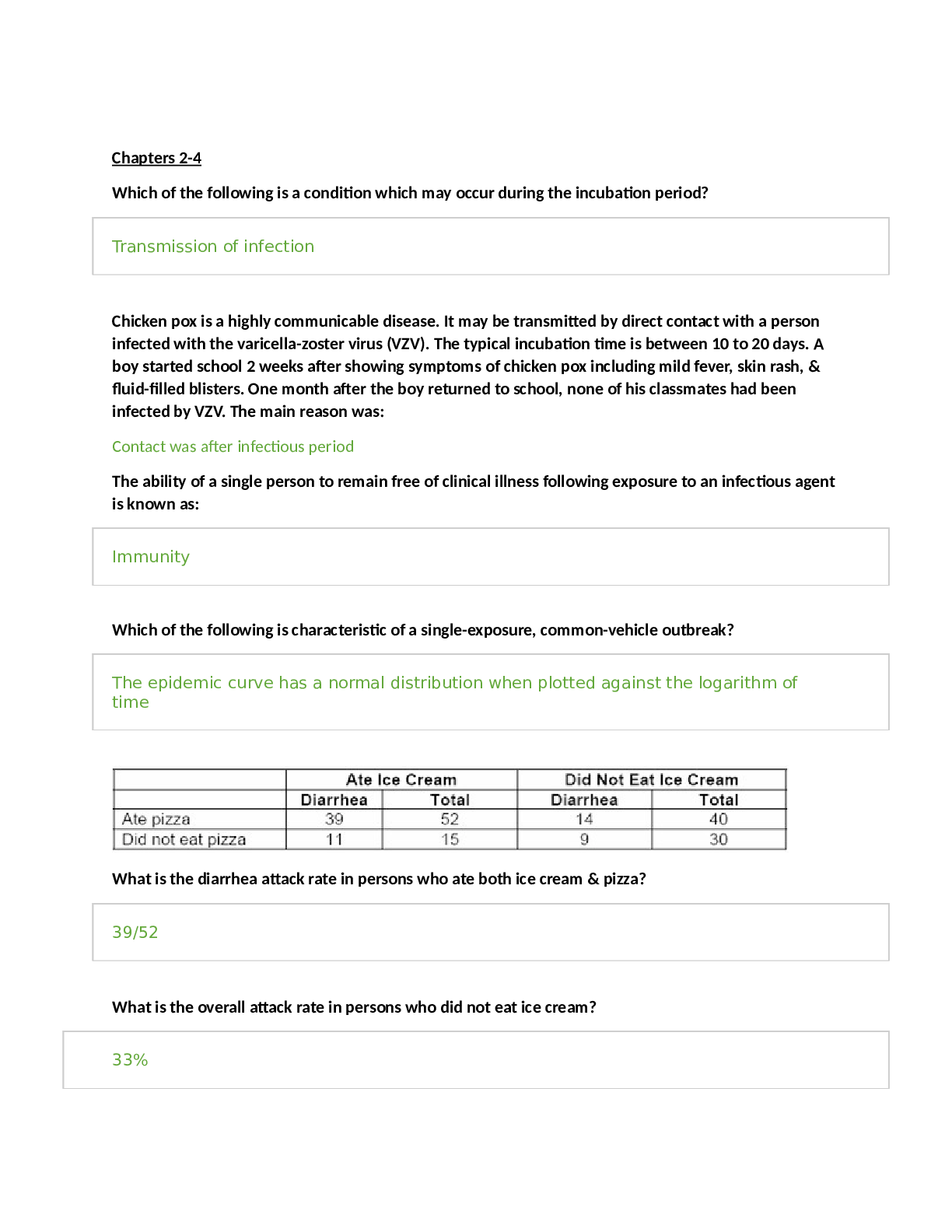
While watching a single cell divide, you notice that it has produced two daughter cells which then divide to produce a total of four cells. Each of those four cells is genetically identical to the original single cell. Have you observed mitosis or meiosis?
mitosis
In a cell there are 20 double stranded chromosomes. How many chromatids are there? 20 x 2= 40
Meiosis produces daughter cells which are diploid. false
The haploid number contains two chromosomes of each kind. false
Sex cells are diploid. false
Fill in the blank:
The diploid number in humans is 46
A cell has 36 chromosomes. After it divides by mitosis, how many chromosomes will be in each cell?
36
Occurs only to produce new offspring meiosis
One division cycle mitosis
Crossing-over occurs meisis
Four daughter cells are produced. meiosis
Produces cells which are genetically identical to the parent mitosis
The spindle begins to form. prophase
Chromatids separate and move toward opposite poles. anaphase
The sister chromatids line up in the center of the cell. metaphase
Cytokinesis occurs. telophase
The number of homologous pairs in humans is 22
For the following four questions on this page, answer true or false:
Each homologous pair is made of chromosomes of the same length. TRUE
Homologous pairs are present in haploid cells. FALSE
Homologous pairs have their centromere at the same site. TRUE
Homologous pairs are required for crossing-over to occur. TRUE
Based upon what you know from the module, explain why siblings with the same biological parents are not identical.
Since crossing-over occurs during meiosis, this allows for diversity and variation between offspring.
What is the benefit of sexual reproduction occurring via meiosis as opposed to mitosis? Meiosis allows variability of offspring and allows adaptations to occur
Break the polypeptide chain down into individual codons.
AUGAAAGCCGCACACCAUAACUAG
AUG AAA GCC GCA CAC CAU AAC UAG
Each tRNA anticodon codes for one type of : C
a. protein
b. ribosome
c. amino acid
d. enzyme
Does transcription or translation occur primarily at the ribosome? Translation
Which requires RNA polymerase, transcription or translation? Transcription
Are amino acids bonded together during translation or transcription? Translation
If a codon reads: GAC, what is the correct anticodon? CUG
The ribosome attaches to the mRNA strand initiation
A “stop” codon is reached on the mRNA termination
Peptide bonds form between two amino acids. elongation
Methionine is important in this process initiation
The ribosome continues to slide along the mRNA strand. elongation
Describe the shape, size and weight of a human adult kidney. bean shape
similar to size of a can of soup about 5 oz
Describe the structure and function of the renal pelvis. a funnel shape tube that connects the ureter
Structure:
1. Collecting duct
l. Influenced by aldosterone to reabsorb more water
2. Glomerulus
p. Network of capillaries in the renal corpuscle
3. Loop of Henle
a. Allows water and salt loss to regulate urine concentration
4. Urethra
i. Contains two sphincters
Description:
a. Allows water and salt loss to regulate urine concentration
b. Basic functional unit of kidney
c. Capillaries associated with juxtamedullary nephrons
d. Carries out fluid homeostasis
e. Center region of urinary bladder
f. Connects glomerulus to Loop of Henle
g. Connects kidney to bladder
h. Connects Loop of Henle to collecting ducts
i. Contains two sphincters
j. Funnel-shaped collecting region of kidney
k. Holds kidney in place in abdominal cavity
l. Influenced by aldosterone to reabsorb more water
m. Kidney location of glomerulus
n. Kidney location of Loop of Henle
o. Low-pressure capillaries that follow nephron tubules
p. Network of capillaries in the renal corpuscle
q. Outer skin of kidney
r. Sits atop kidney
s. Sphincter which prevents backward flow of urine toward kidney
t. Stores urine for later disposal
What are the 3 major processes by which the nephron is able to carry out its functions? filters blood
reabsords materials that are needed excretes urine
What is unique about the glomerular capillaries?
they are the only capillaries within the body that are between two arterioles instead of an artery and vien
You are treating a patient in the hospital who was admitted with signs of orthostatic hypotension (decreased blood pressure, increased heart rate, lightheaded) secondary to having severe diarrhea and dehydration. Which of the following would you expect to be their GFR (glomerular filtration rate) given their symptoms? Explain your answer.
a. 85 ml/min.
b. 120 ml/min.
c. 142 ml/min
a. 85 ml/min. Dehydration decreases glomerular filtration rate.
Name and describe the 3 types capillaries associated with the nephrons. glomular = filters fluid and solutes out of blood
peritubular = absorption of and reclaiming water and solutes vasa recta = floow loops of henle
Where does the greatest amount of renal tubular reabsorption occur and how much water and Na+ ion are absorbed in that portion of the renal tubules?
in the proximal convulauted tubular cells 65% Na+ and 65% water
Identify the parts of the urinary system/nephron shown in the diagrams below.
A1.
Kidney
B1.
Renal corpuscle
B4.
Distal tubule
Describe how urine concentration and volume is altered and why it is necessary. it is altered by the kidneys in order to maintain a constant concentration of fluids
Describe the action of a diuretic, list the four mechanisms by which they operate and a specific example of each of the 4 types.
diuretics increase the flow of urine causing more frequent urination
-glucose causes osmotic re absorption of water
-diuretic drugs decrease Na+ re absorption
-caffeine causes renal tubules diameter to increase resulting in an increase of urine flow
-alcohol inhibits release of ADH
If a patient is dehydrated would you expect a higher or lower amount of ADH in their blood? Explain your answer.
a higher amount as this is the bodys natural response to dehydration
Describe the structures within and arrangement of the ureter which prevents urine from flowing backward toward the kidney.
The ureters descend into the bottom of the bladder and sphincters prevent urine from backflowing to the kidney
Describe how the urethra functions to control the flow of urine from the bladder. involuntary controlled sphincters keep the urethra closed to prevent urine from exiting the bladder
voluntary external sphincters around the urethra go through the pelvic floor region allowing urination
Identify the parts of the urinary bladder shown in the diagram below.
2.
Detrusor muscle
4.
Fibrous connective tissue
6.
Trigone
Rank the following people in regards to the percentage of water in their body composition (assume that they are all healthy individuals) in a vertical list from lowest (at the top) to greatest (at the bottom).
a 45 year old male
a 23 year old female an 85 year old male a 6 month old female 85 year old male
45 year old male
23 year old female 6 month old female
Which fluid (intracellular, interstitial, blood plasma) contains the greater concentration of HCO3- (bicarbonate); which contains the greater concentration of HPO4-2 (hydrogen phosphate); which contains the greater concentration of protein? (more than 1 may apply.)
Interstitial fluid contains greater concentration of HC03 Intracellular fluid greater concentration of HC04
blood plasma contain greater concentration of protein
Describe how each of the water balance regulation mechanisms responds to a decrease in plasma volume.
When plasma volume decreases, the thirst center is activated, causing one to want to drink more. ADH is releases making the kidneys conserve water to release a more concentrated urine.
Describe the treatment for water intoxication and how this works to correct the condition. IV treatment with hyper tonic saline solution is necessary to pull the excess amount of water from the cells
Explain, in detail, how the cardiovascular baroceptors work to maintain blood pressure.
If and when the blood pressure rises, the baroceptors send a signal to the kidney which causes an intense increase in filtration rate and increases the output of water and Na+ to reduce blood volume and quickly cause blood pressure to return to normal.
Explain in detail, how aldosterone acts to maintain potassium balance.
It triggers the adrenal cortex when potassium levels increases which causes an excretion of potassium, ridding of the extra, to maintain balance.
If someone is experiencing chronic low levels of aldosterone, what dietary change could they make that could help increase aldosterone production? Explain your answer.
They could increase the amount of potassium rich food that they eat. A high level of potassium in the blood triggers the release of aldosterone.
Explain, in detail, how the interstitial and plasma bicarbonate buffer system acts to minimize pH changes.
If free H+ is released, bicarbonates reaction is to bind it as carbonic acid as follows: H+ + HCO3 -
→H2 CO3
If OH- is released, cabonic acids reaction is to bind with it in order to covert it to bicarbonate as follows:
OH- + H2 CO3 → HCO3 -
List the 3 major chemical buffer systems of the body and the body compartment or system in which they operate.
bicarbonate system = main buffer of interstitial / plasma fluid phosphate system= 1 buffer in the urine / intracellular fluid protein system = main intracellular fluid buffer
List the 3 ways in which the pH of blood is regulated. 3 chemical buffer systems
brain stem respiratory center renal system
Normal values for blood plasma are:
pH = 7.35-7.45, PCO2 = 35-45 mm, HCO3- = 22-26 mEq/L
If the patient has blood plasma vales as follows: pH = 7.6, PCO2 = 25 mm, HCO3- = 20 mEq/L
Is the patient in acidosis or alkalosis?
alkalosis
Is the cause respiratory or metabolic?
respiratory
Is the condition is being compensated?
compensated by renal system
[Show More]