NUR 231 final exam Questions and
answers. Latest 2021
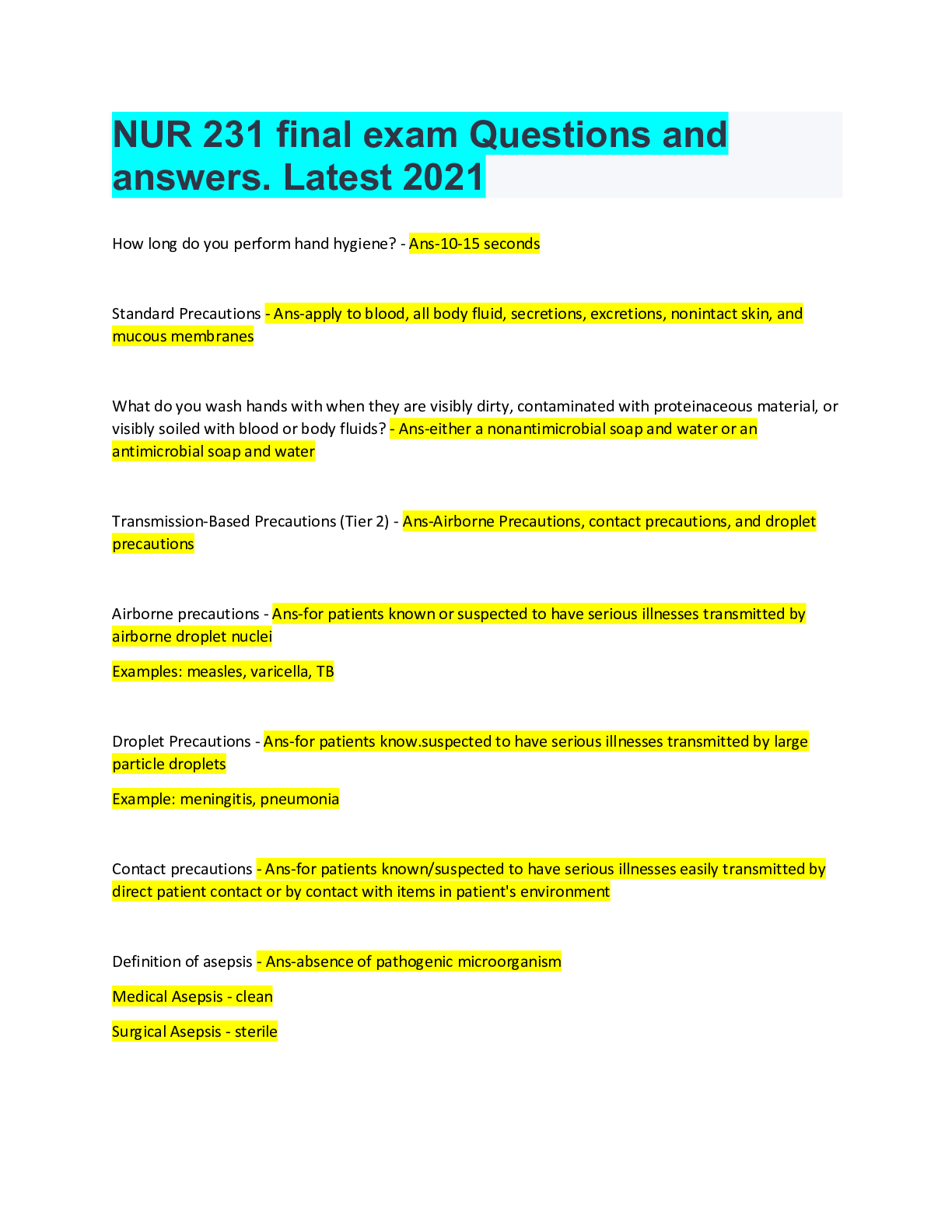
How long do you perform hand hygiene? - Ans-10-15 seconds
Standard Precautions - Ans-apply to blood, all body fluid, secretions, excretions, nonintact skin, and
m
...
NUR 231 final exam Questions and
answers. Latest 2021
How long do you perform hand hygiene? - Ans-10-15 seconds
Standard Precautions - Ans-apply to blood, all body fluid, secretions, excretions, nonintact skin, and
mucous membranes
What do you wash hands with when they are visibly dirty, contaminated with proteinaceous material, or
visibly soiled with blood or body fluids? - Ans-either a nonantimicrobial soap and water or an
antimicrobial soap and water
Transmission-Based Precautions (Tier 2) - Ans-Airborne Precautions, contact precautions, and droplet
precautions
Airborne precautions - Ans-for patients known or suspected to have serious illnesses transmitted by
airborne droplet nuclei
Examples: measles, varicella, TB
Droplet Precautions - Ans-for patients know.suspected to have serious illnesses transmitted by large
particle droplets
Example: meningitis, pneumonia
Contact precautions - Ans-for patients known/suspected to have serious illnesses easily transmitted by
direct patient contact or by contact with items in patient's environment
Definition of asepsis - Ans-absence of pathogenic microorganism
Medical Asepsis - clean
Surgical Asepsis - sterile
Chain of infection - Ans-infectious agent - reservoir - portal of exit - mode of transmission - portal of
entry - susceptible host
When giving a bed bath, if one extremity is injured or immobilized what do you do? - Ans-always dress
the affected side first
What should you assess for during a bath? - Ans-signs of warmth, redness, swelling, tenderness, and
pain in lower extremities
If a patient demonstrates weakness or paralysis of one side of the body, where would you place a chair?
- Ans-On the patient's strong side
Orthostatic hypotension - Ans-drop in blood pressure that occurs when a patient changes position from
horizontal to vertical (greater than 20 mmHg or >10 mmHg)
What is important to do with aging adults before having them get up off the bed? - Ans-Raise the head
of the bed and allow them a few minute before dangling.
List some Long-term care considerations - Ans-patients who have maintained bed rest for a long period
may revert back to a favorite position and you should frequently assess them and turn more often than
needed.
Use a drawsheet to prevent shearing force on fragile skin
Allow the patient to assist with moving and positioning
First priority if a fire occurs is _____ - Ans-the patient, or course!
MSDS - Ans-Material Safety Data Sheet: for hazardous chemicals
Fire Safety: What do you do if a fire occurs in the hospital? - Ans-Rescue
Activate the alarm
Contain the fire
Evacuate the patients
When you contain the fire, what are important things to do? - Ans-1. close all doors and windows
2. turn off O2 and electrical equipment
3. Place wet towels along base of doors
Explain how to properly evacuate all types of patients - Ans-1. Direct ambulatory patients to walk to
designated area
2. patient on life support: maintain respiratory status until removing from fire area
3. Mode bedridden patients by stretcher/bed/chair
4. For patients that can't walk/ambulate place on a blanket and drag, use the 2 person swing, or backstrap
Effective documentation ensures _____ - Ans-continuity of care, maintains, standards, and reduces
errors
When can patients be denied to read their record? - Ans-Only if it involves a patient with a mental illness
How do you correct a mistake when charting? - Ans-draw a single line through mistake, write "error"
above it, and sign yourname
if you acquire new info on a patient, but have already charted how would you add the new information?
What if you just forgot to add something? - Ans-write the date and time of new entry on next available
space and mark as addendum (date and time of prior note)
If you forgot something, put the current date and time and mark as a late entry with the date and
time/shift missed
Anthropometrics are _____ - Ans-measures of height, weight, head, arm, muscle circumferences, and
skinfold thickness
How to find percent weight change - Ans-((usual body weight - actual body weight)/ Usual body
weight)x100
Classification of BMI in adults - Ans-Underweight: <18.5
Normal: 18.5-24.9
Overweight: 25-29.9
Obesity Class 1: 30-34.9
Obesity Class 2: 35-39.9
Extreme Obesity: >/= 40
When should you use a NG tube? - Ans-for short periods of time (usually <30 days)
Main complication RT feeding tubes is _____ - Ans-pulmonary aspiration
NG tubes are contraindicated in patients with _____ - Ans-facial trauma, prolonged bleeding, and upper
GI block
Pulmonary aspiration occurs when ____ - Ans-gastric contents enter the tracheobronchial passages
Who is at highest risk of pulmonary aspiration? - Ans-patients with altered mental status
If gastric residual is >200 mL what do you do? - Ans-stop tube fedding
Inserting NG tube in comatose patient...what position should you put them in? - Ans-semi-Fowlers
If a patient is forced to lie supine, when position should you put them in? - Ans-reverse Trendelenburg's
You are inserting an NG tube and the patient begins to cough and choke with cyanosis, what do you do?
- Ans-stop advancing, pull back, and begin again
How often do you verify tube placement? - Ans-every 4-6 hours or prn
What is contraindicated in Digital Fecal Impaction Removal? - Ans-Patients with heart problems
When administering an enema, what do you do if patient has poor sphincter control? - Ans-Position
them on a bedpan in the dorsal recumbent position
If there is pain or resistance when administering an enema, how do you proceed? - Ans-stop and discuss
with prescriber
How long should the patient retain the enema solution? - Ans-2-5 minutes
A patient taking diuretic meds should receive them when? - Ans-early in the morning
Signs of Fluid volume deficit in the eyes - Ans-sunken eyes, dry conjunctivae, decreased tear production
Signs of Fluid Volume Excess in the eyes - Ans-Periorbital edema, blurred vision
Signs of FVD in mouth - Ans-stick, dry mucous membrane; dry cracked lips; decreased saliva; furrowed,
shrunken tongue
Signs of FVE in mouth - Ans-excessive salivation
Signs of FVD in skin - Ans-increase in temperature; dry, scaly; poor turgor
Signs of FVE in Skin - Ans-edema, anasarca
Signs of FVD for cardiac - Ans-increased pulse and weak; hypotension
Signs of FVE for cardiac - Ans-bounding pulse; S3; distended neck veins
Signs of FVD in GI - Ans-sunken abdomen, vomiting, diarrhea, cramps
Signs of FVE inGI - Ans-diarrhea, vomiting, cramps
Signs of FVD for renal system - Ans-oliguria or anuria
Signs of FVE for renal system - Ans-decreased urine specific gravity
average urine output range - Ans-1000-2400mL
Size of straight/indwelling catheter for women? men? - Ans-14-16 Fr
16-18 Fr
Type of effluent expected for colostomy
[Show More]