ATI Community Health Questions and
Answers with Complete Solutions
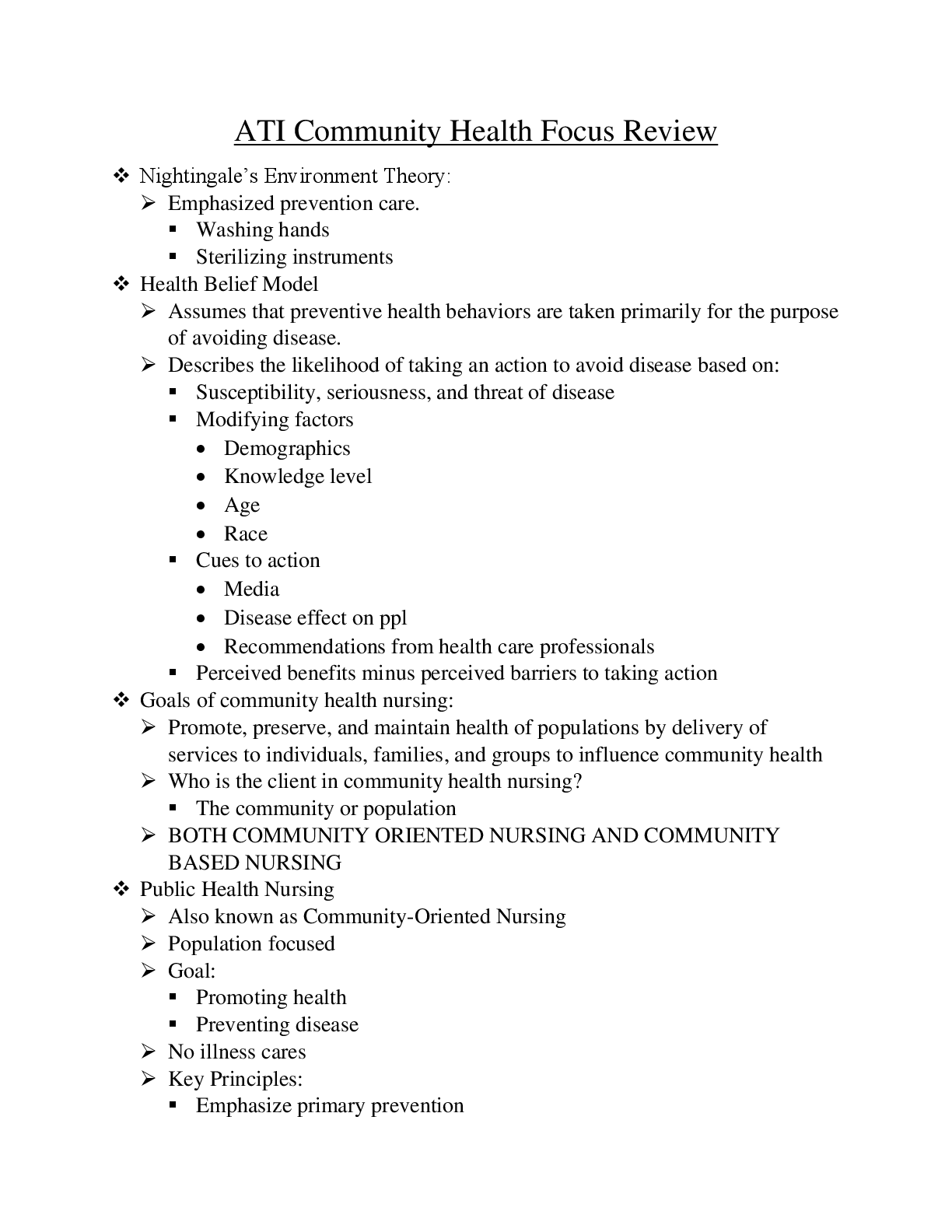
What are community health nurses concerned with? Correct Answer-protecting, promoting, preserving
and maintaining health, as well as preventing diseas
...
ATI Community Health Questions and
Answers with Complete Solutions
What are community health nurses concerned with? Correct Answer-protecting, promoting, preserving
and maintaining health, as well as preventing disease.
How should community nurses use their resources. Correct Answer-Must benefit the greatest number of
citizens.
What is epidemiology? Correct Answer-invenstigative study of disease trends in populations to prevent
disease and maintain health.
The agent Correct Answer-animate or inanimate object that causes the disease. (bacteria, virus,
pesticide, food additive, etc.)
The host Correct Answer-living being that is affected by the agent. (human or animal).
The environment Correct Answer-the setting or surrounding that sustains the host (place of
transmission: daycare, body of water, country
Incidence: Correct Answer-number of new cases in the population at a specific time divided by
population total X 1,000= number per 1,000
Prevalence: Correct Answer-Number of existing cases in the population at a specific time divided by
population total X 1,000= number per 1,000
Mortality rate: Correct Answer-number of deaths divided by population total X 1,000=number per 1,000
Attack rate: Correct Answer-number of people exposed to a specific agent who develop the disease
divided by total number of people exposed.
Development of a community health program plan Correct Answer-Identify the needs of community:
assessment.
plan the program
implement the program
evaluate the effectiveness of program.
Primary disease prevention: Correct Answer-focus on prevention of the initial occurence of disease or
injury. Includes nutrition counseling, family planning, smoking cessation, safety education (seat belt
helmet use), prenatal classes.
Secondary prevention: Correct Answer-focus is on early detection of disease and treatment with goal of
limiting severity and adverse effects. includes: screenings (cancer, diabetes, HTN, TB lead exposure) and
treatments (STI, TB)
tertiary prevention: Correct Answer-focus is on maximization of recovery after injury or illness. Includes:
exercise rehab, nutrition counseling, case management, support groups.
Interpreters Correct Answer-NOT family members. Need to have health-related terminology knowledge.
Give teaching material in client's primary language.
Medicare: Correct Answer-older than 65 and receiving Social Security, disability benefits for 2 years,
have ALS or kidney failure on dialysis or transplant to qualify.
Medicare part A Correct Answer-hospital care, home care, limited skilled nursing care
Part B Correct Answer-medical care, diagnostic services, physiotherapy.
Part C Correct Answer-combo of part A and B through a private insurance.
Part D Correct Answer-Prescription drug coverage.
Medicaide Correct Answer-low socioeconomic status and kids. federal and stage governmental
assistance. Priority given to pregnant women, children, and those with disability.
Medicade provides: Correct Answer-in and outpatient hospital care. home health. radiology. vaccines
for children. family planning. pregnancy-related care. screening. diagnosis. and treatment for young
un's.
Demographic Correct Answer-Distribution, mobility, density, census data, racial distrubution
Biological Factors: Correct Answer-health and disease status, genetics, race, age, gender, causes of
death.
Social factors: Correct Answer-occupation, activities, marital status, education, income, crime rates,
recreation, industry.
Social Factors: Correct Answer-occupation, activities, marital status, education, income, crime rates,
recreation, industry
Cultural factors: Correct Answer-positions, roles, history, values, customs, norms, religion.
Why is education inportant: Correct Answer-encourages clients to be independent, and involved in the
own care. families can also be involved.
What does hospice care focus on: Correct Answer-enhancing the quality of life through the provision of
palliative care, support through the dying process.
[Show More]
.png)
.png)